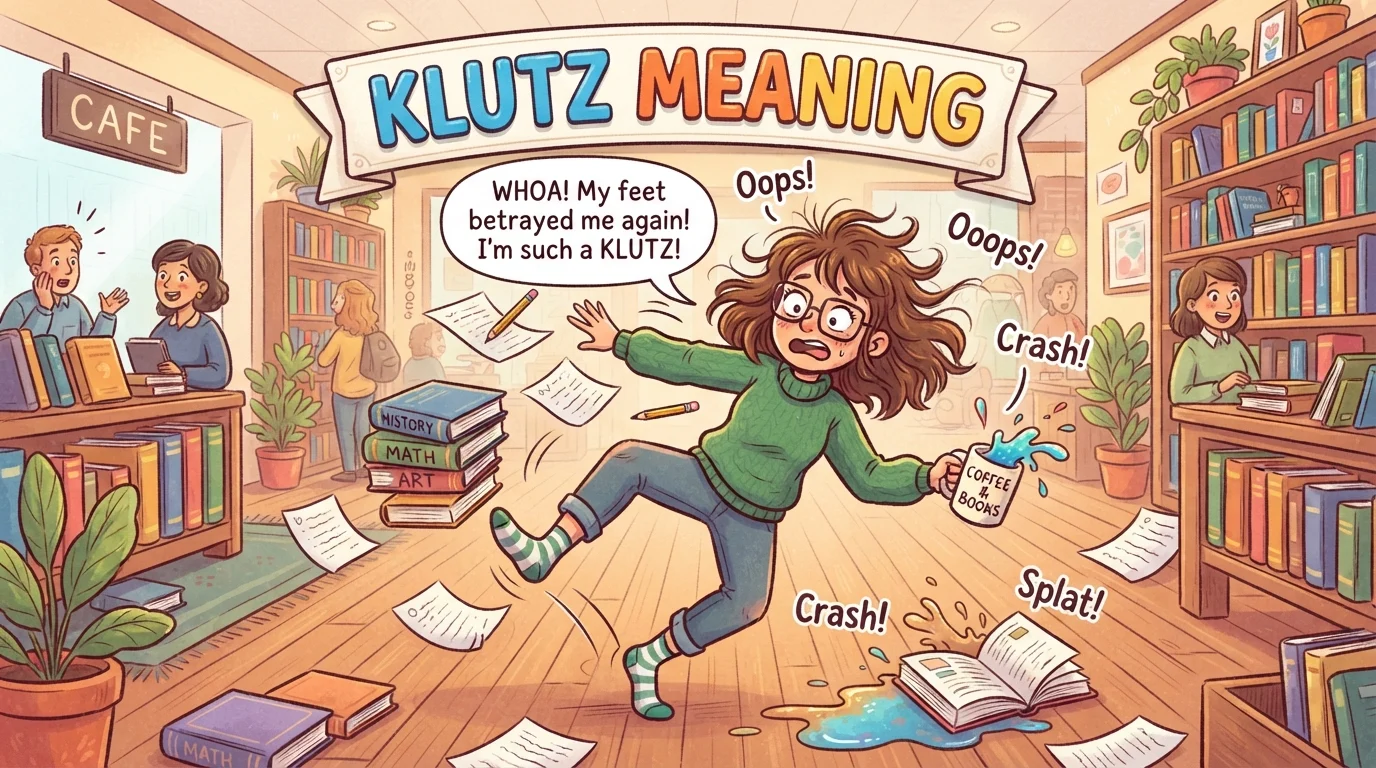
Have you ever accidentally dropped your phone, tripped over your own feet, or knocked something off a table? Someone might jokingly call you a “klutz.” This informal English word describes a clumsy person who frequently makes awkward movements, drops things, or has minor accidents.
The word “klutz” is commonly used in casual American English. It can describe someone who is physically awkward or someone who often makes simple mistakes because of carelessness or a lack of coordination. Although it is usually playful or humorous, it can sometimes sound insulting depending on the situation and the speaker’s tone.
In this article, you will learn the meaning of “klutz,” its origin, pronunciation, synonyms, and how to use it correctly in everyday conversations. You will also discover the difference between a klutz and a clumsy person through practical examples.
Quick Answer: What Does Klutz Mean?
Klutz is an informal noun that means a clumsy, awkward, or uncoordinated person who frequently drops things, bumps into objects, trips, or makes physical mistakes.
Examples:
- I’m such a klutz. I dropped my coffee again.
- He’s a real klutz when it comes to sports.
- Don’t be a klutz! Watch where you’re going.
In simple words, a klutz is someone who is often physically clumsy or awkward.
What Does Klutz Mean in Different Contexts?
The word “klutz” is mainly used to describe someone who lacks physical coordination or frequently has minor accidents. However, its meaning can vary slightly depending on the situation.
1. A Physically Clumsy Person
The most common meaning of “klutz” is someone who regularly drops things, trips, bumps into furniture, or struggles with coordinated movements.
Examples:
- I’m such a klutz. I spilled water all over the table.
- My brother is a klutz who constantly drops his phone.
- She felt like a klutz when she tripped in front of everyone.
2. Someone Who Is Awkward or Uncoordinated
A klutz may also be someone who struggles with physical activities such as dancing, playing sports, or performing tasks that require coordination.
Examples:
- I’m a complete klutz on the dance floor.
- He is a klutz when it comes to playing basketball.
- She may be intelligent, but she’s a bit of a klutz in the kitchen.
3. A Person Who Frequently Makes Silly Mistakes
Although “klutz” usually refers to physical clumsiness, it can sometimes be used humorously for someone who repeatedly makes awkward mistakes.
Examples:
- I forgot my keys again. I’m such a klutz!
- The klutz accidentally sent the message to the wrong person.
- He made another silly mistake and called himself a klutz.
Origin of the Word Klutz
The word “klutz” comes from the Yiddish word klots, meaning a wooden block or log. The word eventually developed the figurative meaning of a clumsy or awkward person.
It entered American English through Yiddish speaking communities and became popular in informal conversation during the twentieth century.
Today, “klutz” is widely understood in American English and is often used in a humorous or lighthearted way to describe someone who lacks physical coordination.
How to Use Klutz in a Sentence
“Klutz” is a noun, so it is generally used to identify or describe a person.
Here are some practical examples:
- I’m such a klutz! I dropped my phone again.
I am so clumsy that I keep dropping things. - He’s a klutz when it comes to dancing.
He is awkward and uncoordinated when dancing. - Don’t be such a klutz! Be careful with that glass.
Don’t act so clumsily or carelessly. - My sister is a complete klutz in the kitchen.
My sister often makes physical mistakes while cooking. - I felt like a klutz when I tripped over the carpet.
I felt embarrassed because I was clumsy. - That poor klutz bumped into the door again.
That clumsy person accidentally hit the door. - He’s a lovable klutz who always makes everyone laugh.
He is a clumsy but likable person. - I was being a klutz and spilled juice on my shirt.
I was acting clumsily and accidentally spilled juice.
Klutz vs. Clumsy: What Is the Difference?
“Klutz” and “clumsy” are closely related, but they are different parts of speech.
- Klutz is a noun that describes a clumsy person.
- Clumsy is an adjective that describes someone or something lacking coordination or being awkward.
Compare the following examples:
| Klutz | Clumsy |
|---|---|
| He is a klutz. | He is clumsy. |
| I’m such a klutz. | I’m so clumsy. |
| She’s a lovable klutz. | She’s a lovable but clumsy person. |
| My brother is a klutz. | My brother is a clumsy person. |
Both words communicate a similar idea, but they have different grammatical functions.
Klutz vs. Clod vs. Oaf
These words can all describe awkward or clumsy people, but their meanings and tones are slightly different.
| Word | Meaning | Example |
|---|---|---|
| Klutz | A physically clumsy person | I’m such a klutz! |
| Clod | An awkward, insensitive, or foolish person | Don’t be such a clod. |
| Oaf | A big, awkward, or socially insensitive person | He’s a lovable oaf. |
| Butterfingers | Someone who frequently drops things | You’re such a butterfingers! |
| Bumbler | Someone who repeatedly makes awkward mistakes | He’s a well meaning bumbler. |
“Klutz” is generally more playful than “oaf” or “clod,” although the tone depends on the context.
Is Klutz an Insult or a Friendly Word?
“Klutz” is usually a lighthearted or teasing expression, but it can sometimes be insulting.
It depends on how and when you use it.
Friendly or Playful Use
Friends and family members may use “klutz” jokingly when someone accidentally drops something or trips.
Example:
- You’re such a klutz! You dropped your keys again.
In this situation, the word is likely playful rather than offensive.
Negative or Insulting Use
Calling someone a klutz in an angry or disrespectful tone may make them feel embarrassed or insulted.
Example:
- Stop being such a klutz. You keep ruining everything.
Here, the word sounds critical rather than friendly.
Tip: Use “klutz” carefully when speaking to people you do not know well. A gentler alternative is “a little clumsy.”
Common Mistakes to Avoid
Mistake 1: Using Klutz as an Adjective
Incorrect: She is very klutz.
Correct: She is very clumsy.
Correct: She is a klutz.
Explanation: “Klutz” is a noun, while “clumsy” is an adjective.
Mistake 2: Confusing Klutz with Klutzy
Both words are related, but they have different grammatical functions.
- Klutz: A clumsy person.
- Klutzy: Clumsy or awkward.
Examples:
- He’s a klutz.
- He’s a klutzy dancer.
Mistake 3: Assuming Klutz Always Has a Negative Meaning
“Klutz” is not always intended as an insult. It can be used affectionately or humorously, especially when someone describes their own clumsiness.
Example:
- I’m such a klutz, but at least I make people laugh!
Easy Ways to Remember Klutz
Here is a simple memory trick:
Klutz = A clumsy person.
Imagine someone walking into a room, accidentally knocking over a chair, dropping their keys, and spilling their drink. You might jokingly describe that person as a klutz.
Remember these examples:
- A klutz drops things.
- A klutz trips easily.
- A klutz bumps into objects.
- A klutz often makes awkward physical mistakes.
You can also remember the difference between the related words:
- Klutz is a noun.
- Clumsy is an adjective.
- Klutzy is an adjective.
Frequently Asked Questions About Klutz
1. What does klutz mean in simple words?
A klutz is a clumsy or awkward person who frequently drops things, trips, bumps into objects, or makes physical mistakes.
2. Is klutz a slang word?
Yes. “Klutz” is an informal English word, especially common in American English. It is often used in casual conversations to describe someone who is physically clumsy.
3. Is klutz an insult?
It can be, but it is usually used playfully or humorously. Calling yourself a klutz is generally lighthearted, while calling someone else a klutz in an angry tone may sound insulting.
4. What is the plural of klutz?
The plural of “klutz” is “klutzes.”
Example: The two klutzes accidentally knocked over the chairs.
5. What is the difference between klutz and clumsy?
“Klutz” is a noun describing a clumsy person, while “clumsy” is an adjective describing someone who lacks coordination or acts awkwardly.
Example: “He is a klutz” and “He is clumsy” communicate a similar idea.
6. What is the adjective form of klutz?
The adjective form is “klutzy,” which means clumsy or awkward.
Example: I’m a little klutzy when I play sports.
7. What is another word for klutz?
Common alternatives include clumsy person, butterfingers, bumbler, oaf, and awkward person. The best choice depends on the context and intended tone.
8. Where does the word klutz come from?
“Klutz” comes from the Yiddish word klots, meaning a wooden block or log. It later developed the figurative meaning of a clumsy person and entered informal American English.
Conclusion
“Klutz” is an informal noun that describes someone who is physically clumsy, awkward, or uncoordinated. It is commonly used when someone frequently drops things, trips, bumps into objects, or makes silly physical mistakes.
For example, if you accidentally spill your coffee, drop your phone, or trip over your own feet, you might jokingly say, “I’m such a klutz!”
Remember that “klutz” is a noun, “clumsy” is an adjective, and “klutzy” is another adjective with a similar meaning. The word is generally playful, but its tone can become insulting depending on how it is used.