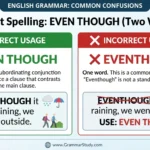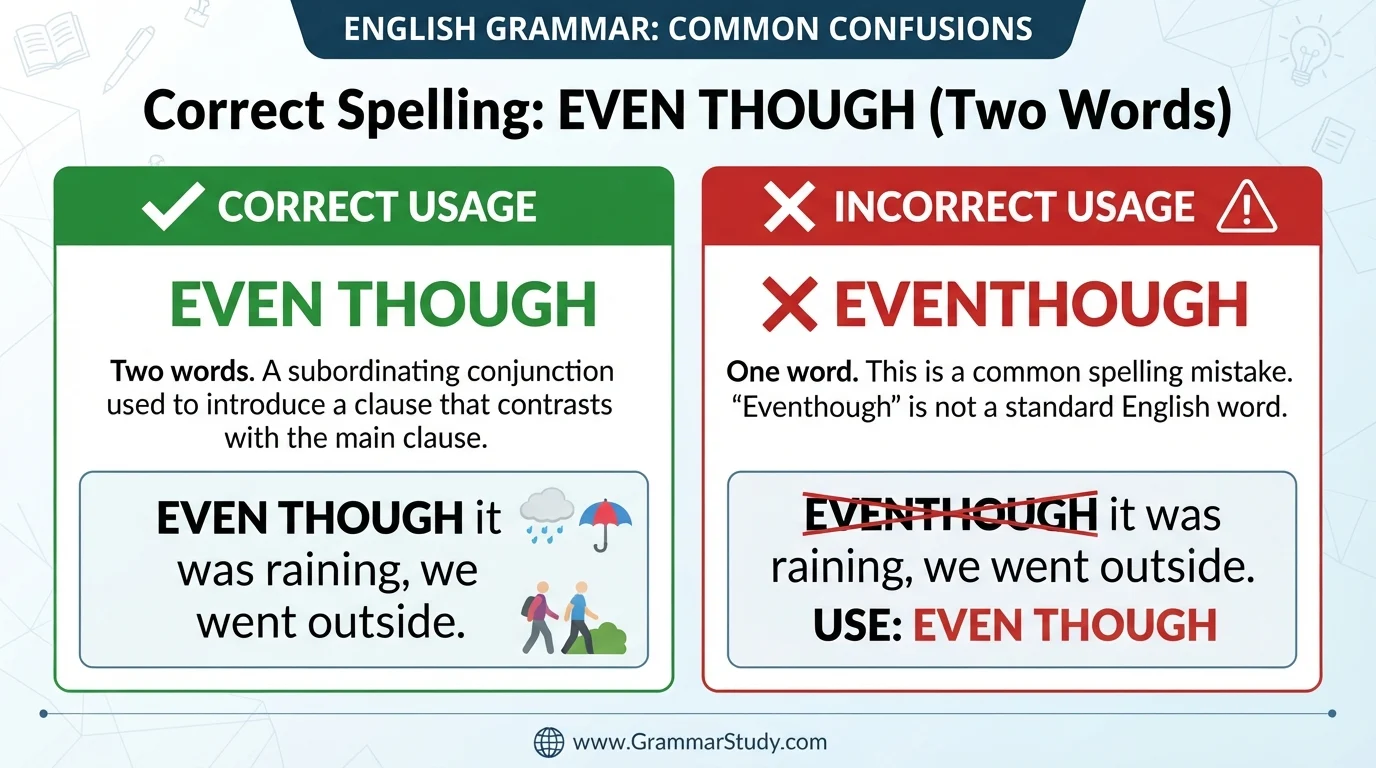
Is it even though or eventhough? The correct spelling is even though, written as two separate words. The form eventhough is incorrect in standard English because the expression is a compound conjunction that must remain separate.
Even though is used to introduce a contrast between two ideas. It means although, despite the fact that, or in spite of the fact that. For example, “Even though it was raining, we went outside” means that we went outside despite the rain. The phrase is common in everyday conversations, academic writing, emails, and professional communication. Understanding how to spell and use it correctly will help you avoid a frequent writing mistake. In this guide, you will learn its meaning, grammatical function, sentence structure, differences from similar expressions, and practical examples.
Quick Answer: Even Though or Eventhough?
Even though is the correct spelling. It is a three word? No, it consists of two separate words: even and though. It is a subordinating conjunction used to introduce a contrast or unexpected result.
Eventhough is not a standard English spelling and should be avoided.
Example: Even though I was tired, I finished my work.
This means I finished my work despite being tired.
Why Do People Confuse Even Though and Eventhough?
People often confuse these forms because they are pronounced together in natural speech. When spoken quickly, even though can sound like one word.
Another reason is that English contains several expressions that are written as single words, such as although, because, and however. Writers may assume that even though follows the same pattern.
However, the expression always consists of two separate words.
- Even though: Correct.
- Eventhough: Incorrect.
- Even: A separate word.
- Though: A separate word.
Remember that pronunciation does not determine whether an expression should be written as one word or two.
What Does Even Though Mean?
Even though is a subordinating conjunction that introduces a contrast between two statements. It shows that something happened despite a fact or situation that might have prevented it.
It is similar in meaning to:
- Although
- Though
- Despite the fact that
- In spite of the fact that
For example:
Even though she was sick, she went to work.
The sentence means that she went to work despite being sick. Her illness might normally have prevented her from going, but she went anyway.
Examples of Even Though in Sentences
- Even though it was raining, we went for a walk.
- She smiled even though she was upset.
- Even though he studied hard, he did not pass the exam.
- I enjoyed the movie even though it was very long.
- Even though they were tired, they continued working.
- He helped me even though he was busy.
- Even though the restaurant was expensive, the food was excellent.
- We decided to travel even though the weather was not ideal.
In each example, even though introduces a fact that contrasts with the main statement.
Is Eventhough Ever Correct?
No. Eventhough is not accepted as a standard English word.
You should always write the expression as two separate words:
- Correct: Even though I was busy, I answered your call.
- Incorrect: Eventhough I was busy, I answered your call.
Even though remains two words regardless of its position in a sentence.
Examples:
- Even though he apologized, she was still angry.
- She went to school even though she had a headache.
- I will support you even though we disagree.
How to Use Even Though in a Sentence
Even though introduces a dependent clause. This clause gives information that contrasts with the main clause.
There are two common sentence structures.
1. Even Though at the Beginning of a Sentence
Use this structure when you want to introduce the contrasting information first.
Structure:
Even though + subject + verb, main clause.
Examples:
- Even though I was tired, I completed the assignment.
- Even though it was cold, they went swimming.
- Even though she had little experience, she got the job.
- Even though he was nervous, he delivered an excellent speech.
When the even though clause comes first, place a comma after it.
2. Even Though in the Middle of a Sentence
You can also place even though after the main clause.
Structure:
Main clause + even though + subject + verb.
Examples:
- I completed the assignment even though I was tired.
- They went swimming even though it was cold.
- She got the job even though she had little experience.
- He delivered an excellent speech even though he was nervous.
When the even though clause comes at the end, a comma is generally unnecessary.
Even Though vs. Although vs. Though
These expressions have similar meanings, but they differ slightly in emphasis and style.
| Expression | Meaning | Typical usage |
|---|---|---|
| Even though | Despite the fact that | Emphasizes a strong contrast |
| Although | Despite the fact that | Neutral and common in formal and informal English |
| Though | Although or despite the fact that | Often conversational and flexible |
1. Even Though
Even though often emphasizes the contrast more strongly.
Example: Even though he was exhausted, he continued working.
The sentence highlights the surprising fact that he continued despite being exhausted.
2. Although
Although has nearly the same meaning but is often more neutral.
Example: Although he was exhausted, he continued working.
3. Though
Though is often more conversational and can also appear at the end of a sentence.
Example: He was exhausted. He continued working, though.
All three expressions can introduce a contrast, but even though often gives that contrast greater emphasis.
Even Though vs. Even If
These two expressions may look similar, but they have different meanings.
Even though refers to something that is true or known.
Even if refers to a possible or hypothetical situation.
| Even though | Even if |
|---|---|
| Refers to a real or known fact | Refers to a possibility or condition |
| Introduces a contrast | Introduces a hypothetical condition |
| Even though it was raining, we went out. | Even if it rains, we will go out. |
Examples:
- Even though he is rich, he lives simply. (He is actually rich.)
- Even if he becomes rich, he may continue living simply. (His becoming rich is only a possibility.)
Even Though vs. Despite and In Spite Of
Even though is followed by a clause containing a subject and a verb. Despite and in spite of are generally followed by a noun, pronoun, or gerund.
| Expression | Correct structure | Example |
|---|---|---|
| Even though | Subject + verb | Even though it was raining, we went out. |
| Despite | Noun or gerund | Despite the rain, we went out. |
| In spite of | Noun or gerund | In spite of the rain, we went out. |
More examples:
- Even though she was ill, she attended the meeting.
- Despite her illness, she attended the meeting.
- In spite of being ill, she attended the meeting.
The meanings are similar, but the grammatical structures are different.
15 Common Examples of Even Though
Here are more practical examples to help you understand the expression.
- Even though I was hungry, I waited for everyone before eating.
- She went to work even though she had a fever.
- Even though he is young, he is very responsible.
- We enjoyed our trip even though the weather was terrible.
- Even though the task was difficult, she completed it successfully.
- He continued playing even though he was injured.
- Even though I disagree with you, I respect your opinion.
- They bought the house even though it needed repairs.
- Even though the road was crowded, we arrived on time.
- I trust him even though we have different opinions.
- Even though she earns a good salary, she saves very little money.
- He remained calm even though everyone else was worried.
- Even though the exam was challenging, most students passed.
- We decided to stay even though the hotel was expensive.
- Even though I explained everything, he did not understand.
Common Mistakes to Avoid
Mistake 1: Writing Eventhough as One Word
Incorrect: Eventhough I was tired, I went to work.
Correct: Even though I was tired, I went to work.
Explanation: Even though is always written as two separate words.
Mistake 2: Using Even Though With a Noun Alone
Incorrect: Even though the rain, we went outside.
Correct: Even though it was raining, we went outside.
Also correct: Despite the rain, we went outside.
Explanation: Even though introduces a clause containing a subject and a verb. Despite can be followed by a noun phrase.
Mistake 3: Using Although and But Together Unnecessarily
Incorrect: Although I was tired, but I finished my work.
Correct: Although I was tired, I finished my work.
Also correct: I was tired, but I finished my work.
Explanation: In standard sentence construction, do not normally use although and but together to connect the same contrast.
Mistake 4: Confusing Even Though With Even If
Incorrect for a known fact: Even if I was sick yesterday, I went to work.
Better: Even though I was sick yesterday, I went to work.
Explanation: Use even though for a known fact. Use even if for a hypothetical or possible situation.
Easy Memory Trick
Remember this simple rule:
Even though = Two words, one contrast.
Think of the expression as two separate words working together:
- Even
- Though
You can also remember it by replacing even though with although.
Example:
- Even though I was tired, I studied.
- Although I was tired, I studied.
Both sentences are correct and have nearly the same meaning.
If you see eventhough written as one word, separate it into even though.
American vs. British English
There is no spelling difference between American and British English for this expression.
Both varieties use even though as two separate words.
Examples:
- American English: Even though it was late, I continued working.
- British English: Even though it was late, I continued working.
The meaning, spelling, and grammatical usage remain the same.
Similar Words and Expressions
Here are some related expressions that can help you communicate contrast more naturally.
| Expression | Meaning | Example |
|---|---|---|
| Although | Despite the fact that | Although it was cold, we went out. |
| Though | Despite the fact that | Though he was tired, he continued. |
| Even if | Regardless of whether something happens | Even if it rains, we will go. |
| Despite | Without being affected by something | Despite the rain, we played. |
| In spite of | Despite something | In spite of the delay, we arrived. |
| Nevertheless | In spite of that | It was difficult. Nevertheless, we succeeded. |
| However | Used to introduce a contrasting idea | I was tired. However, I continued. |
Final Verdict: Even Though or Eventhough?
The correct expression is even though, written as two separate words. It is a subordinating conjunction that introduces a contrast between two ideas and means although or despite the fact that.
Eventhough is not a standard English spelling and should not be used in formal or informal writing.
For example:
- Correct: Even though I was busy, I helped him.
- Incorrect: Eventhough I was busy, I helped him.
Remember that even though always stays as two words, whether it appears at the beginning or in the middle of a sentence.
Frequently Asked Questions
1. Is even though one word or two words?
Even though is written as two separate words. The spelling eventhough is incorrect in standard English.
2. What does even though mean?
Even though means although or despite the fact that. It introduces a contrast between two ideas.
Example: Even though it was raining, we went outside.
3. Is eventhough a real word?
No. Eventhough is not recognized as a standard English word. The correct spelling is always even though.
4. Can I use even though at the beginning of a sentence?
Yes. You can begin a sentence with even though to introduce a contrasting idea.
Example: Even though she was tired, she finished her homework.
Place a comma after the introductory even though clause.
5. What is the difference between even though and although?
Both expressions introduce a contrast and often have the same meaning. Even though usually places stronger emphasis on the contrast, while although is more neutral.
6. What is the difference between even though and even if?
Even though refers to a real or known fact, while even if refers to a possible or hypothetical situation.
Example: Even though it is raining, we are going out. Even if it rains tomorrow, we will go out.
7. Can even though be used in the middle of a sentence?
Yes. Even though can appear at the beginning or in the middle of a sentence.
Example: I went to work even though I was feeling sick.
8. Is even though formal or informal?
Even though is suitable for both formal and informal English. It is commonly used in conversations, academic writing, business communication, and everyday messages.
Remember This
- Even though: Correct spelling, written as two words.
- Eventhough: Incorrect spelling in standard English.
- Meaning: Although or despite the fact that.
- Grammar: Followed by a subject and a verb.
- Usage: Introduces a contrast between two ideas.
Example: Even though I was tired, I finished my work.
Conclusion
The difference between even though and eventhough is simple: even though is the correct form, and eventhough is a spelling mistake. The expression consists of two separate words and is used to introduce a contrast between two statements. It is similar to although and despite the fact that.
To use it correctly, remember that even though is generally followed by a subject and a verb. You can place it at the beginning or in the middle of a sentence, depending on how you want to structure your idea. Once you remember that it is always written as two words, you can use this common English expression confidently in conversations, emails, and formal writing.