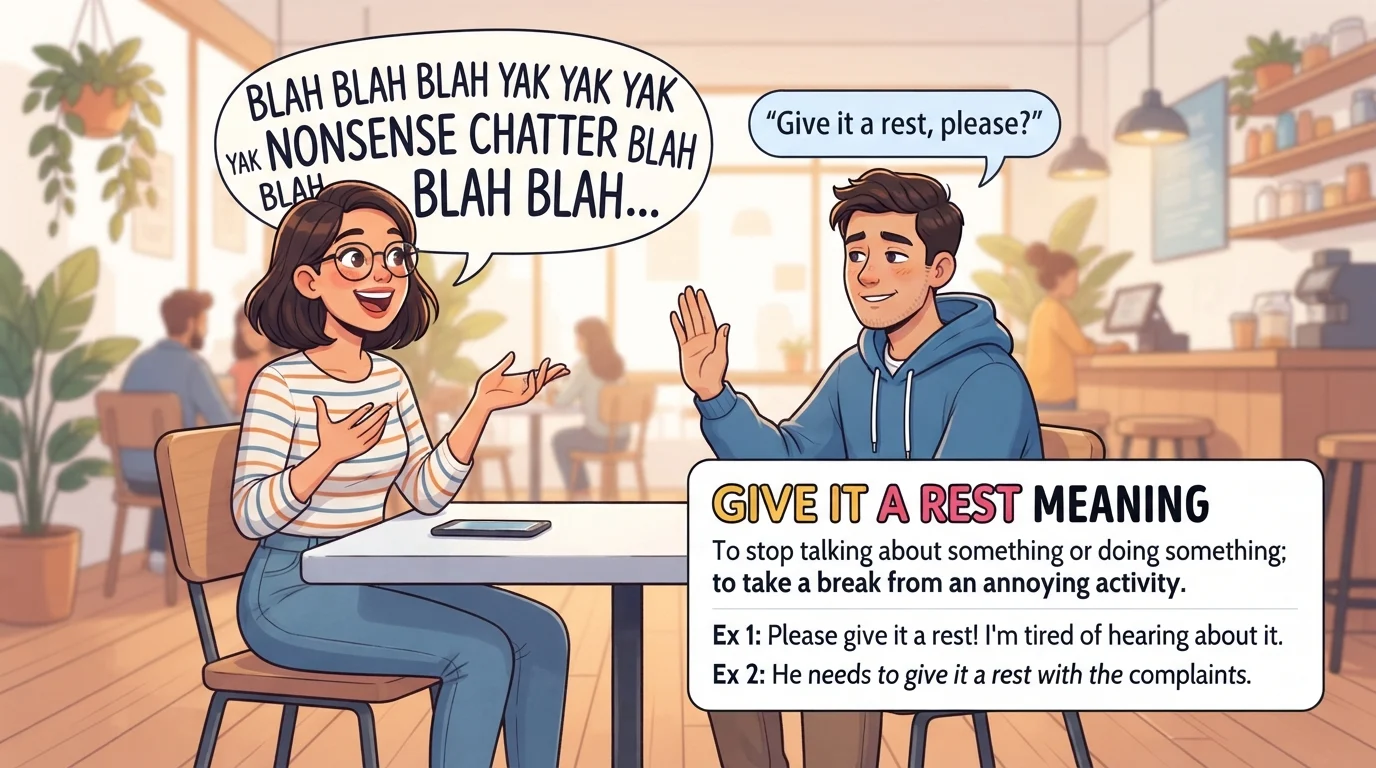
Have you ever heard someone say, “Oh, give it a rest!” during an argument or conversation? This common English expression is used when someone wants another person to stop talking about something, repeating a complaint, making jokes, or continuing an annoying behavior.
The phrase “give it a rest” is an informal idiom that usually means stop doing or saying something, especially because it has become irritating, repetitive, or unnecessary. Depending on the situation and tone, it can sound playful, impatient, sarcastic, or even rude.
For example, if someone keeps making the same joke, you might say, “Give it a rest! That joke isn’t funny anymore.” The expression is widely used in everyday conversations, movies, and informal writing. In this article, you will learn its meaning, usage, examples, synonyms, and differences from similar expressions.
Quick Answer: What Does Give It a Rest Mean?
“Give it a rest” means to stop doing, saying, or discussing something, especially when it has become annoying, repetitive, or tiresome. It is an informal expression commonly used to tell someone to stop bothering others with a particular subject or behavior.
Examples:
- Give it a rest! You’ve told that story five times.
- Can you give it a rest with the complaints?
- Oh, give it a rest. Nobody believes that excuse.
In simple words, give it a rest means stop it or leave the subject alone.
What Does Give It a Rest Mean in Different Contexts?
The expression can be used in several situations. Its exact meaning depends on what someone is doing and how the phrase is delivered.
1. Telling Someone to Stop Repeating Something
The most common use of “give it a rest” is asking someone to stop repeating the same thing.
Examples:
- Give it a rest! You’ve already explained your point.
- He keeps telling the same story. Someone should tell him to give it a rest.
- Can you give it a rest with that old joke?
In these examples, the speaker is tired of hearing the same thing repeatedly.
2. Asking Someone to Stop Complaining
You can also use this expression when someone repeatedly complains about something.
Examples:
- Give it a rest! The situation isn’t going to change.
- You’ve been complaining about the weather all morning. Give it a rest.
- He needs to give it a rest with all those complaints.
Here, the phrase communicates frustration with repeated complaints.
3. Telling Someone to Stop Arguing
“Give it a rest” can be used during disagreements when someone wants the other person to stop arguing or bringing up an issue.
Examples:
- We’ve discussed this enough. Give it a rest.
- Give it a rest! There’s no point in arguing anymore.
- I don’t want to hear another excuse. Just give it a rest.
In this context, the expression means to stop the argument or discussion.
4. Asking Someone to Stop Making Jokes
Sometimes people repeat jokes until they become annoying. You can use “give it a rest” to ask them to stop.
Examples:
- Give it a rest with those silly jokes.
- Everyone has heard that joke. Give it a rest.
- You’re still making fun of my haircut? Give it a rest!
This usage is often playful, especially among friends.
How to Use Give It a Rest in a Sentence
“Give it a rest” is an informal idiom that usually appears as a command or request. You can use it in conversations when someone is repeating something, complaining, arguing, or behaving annoyingly.
Here are some practical examples:
- Give it a rest! I’m tired of hearing the same excuse.
Stop repeating the same excuse because it is becoming irritating. - You’ve been talking about that problem all day. Give it a rest.
Stop discussing the problem for a while. - Oh, give it a rest! Nobody thinks your joke is funny.
Stop making the same joke because nobody enjoys it. - Can you give it a rest with the criticism?
Can you stop criticizing everything? - They kept arguing about the same issue, so I told them to give it a rest.
I asked them to stop arguing. - Give it a rest, will you? We have more important things to discuss.
Stop talking about that subject because there are other things to discuss. - My brother keeps teasing me about my old hairstyle. I wish he would give it a rest.
I wish he would stop making jokes about it. - You’ve made your point. Now give it a rest.
Stop repeating your argument because your point is already understood. - The neighbors need to give it a rest with the loud music.
They need to stop playing loud music. - I know you’re upset, but give it a rest for now.
Stop discussing the issue temporarily.
Give It a Rest: Is It Rude or Polite?
“Give it a rest” is generally informal and can sound impatient or dismissive. It is not necessarily rude, but it depends on your tone, relationship with the listener, and situation.
When It Sounds Playful
Among friends or family members, the phrase can be used humorously.
Example:
- Oh, give it a rest! You always tease me about my cooking.
Here, the speaker may be joking rather than genuinely angry.
When It Sounds Impatient
If someone repeatedly complains or argues, the expression can communicate frustration.
Example:
- Give it a rest! I’m tired of discussing this.
Here, the speaker clearly wants the other person to stop.
When It May Sound Rude
Using the expression with a boss, customer, teacher, or someone you do not know well may sound disrespectful.
For a more polite alternative, try:
- Could we move on to another topic?
- Let’s discuss something else.
- I think we’ve covered this enough.
- Could we leave this subject for now?
Give It a Rest vs. Give It a Break: What Is the Difference?
“Give it a rest” and “give it a break” can both be used to tell someone to stop doing something, but they have slightly different meanings.
| Expression | Meaning | Example |
|---|---|---|
| Give it a rest | Stop repeating or doing something annoying | Give it a rest with those complaints. |
| Give it a break | Stop criticizing or pressuring someone, or allow something some relief | Give him a break. He’s trying his best. |
| Drop it | Stop discussing a particular subject | Just drop it. |
| Let it go | Stop worrying about or holding on to something | Let it go. It happened years ago. |
| Cut it out | Stop doing something annoying or inappropriate | Cut it out! You’re distracting me. |
Key difference: “Give it a rest” often expresses irritation with repeated behavior, while “give someone a break” often means to be less critical or demanding.
Give It a Rest vs. Take a Break
These expressions may look similar, but their meanings are different.
Give it a rest usually means stop doing or discussing something that has become annoying.
Example:
- Give it a rest with the constant complaining.
Take a break means stop working or doing an activity temporarily so you can relax.
Example:
- You’ve been studying for three hours. Take a break.
Remember that “give it a rest” often addresses irritating behavior, while “take a break” usually refers to resting or pausing an activity.
Common Mistakes to Avoid
Mistake 1: Thinking Give It a Rest Always Means Sleeping
The phrase does not usually mean going to sleep or getting physical rest.
Incorrect understanding: Give it a rest means go to sleep.
Correct understanding: Give it a rest means stop doing or saying something, especially when it is annoying.
Mistake 2: Confusing Give It a Rest with Take a Rest
“Give it a rest” is commonly used to tell someone to stop an annoying activity or discussion. “Take a rest” means to relax or stop working temporarily.
Examples:
- Give it a rest with the excuses.
- You look tired. Take a rest.
Mistake 3: Using It in Formal Situations
The expression can sound impatient or disrespectful in professional situations.
Instead of:
Give it a rest with the unnecessary questions.
Try:
Could we move on to the next topic, please?
Easy Ways to Remember Give It a Rest
Remember this simple definition:
Give it a rest = Stop it or leave it alone.
Imagine someone repeating the same joke, complaining about the same problem, or arguing about something that has already been discussed. You might tell that person to “give it a rest.”
Think of these examples:
- Someone keeps complaining. Give it a rest.
- Someone repeats the same joke. Give it a rest.
- Someone continues an unnecessary argument. Give it a rest.
- Someone keeps bringing up an old issue. Give it a rest.
The main idea is to stop an action or conversation that has become tiresome.
Frequently Asked Questions About Give It a Rest
1. What does give it a rest mean in simple words?
“Give it a rest” means stop doing or saying something, especially when it has become annoying or repetitive. It is an informal way of telling someone to stop.
2. Is give it a rest an idiom?
Yes. “Give it a rest” is an informal English idiom. Its meaning is not usually about physical rest. Instead, it means to stop a particular action, complaint, argument, or discussion.
3. Is give it a rest rude?
It can sound rude or impatient, depending on the situation and tone. Among friends, it may be playful. However, in professional or formal conversations, it is better to use a polite alternative such as “Could we move on?”
4. What is another way to say give it a rest?
Common alternatives include “stop it,” “drop it,” “cut it out,” “let it go,” and “leave it alone.” The best alternative depends on the context.
5. What does give it a rest mean in an argument?
During an argument, “give it a rest” means stop arguing or repeating the same point. It usually suggests that the speaker is tired of discussing the issue.
6. What is the difference between give it a rest and give it a break?
“Give it a rest” usually means stop doing or discussing something annoying. “Give it a break” can mean stop criticizing or pressuring someone, or allow someone some relief.
7. Can I use give it a rest jokingly?
Yes. You can use it jokingly with friends and family when someone is teasing you or repeating a funny story. Your tone helps communicate that you are not genuinely upset.
8. What does give it a rest for now mean?
“Give it a rest for now” means stop discussing or doing something temporarily. It suggests that the subject or activity might be addressed again later.
Conclusion
“Give it a rest” is a common informal English idiom that means to stop doing, saying, or discussing something, especially when it has become annoying, repetitive, or tiresome.
You can use it when someone keeps complaining, repeating a joke, making excuses, or arguing about the same issue. For example, “Give it a rest! We’ve already discussed this” means the speaker wants the discussion to stop.
Remember that the expression can sound playful among friends but impatient or rude in formal situations. When speaking professionally, choose gentler alternatives such as “Let’s move on” or “Could we discuss something else?”