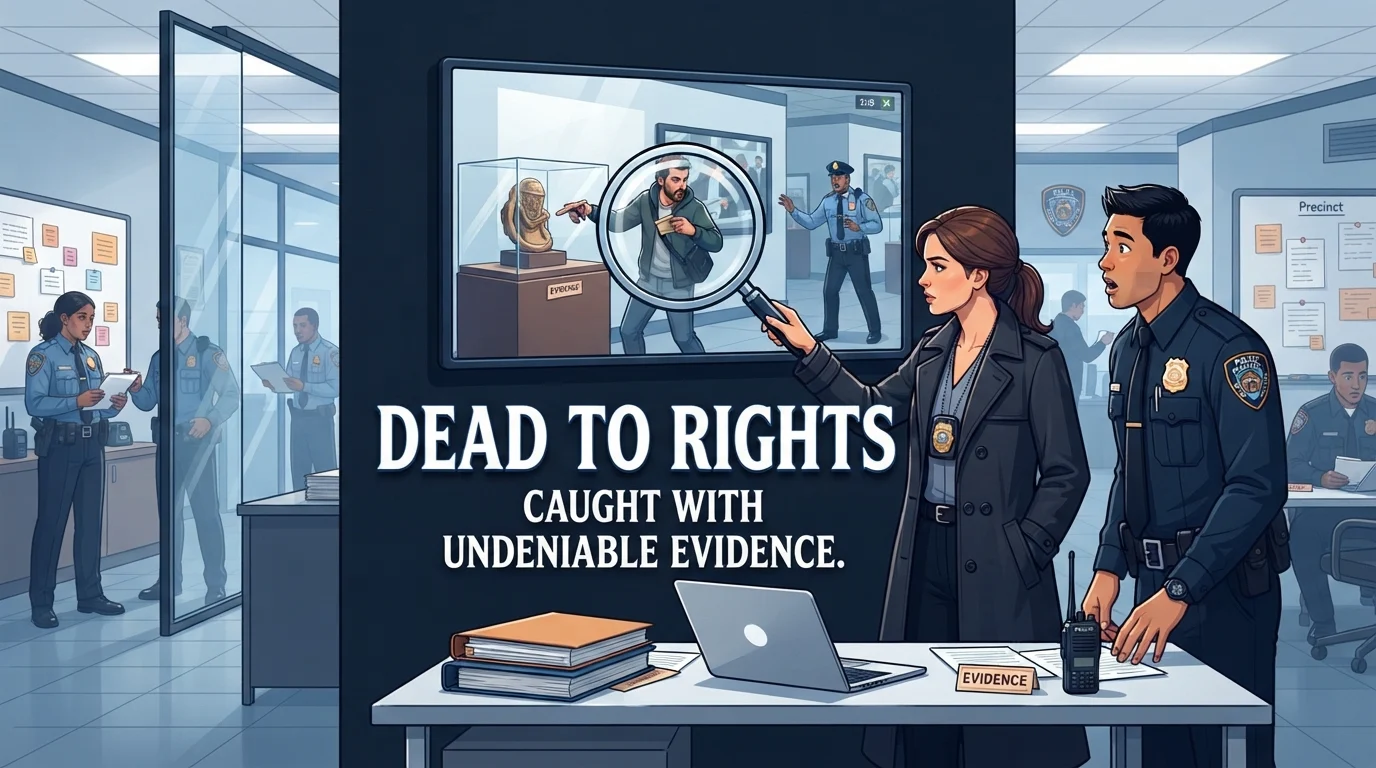
Have you ever heard someone say, “The police caught him dead to rights” and wondered what the expression means? “Dead to rights” is an English idiom that means catching someone clearly guilty or proving that someone has done something wrong with strong, undeniable evidence. It is often used when a person is caught in the act or when the evidence against them is so convincing that they cannot reasonably deny their actions.
This expression is common in informal conversations, crime stories, movies, television shows, and discussions about investigations. Although it contains the word “dead,” it has nothing to do with someone dying. Instead, it emphasizes how completely someone has been caught or exposed. Learning its meaning, common sentence patterns, and practical examples will help you understand and use this colorful expression naturally.
Quick Answer: What Does Dead to Rights Mean?
“Dead to rights” means caught red handed or proven guilty with clear and convincing evidence. The expression is commonly used when someone is caught doing something wrong and has little or no reasonable way to deny it. For example, “The security camera caught him dead to rights.”
Why Do People Use the Expression Dead to Rights?
People use “dead to rights” to emphasize that someone has been caught beyond reasonable doubt in an everyday or figurative sense. It suggests that the evidence is so clear that the person cannot easily escape blame or responsibility.
The expression is especially useful when describing situations involving:
- Someone caught committing an offense.
- A person exposed by photographs or video footage.
- Someone whose lies are revealed by clear evidence.
- A person confronted with proof of wrongdoing.
- Someone who cannot reasonably deny what they have done.
For example:
“The manager caught the employee dead to rights stealing money from the cash register.”
This means the manager had clear evidence that the employee was stealing.
Dead to Rights: Meaning and Definition
Dead to rights is an informal English idiom meaning caught completely, caught red handed, or shown to be guilty through undeniable evidence.
It is generally used when the evidence against someone is so strong that denying the accusation would be difficult or pointless.
The expression often appears in the following sentence patterns:
- Catch someone dead to rights.
- Have someone dead to rights.
- Be caught dead to rights.
- Catch someone in the act and have them dead to rights.
Simple Examples
- The police caught the suspect dead to rights.
- She had him dead to rights with the photographs.
- The security footage caught the thief dead to rights.
- He was dead to rights after the witnesses identified him.
In each example, the expression emphasizes that there is strong evidence against the person.
Origin of Dead to Rights
The exact origin of “dead to rights” is uncertain, but the expression is associated with older English slang and the language of law enforcement and criminal investigations.
The word “dead” strengthens the expression, suggesting that someone is completely or conclusively caught. “To rights” is associated with being caught or established in a position where the facts are clear.
Over time, the phrase became a familiar idiom in American English, particularly in crime related conversations, detective stories, and popular entertainment.
Today, it is also used figuratively in everyday situations, even when no actual crime has occurred.
10+ Examples of Dead to Rights in Sentences
Here are practical examples to help you understand how to use “dead to rights” correctly.
- The police caught the burglar dead to rights while he was breaking into the house.
- The security cameras had the delivery driver dead to rights.
- She caught her brother dead to rights eating the cake he had promised not to touch.
- The teacher had the student dead to rights after finding the answers written on his hand.
- The photographs caught him dead to rights at the scene of the accident.
- The investigators had the suspect dead to rights after discovering his fingerprints.
- He tried to deny taking the money, but the video footage caught him dead to rights.
- My mother caught me dead to rights sneaking out of the house.
- The company had the contractor dead to rights after uncovering the fraudulent invoices.
- The referee caught the player dead to rights after reviewing the video.
- She had her colleague dead to rights when she found the original email.
- The detective knew he had the criminal dead to rights once the missing documents were discovered.
When Should You Use Dead to Rights?
Use “dead to rights” when you want to emphasize that someone has been caught doing something wrong or that convincing evidence proves their involvement.
1. When Someone Is Caught Red Handed
This is one of the most common uses of the expression.
Example:
“The shop owner caught the customer dead to rights putting unpaid items into his bag.”
The customer was caught in the act of stealing.
2. When Evidence Proves Someone’s Wrongdoing
You can use the expression even when someone is not caught at the exact moment of committing an offense.
Example:
“The investigators had him dead to rights after finding his fingerprints on the stolen property.”
The evidence strongly connected him to the crime.
3. In Everyday and Humorous Situations
The expression can also describe harmless situations.
Example:
“My sister caught me dead to rights eating the chocolate she had hidden.”
This means the sister discovered what the speaker was doing.
Dead to Rights vs. Caught Red Handed
“Dead to rights” and “caught red handed” have similar meanings, but they are not always used in exactly the same way.
| Expression | Meaning | Example |
|---|---|---|
| Dead to rights | Caught or proven guilty with strong evidence | The video caught him dead to rights. |
| Caught red handed | Discovered while doing something wrong | She caught him red handed taking the money. |
| Caught in the act | Discovered at the exact moment of wrongdoing | The guard caught the thief in the act. |
| Have the goods on someone | Possess convincing evidence against someone | The detective had the goods on the suspect. |
| Busted | Caught doing something wrong | He was busted cheating on the test. |
The main distinction is that “caught red handed” and “caught in the act” emphasize the moment someone is discovered, while “dead to rights” can emphasize either being caught or having strong evidence against someone.
Common Mistakes to Avoid
Mistake 1: Thinking It Means Someone Is Dead
The expression has nothing to do with physical death.
Incorrect understanding: Someone is dead or has been killed.
Correct understanding: Someone has been caught or exposed with convincing evidence.
Mistake 2: Using It Only for Serious Crimes
Although the expression is common in crime related situations, it can also be used humorously or casually.
Example:
“My dad caught me dead to rights eating cookies before dinner.”
Mistake 3: Confusing It With Dead Right
“Dead to rights” is a complete idiomatic expression. “Dead right” is a different informal expression meaning completely correct.
Examples:
- The police caught him dead to rights.
- You are dead right about that.
Do not confuse these two expressions.
Mistake 4: Using It in Every Formal Situation
“Dead to rights” is informal. In formal reports, academic writing, or legal documents, expressions such as “caught in the act,” “supported by clear evidence,” or “conclusively established” may be more appropriate.
Memory Trick: How to Remember Dead to Rights
Remember this simple connection:
Dead to rights = Caught completely = No convincing way to deny it.
Imagine someone denying that they ate a piece of cake, but a photograph clearly shows them holding the empty plate with chocolate on their face.
They have been caught dead to rights!
This mental picture will help you remember the expression and its meaning.
American vs. British English
“Dead to rights” is especially familiar in American English and is widely recognized in American movies, television shows, crime stories, and everyday conversation.
British English speakers may understand the expression, but alternatives such as “caught red handed” and “bang to rights” are also familiar in British usage.
“Bang to rights” is a particularly useful British alternative. It means caught clearly and unmistakably doing something wrong.
Examples:
- American English: The detective caught the suspect dead to rights.
- British English: The detective caught the suspect bang to rights.
Both communicate that the person has been caught with convincing evidence.
Similar Words and Expressions
Here are some expressions related to “dead to rights” that can help expand your English vocabulary.
| Expression | Meaning |
|---|---|
| Caught red handed | Discovered while doing something wrong |
| Caught in the act | Discovered at the moment of wrongdoing |
| Busted | Caught doing something wrong |
| Bang to rights | Clearly caught, especially in British English |
| Have the goods on someone | Have convincing evidence against someone |
| Incriminating evidence | Evidence suggesting someone’s involvement in wrongdoing |
| No way out | No reasonable escape from a difficult situation |
| Open and shut case | A case that is easy to decide because the evidence is clear |
| Caught with one’s hand in the cookie jar | Discovered doing something dishonest or forbidden |
Final Verdict: What Does Dead to Rights Mean?
“Dead to rights” is an informal idiom meaning caught red handed or proven guilty through strong, convincing evidence.
Use it when someone is caught doing something wrong or when the available evidence makes it difficult for them to deny responsibility.
For example:
“The security footage caught the employee dead to rights.”
This means the footage clearly showed the employee’s wrongdoing.
Remember that the expression does not refer to death. It emphasizes how completely someone has been caught or exposed.
Frequently Asked Questions (FAQs)
1. What does dead to rights mean in simple English?
It means catching someone doing something wrong or having clear evidence that proves their involvement. In simple terms, it means someone has been caught and cannot easily deny it.
2. Is dead to rights the same as caught red handed?
They have very similar meanings. However, “caught red handed” usually emphasizes discovering someone while they are doing something wrong, whereas “dead to rights” can also refer to having strong evidence against someone.
3. Is dead to rights an idiom?
Yes. “Dead to rights” is an informal English idiom used to describe someone who has been caught or exposed through convincing evidence.
4. Is dead to rights informal?
Yes. It is mainly used in informal conversations, crime stories, movies, and everyday discussions. More neutral expressions are usually preferable in formal and academic writing.
5. What does caught dead to rights mean?
It means someone has been caught clearly doing something wrong or has been exposed by strong evidence.
Example: The police caught the suspect dead to rights with the stolen goods.
6. What is another way to say dead to rights?
You can use “caught red handed,” “caught in the act,” “busted,” or “caught bang to rights.” The best alternative depends on the context.
7. What does have someone dead to rights mean?
It means having clear and convincing evidence against someone, making it difficult for that person to deny their wrongdoing.
Example: The investigators had the suspect dead to rights after discovering his fingerprints.
8. Is dead to rights commonly used in British English?
It is understood in British English, but “bang to rights” is a particularly familiar British alternative.
Remember This
- Dead to rights means caught completely or exposed by convincing evidence.
- It is an informal English idiom.
- It is often used in crime related situations.
- It can also describe harmless or humorous situations.
- It is similar to “caught red handed.”
- “Dead to rights” does not mean someone has died.
- “Bang to rights” is a common British alternative.
Conclusion
“Dead to rights” is a useful English idiom that describes a situation in which someone is caught doing something wrong or confronted with strong evidence of wrongdoing. It is commonly used in conversations, crime stories, movies, and informal discussions. Although the word “dead” appears in the expression, it has no literal connection to death.
To use this idiom correctly, remember that it emphasizes how clearly someone has been caught or exposed. If a police officer discovers a criminal through video footage or a parent catches a child sneaking cookies, the expression communicates the same basic idea: the evidence is clear, and there is little room for denial.