Have you ever passed an exam by just one mark, caught a train seconds before it departed, or escaped an accident with almost no room to spare? The English idiom “by the skin of my teeth” describes exactly this kind of situation. It means to succeed, survive, or escape something by an extremely narrow margin. In simple words, it means you just barely managed to do something.
This expression is commonly used in everyday English, storytelling, and informal conversations. It often communicates relief, surprise, or disbelief because the person came very close to failing or experiencing something unpleasant. For example, “I passed the driving test by the skin of my teeth” means I passed, but only just. In this guide, you will learn the meaning, origin, correct usage, sentence examples, similar expressions, and common mistakes associated with this interesting idiom.
Quick Answer: What Does By the Skin of My Teeth Mean?
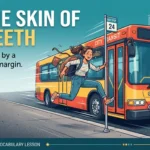
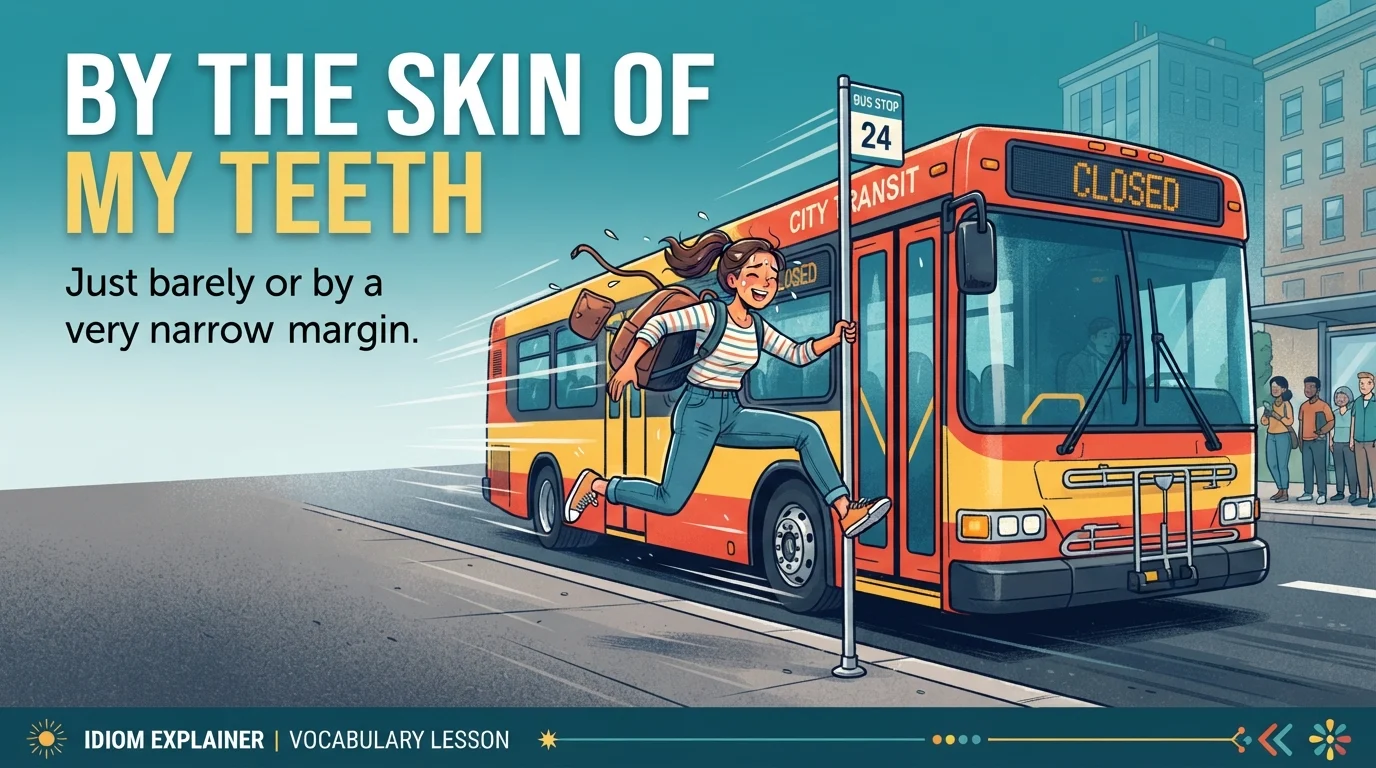
“By the skin of my teeth” means by an extremely small margin, just barely, or with very little to spare. It is used when someone narrowly succeeds, avoids failure, or escapes danger.
Example: I caught the last bus by the skin of my teeth.
This means I caught the bus just before it left, with almost no time to spare.
Why Do People Use the Expression By the Skin of My Teeth?
People use this idiom to describe situations in which success or escape was very close to failure or danger.
It emphasizes how little separated the person from an unsuccessful or unpleasant outcome.
For example:
- I passed the exam by the skin of my teeth.
- We escaped the fire by the skin of our teeth.
- She finished the project by the skin of her teeth.
In each sentence, the person succeeded, but only narrowly.
The expression also makes a sentence more vivid than simply saying barely or just managed to.
What Does By the Skin of My Teeth Mean?
The idiom by the skin of my teeth means achieving something with almost no margin for success. It can describe passing a test, avoiding an accident, meeting a deadline, winning a competition, or escaping a difficult situation.
The phrase is generally informal and conversational, although it can also appear in written English.
Simple Definition
By the skin of my teeth means:
- Just barely.
- By a very narrow margin.
- With almost no room to spare.
- Only just managing to succeed.
- Narrowly escaping failure or danger.
Examples in Simple English
- I passed the exam by the skin of my teeth.
- We caught the train by the skin of our teeth.
- He escaped the accident by the skin of his teeth.
- She finished the assignment by the skin of her teeth.
- Our team won the match by the skin of its teeth.
What Is the Origin of By the Skin of My Teeth?
The expression “by the skin of my teeth” has a biblical origin. It appears in the Book of Job, in the King James Version of the Bible, specifically Job 19:20.
The verse includes the words:
“My bone cleaveth to my skin and to my flesh, and I am escaped with the skin of my teeth.”
The phrase became associated with escaping a difficult situation by the narrowest possible margin.
The image is unusual because teeth do not actually have skin. This unusual wording helps make the expression memorable. Over time, it developed into the familiar English idiom used to describe narrowly succeeding or escaping something.
How to Use By the Skin of My Teeth in a Sentence
The expression is commonly used after a verb describing success, survival, or escape.
A typical sentence structure is:
Subject + verb + by the skin of my teeth.
The possessive word changes according to the subject.
| Subject | Correct expression |
|---|---|
| I | By the skin of my teeth |
| You | By the skin of your teeth |
| He | By the skin of his teeth |
| She | By the skin of her teeth |
| We | By the skin of our teeth |
| They | By the skin of their teeth |
Examples:
- I passed the test by the skin of my teeth.
- She caught the flight by the skin of her teeth.
- They survived the storm by the skin of their teeth.
- We completed the project by the skin of our teeth.
Notice that the word teeth stays the same. Only the possessive word changes.
15 Examples of By the Skin of My Teeth in Sentences
Here are practical examples showing how to use this idiom in everyday English.
- I passed my final exam by the skin of my teeth.
I passed, but my result was very close to the minimum passing mark. - We caught the last train by the skin of our teeth.
We arrived just before the train departed. - She finished her assignment by the skin of her teeth.
She completed it just before the deadline. - He escaped the burning building by the skin of his teeth.
He got out just before the situation became even more dangerous. - Our team won the match by the skin of its teeth.
The team won by a very small margin. - I managed to pay the rent by the skin of my teeth.
I barely had enough money to pay it. - They survived the storm by the skin of their teeth.
They narrowly escaped a dangerous situation. - We made it to the airport by the skin of our teeth.
We arrived just in time to catch our flight. - He kept his job by the skin of his teeth.
He narrowly avoided losing his job. - The company avoided bankruptcy by the skin of its teeth.
The company managed to survive a serious financial problem. - I remembered the answer by the skin of my teeth.
I managed to remember it at the last moment. - She passed the driving test by the skin of her teeth.
She passed, but only just. - The goalkeeper saved the penalty by the skin of his teeth.
He barely managed to stop the ball. - We finished the presentation by the skin of our teeth.
We completed it with almost no time left. - He avoided a serious accident by the skin of his teeth.
He narrowly escaped being involved in a serious accident.
By the Skin of My Teeth vs. Barely vs. Just in Time
These expressions are similar, but they are not always interchangeable.
| Expression | Meaning | Example |
|---|---|---|
| By the skin of my teeth | Succeeding or escaping by a very narrow margin | I passed by the skin of my teeth. |
| Barely | Only just; almost not | I barely passed the exam. |
| Just in time | Arriving or doing something at the last possible moment | I arrived just in time for the train. |
| By a hair’s breadth | By an extremely small distance or margin | He escaped by a hair’s breadth. |
| Narrowly | By a small margin | She narrowly won the election. |
1. By the Skin of My Teeth vs. Barely
Both expressions describe something achieved with difficulty or by a small margin.
- I passed the exam by the skin of my teeth.
- I barely passed the exam.
The meanings are very close. However, by the skin of my teeth is a more colorful idiom.
2. By the Skin of My Teeth vs. Just in Time
Just in time emphasizes timing, while by the skin of my teeth emphasizes how narrowly someone succeeds or escapes.
- I caught the bus just in time.
- I caught the bus by the skin of my teeth.
Both sentences are natural, but the second emphasizes how close you came to missing it.
3. By the Skin of My Teeth vs. By a Hair’s Breadth
Both expressions describe a very narrow margin.
- The car missed me by a hair’s breadth.
- I escaped the accident by the skin of my teeth.
The first often emphasizes a tiny distance, while the second can describe narrowly escaping danger or achieving success.
Common Mistakes to Avoid
Mistake 1: Changing Teeth to Tooth
Incorrect: I passed the exam by the skin of my tooth.
Correct: I passed the exam by the skin of my teeth.
The established idiom uses the plural noun teeth.
Mistake 2: Forgetting the Possessive Word
Incorrect: She passed by the skin of my teeth.
Correct: She passed by the skin of her teeth.
The possessive word should match the person being discussed.
Mistake 3: Using the Expression for Easy Success
Less suitable: I completed the simple task by the skin of my teeth.
Better: I completed the task by the skin of my teeth after struggling with it until the last minute.
The idiom suggests that success was difficult or narrowly achieved. It is not usually used for something completed easily.
Mistake 4: Confusing It With a Physical Description
The expression is figurative, not literal. It does not refer to the actual skin or surface of someone’s teeth.
It describes a narrow escape or a very close success.
Easy Memory Trick
Remember this simple idea:
By the skin of my teeth = I just barely made it.
Imagine arriving at an airport seconds before the boarding gate closes. You have almost missed your flight, but you manage to board.
You can say:
“I caught my flight by the skin of my teeth.”
Think of it as succeeding with almost nothing to spare.
American vs. British English
The idiom “by the skin of my teeth” is used and understood in both American and British English.
There is no important difference in its meaning or standard wording between the two varieties.
Examples:
- American English: I passed the exam by the skin of my teeth.
- British English: I passed the exam by the skin of my teeth.
Both sentences mean that the speaker passed the exam by a very narrow margin.
Similar Words and Expressions
If you want to express the same or a closely related idea, you can use these words and phrases.
| Expression | Meaning |
|---|---|
| Just barely | Only just managing to do something |
| By a narrow margin | With very little difference between success and failure |
| By a hair’s breadth | By an extremely small distance or margin |
| Close call | A situation in which something bad almost happens |
| Narrow escape | Escaping danger by a small margin |
| Just in time | At the last possible moment |
| Against the odds | Succeeding despite difficult circumstances |
| By the smallest margin | With very little difference |
Examples:
- I just barely passed the examination.
- We won by a narrow margin.
- That was a close call!
- He had a narrow escape from the accident.
- She arrived just in time for the interview.
Final Verdict: What Does By the Skin of My Teeth Mean?
“By the skin of my teeth” means to succeed, survive, or escape something by an extremely narrow margin. It describes a situation in which someone almost fails or experiences something unpleasant but manages to avoid that outcome.
For example, if you pass an exam with a score just above the passing mark, you can say:
“I passed the exam by the skin of my teeth.”
The expression is informal, widely understood in American and British English, and useful for describing close calls, narrow victories, and last minute successes.
Frequently Asked Questions
1. What does by the skin of my teeth mean in simple words?
It means just barely or by a very small margin. Someone who does something by the skin of their teeth succeeds or escapes a situation with almost no room to spare.
2. Is by the skin of my teeth a positive or negative expression?
It can be used in both positive and negative situations. It often describes a positive outcome, such as passing an exam or winning a match, but it can also describe narrowly escaping danger or failure.
3. What is an example of by the skin of my teeth?
“I caught the last bus by the skin of my teeth.” This means the speaker caught the bus just before it left and almost missed it.
4. Where does the expression by the skin of my teeth come from?
The expression comes from the Book of Job in the Bible, specifically Job 19:20 in the King James Version. It describes escaping with only the skin of one’s teeth.
5. Is by the skin of my teeth an idiom?
Yes. It is an English idiom because its meaning is figurative rather than literal. It describes narrowly succeeding or escaping something, not the actual skin of teeth.
6. Can I say by the skin of her teeth or by the skin of his teeth?
Yes. The possessive word changes according to the person.
Examples:
- She passed by the skin of her teeth.
- He escaped by the skin of his teeth.
- They won by the skin of their teeth.
7. Is by the skin of my teeth formal or informal?
It is generally considered an informal idiom. It is natural in everyday conversation, storytelling, and less formal writing. In formal academic or professional writing, expressions such as by a very narrow margin may be more suitable.
8. What is another way to say by the skin of my teeth?
You can say just barely, by a narrow margin, by a hair’s breadth, or with almost nothing to spare. The best alternative depends on the context.
Remember This
By the skin of my teeth = Just barely = By a very narrow margin.
Use this idiom when someone succeeds, survives, or escapes something with almost no room to spare.
Examples:
- I passed the exam by the skin of my teeth.
- We caught the flight by the skin of our teeth.
- She escaped the accident by the skin of her teeth.
The key idea is simple: you almost did not make it, but you managed to succeed.
Conclusion
The idiom “by the skin of my teeth” is a colorful way to describe a narrow success or escape. It means that someone managed to do something with very little time, distance, money, or opportunity to spare. If you pass an examination by one mark, catch a train seconds before departure, or narrowly avoid an accident, this expression communicates how close you came to an unsuccessful or dangerous outcome.
The phrase comes from the Bible and remains a familiar part of modern English. Remember that it is figurative, generally informal, and commonly used in both American and British English. When you want to say that you just barely made it, “by the skin of my teeth” is an expressive and natural choice.