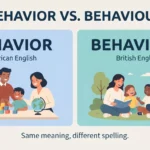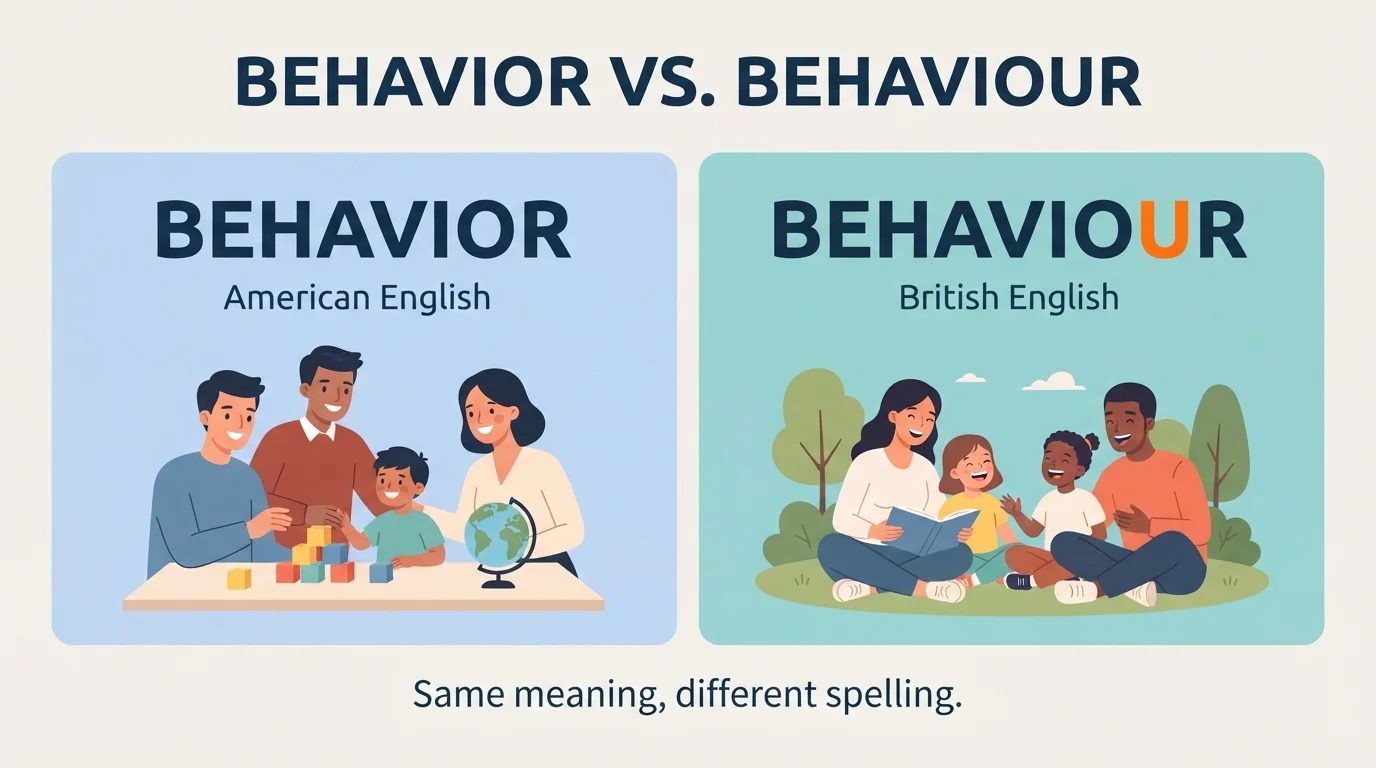
The words behavior and behaviour have exactly the same meaning, but they follow different English spelling conventions. Both are correct, and the main difference is regional. Behavior is the standard spelling in American English, while behaviour is the standard spelling in British English and several other varieties, including Canadian and Australian English.
Both words refer to the way a person, animal, or group acts or conducts itself in a particular situation. For example, an American writer might say, “His behavior was unacceptable,” while a British writer would write, “His behaviour was unacceptable.” Neither spelling is wrong. The important thing is to understand which version your audience expects and use it consistently throughout your writing. This guide explains the meanings, spelling differences, examples, related words, and common mistakes associated with behavior and behaviour.
Quick Answer: Behavior vs. Behaviour
Behavior is the correct American English spelling, while behaviour is the standard British English spelling. Both words have the same meaning: the way someone or something acts. Use behavior for American audiences and behaviour for British audiences, and remain consistent within the same document.
Why Do People Confuse Behavior and Behaviour?
People often confuse these words because they differ by only one letter. Both are pronounced the same way and have identical meanings.
The difference comes from the spelling conventions used in different English speaking countries.
- American English generally uses behavior.
- British English generally uses behaviour.
- Australian English generally uses behaviour.
- Canadian English generally uses behaviour, although some Canadian publications and institutions follow American spelling conventions.
The letter u is the only difference between the two spellings.
For example:
- American English: Children’s behavior can change as they grow.
- British English: Children’s behaviour can change as they grow.
Both sentences are grammatically correct.
1. Behavior: Meaning, Definition, and Usage
Behavior is the standard American English spelling of the noun that describes how a person, animal, or group acts or responds in different situations.
It can refer to someone’s actions, habits, manners, conduct, or reactions.
Definition of Behavior
Behavior means the way a person, animal, or other living thing acts, particularly in response to a particular situation, environment, or experience.
Simple meaning: The way someone or something acts.
Examples of Behavior in Sentences
- His behavior during the meeting was very professional.
- Parents play an important role in shaping children’s behavior.
- The teacher praised the student’s good behavior.
- His aggressive behavior worried his family.
- Scientists study animal behavior in different environments.
- The company expects professional behavior from its employees.
- Her behavior changed after she started her new job.
- The child’s unusual behavior attracted the teacher’s attention.
- Good behavior should be encouraged at school.
- His rude behavior offended everyone in the room.
- The research examines consumer behavior in online shopping.
- Social media can influence people’s behavior.
Common Expressions with Behavior
These expressions are frequently used in American English:
- Good behavior
- Bad behavior
- Human behavior
- Animal behavior
- Social behavior
- Consumer behavior
- Workplace behavior
- Aggressive behavior
- Professional behavior
- Unacceptable behavior
Example: The school has strict rules regarding student behavior.
Here, behavior refers to the way students are expected to act.
2. Behaviour: Meaning, Definition, and Usage
Behaviour is the standard British English spelling of the same noun. It has exactly the same meaning as behavior.
It describes how a person, animal, or group acts, responds, or conducts itself.
Definition of Behaviour
Behaviour means the actions, reactions, or conduct of a person, animal, or group in different circumstances.
Simple meaning: The way someone or something acts.
Examples of Behaviour in Sentences
- His behaviour at the party was unacceptable.
- Parents should encourage positive behaviour in children.
- The teacher appreciated the student’s good behaviour.
- Her unusual behaviour surprised everyone.
- Scientists are studying animal behaviour in the wild.
- The company expects professional behaviour from its employees.
- His behaviour has improved significantly.
- The school has introduced new rules to encourage better behaviour.
- Aggressive behaviour can create problems in the workplace.
- Children’s behaviour is influenced by their surroundings.
- The study examines consumer behaviour in the United Kingdom.
- Her polite behaviour made a positive impression on everyone.
Common Expressions with Behaviour
These expressions are commonly used in British English:
- Good behaviour
- Bad behaviour
- Human behaviour
- Animal behaviour
- Social behaviour
- Consumer behaviour
- Workplace behaviour
- Aggressive behaviour
- Professional behaviour
- Unacceptable behaviour
Example: The school encourages positive behaviour among its students.
Here, behaviour refers to the actions and conduct expected from students.
3. Behavior vs. Behaviour: Comparison Table
| Feature | Behavior | Behaviour |
|---|---|---|
| English variety | American English | British English |
| Spelling | Without u | With u |
| Meaning | Way someone or something acts | Way someone or something acts |
| Pronunciation | Same | Same |
| Part of speech | Noun | Noun |
| Usage | US publications and writing | UK and many other varieties |
| Example | His behavior was rude. | His behaviour was rude. |
The Main Difference in One Example
Compare these sentences:
- American English: His behavior was inappropriate.
- British English: His behaviour was inappropriate.
Both sentences communicate exactly the same idea. The only difference is the spelling convention.
4. When to Use Behavior and Behaviour
Choosing the correct spelling depends primarily on your intended audience.
When to Use Behavior
Use behavior when writing in American English.
It is appropriate for:
- American academic assignments.
- US newspapers and magazines.
- American business documents.
- Websites targeting readers in the United States.
- American educational materials.
Examples:
- The research focuses on human behavior.
- The company has a strict code of behavior.
- Parents should teach children appropriate behavior.
When to Use Behaviour
Use behaviour when writing in British English or following a spelling style that uses the British form.
It is appropriate for:
- British academic assignments.
- UK newspapers and magazines.
- British business documents.
- Australian and many Canadian publications.
- Educational materials following British spelling conventions.
Examples:
- The research focuses on human behaviour.
- The company has a strict code of behaviour.
- Parents should teach children appropriate behaviour.
What If You Are Writing for an International Audience?
If your audience is international, either spelling can work. However, choose one spelling convention and apply it consistently.
For example, if you use British English, write:
- Behaviour
- Colour
- Favour
- Neighbour
If you use American English, write:
- Behavior
- Color
- Favor
- Neighbor
Avoid switching between American and British spellings without a specific reason.
5. Behavior vs. Behaviour: 15+ Examples
The following examples show how both spellings are used in everyday English.
| American English | British English |
|---|---|
| His behavior was excellent. | His behaviour was excellent. |
| Good behavior is important. | Good behaviour is important. |
| Her behavior surprised me. | Her behaviour surprised me. |
| Animal behavior is fascinating. | Animal behaviour is fascinating. |
| The child’s behavior improved. | The child’s behaviour improved. |
| His aggressive behavior caused problems. | His aggressive behaviour caused problems. |
| We discussed consumer behavior. | We discussed consumer behaviour. |
| Her professional behavior impressed us. | Her professional behaviour impressed us. |
| The school monitors student behavior. | The school monitors student behaviour. |
| His behavior was unacceptable. | His behaviour was unacceptable. |
| Social behavior varies across cultures. | Social behaviour varies across cultures. |
| The study examines human behavior. | The study examines human behaviour. |
| Their behavior was inappropriate. | Their behaviour was inappropriate. |
| Positive behavior should be rewarded. | Positive behaviour should be rewarded. |
| The research explores workplace behavior. | The research explores workplace behaviour. |
Notice that the meaning, grammar, and sentence structure remain unchanged.
6. Common Mistakes to Avoid
Although both spellings are correct, learners sometimes make mistakes when choosing between them.
Mistake 1: Thinking Behaviour Is Incorrect
Incorrect understanding: Behaviour is a misspelling of behavior.
Correct understanding: Both spellings are correct, but they belong to different spelling conventions.
Example:
- American English: His behavior is excellent.
- British English: His behaviour is excellent.
Mistake 2: Thinking Behavior and Behaviour Have Different Meanings
Incorrect understanding: Behavior refers to actions, while behaviour refers to personality.
Correct understanding: Both words have exactly the same meaning.
Example:
- His behavior surprised me.
- His behaviour surprised me.
Both sentences mean the same thing.
Mistake 3: Mixing American and British Spellings
Inconsistent writing:
- His behavior was excellent.
- The colour of the car was beautiful.
- My neighbour is very friendly.
This combines American and British spellings.
A consistent American English version would be:
- His behavior was excellent.
- The color of the car was beautiful.
- My neighbor is very friendly.
A consistent British English version would be:
- His behaviour was excellent.
- The colour of the car was beautiful.
- My neighbour is very friendly.
Mistake 4: Confusing Behavior With Behave
Behavior is a noun, while behave is a verb.
Examples:
- His behavior is unacceptable.
- You should behave responsibly.
Do not use one in place of the other.
Mistake 5: Assuming the British Spelling Is Always More Formal
Neither spelling is inherently more formal or professional. The appropriate choice depends on the regional spelling standard and the publication’s style guide.
7. Memory Trick: How to Remember Behavior vs. Behaviour
A simple trick can help you remember which spelling belongs to each English variety.
Behavior = American English
Remember that American English usually removes the letter u from words such as behavior, color, and favor.
Behaviour = British English
Remember that British English generally keeps the letter u in words such as behaviour, colour, and favour.
You can also remember this simple rule:
- American spelling: No extra u.
- British spelling: Keep the u.
This pattern will help you remember several other spelling differences.
8. American vs. British English: More Words Like Behavior and Behaviour
The difference between behavior and behaviour is part of a broader spelling pattern in English.
Here are some other words that follow a similar pattern.
| American English | British English |
|---|---|
| Behavior | Behaviour |
| Color | Colour |
| Favor | Favour |
| Neighbor | Neighbour |
| Honor | Honour |
| Labor | Labour |
| Humor | Humour |
| Rumor | Rumour |
| Odor | Odour |
| Favorite | Favourite |
| Organized | Organised |
| Realize | Realise |
Important note: British English spelling conventions are not completely uniform. Some British dictionaries and style guides accept certain spellings with z, such as organize and realize. Therefore, always follow the spelling standard required by your school, publisher, or organization.
9. Similar Words and Their Differences
Understanding related words can help you use behavior and behaviour more accurately.
Behavior vs. Conduct
- Behavior: The way someone acts in general or in a particular situation.
- Conduct: The way someone behaves, especially in terms of rules, standards, or moral expectations.
Examples:
- His behavior was unusual.
- The employee’s conduct violated company policy.
Conduct often sounds more formal than behavior.
Behavior vs. Attitude
- Behavior: A person’s observable actions.
- Attitude: A person’s way of thinking or feeling about something.
Examples:
- His behavior was disrespectful.
- His attitude toward his colleagues was negative.
A person’s attitude can influence their behavior, but the words do not mean the same thing.
Behavior vs. Manner
- Behavior: The way someone acts.
- Manner: The way someone does something or interacts with others.
Examples:
- His behavior was inappropriate.
- She spoke in a polite manner.
Manner often describes how an action is performed, while behavior can describe a wider pattern of actions.
Behavior vs. Personality
- Behavior: The actions and reactions a person displays.
- Personality: The combination of characteristics, qualities, and traits that make someone an individual.
Examples:
- Her behavior changed after the conversation.
- She has a friendly personality.
Personality can influence behavior, but the terms are not interchangeable.
10. Final Verdict: Behavior or Behaviour?
Both behavior and behaviour are correct English spellings. The only difference is regional spelling convention.
Use behavior when following American English spelling.
Use behaviour when following British English spelling, which is also commonly used in Australian English and many Canadian publications.
Remember these examples:
- American English: His behavior was excellent.
- British English: His behaviour was excellent.
Neither spelling is better or more correct than the other. Choose the version that matches your audience, and use it consistently throughout your writing.
Frequently Asked Questions (FAQs)
1. Which is correct, behavior or behaviour?
Both are correct. Behavior is the standard American English spelling, while behaviour is the standard British English spelling. They have exactly the same meaning.
2. Is behavior American or British English?
Behavior is the standard American English spelling. It is commonly used in the United States, including in academic, professional, and everyday writing.
3. Is behaviour British or American English?
Behaviour is the standard British English spelling. It is also commonly used in Australian English and many Canadian publications.
4. Do behavior and behaviour have the same meaning?
Yes. Both words mean the way a person, animal, or group acts or responds in different situations. There is no difference in meaning or pronunciation.
5. Which spelling should I use in academic writing?
Use the spelling convention required by your university, teacher, journal, or publication. If no specific style is required, choose either American or British English and remain consistent.
6. Is behavioral or behavioural correct?
Both are correct. Behavioral is the American English spelling, while behavioural is the British English spelling.
Examples:
- American: Behavioral science studies human actions.
- British: Behavioural science studies human actions.
7. What is the plural of behavior or behaviour?
Both words are generally uncountable nouns when referring to conduct or the way someone acts, so they do not normally have a plural form in this meaning.
For example:
- Correct: Children’s behavior varies.
- Correct: Children’s behaviour varies.
In specialized contexts, behaviors or behaviours may be used to refer to distinct types or patterns of actions.
8. Is behaviour spelled with a u in Australian English?
Yes. Behaviour is the standard Australian English spelling. Australian English generally follows British spelling conventions for words ending in our, although individual style guides may differ in other spelling matters.
Remember This
- Behavior: American English spelling.
- Behaviour: British English spelling.
- Both words have the same meaning.
- Both are pronounced the same way.
- Behavioral is American English.
- Behavioural is British English.
- Choose one spelling style and use it consistently.
Conclusion
The difference between behavior and behaviour is simple: one follows American English spelling conventions, while the other follows British English spelling conventions. Both words describe the way a person, animal, or group acts, and neither is grammatically incorrect. The only thing that changes is the regional spelling preference.
If you are writing for an American audience, choose behavior. If you are writing for a British audience, choose behaviour. Most importantly, maintain consistency throughout your writing. Understanding this small spelling difference will help you communicate more clearly and produce polished English in academic, professional, and everyday contexts.