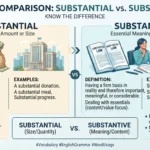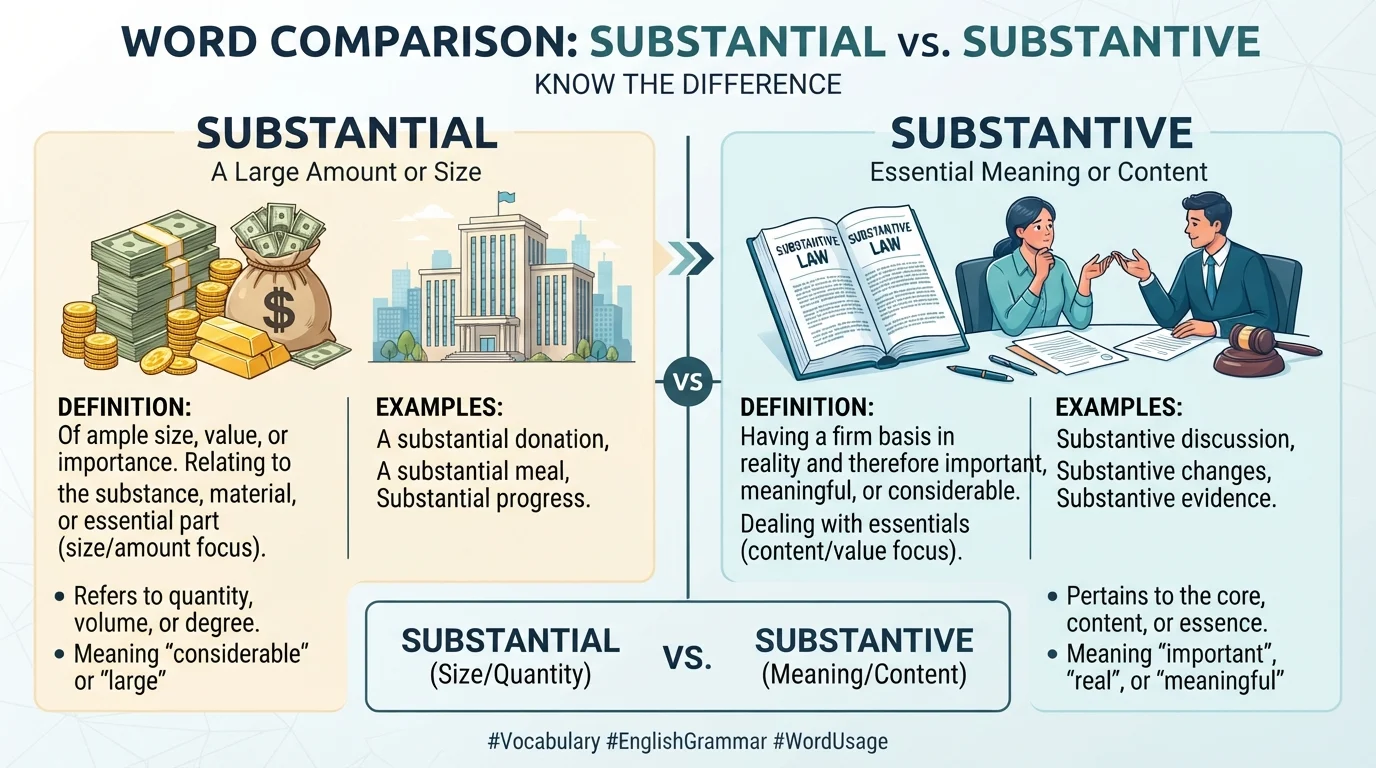
The words substantial and substantive look similar and are sometimes used in related contexts, but they have different meanings. Both can describe something important, significant, or meaningful. However, substantial usually refers to the size, amount, extent, or importance of something, while substantive refers to the essential content, substance, or actual meaning of something.
For example, a company may make a substantial investment, meaning it invests a large amount of money. However, a substantive discussion is one that deals with important issues rather than superficial details.
Understanding the difference between substantial and substantive can help you choose the correct word in academic writing, business communication, legal documents, and everyday English. This guide explains their definitions, differences, grammatical usage, and common mistakes, with practical examples to make the distinction easier to remember.
Quick Answer: What Is the Difference Between Substantial and Substantive?
Substantial means considerable in size, amount, degree, or importance. It describes something that is large, significant, or considerable.
Substantive means relating to the essential substance, content, or actual nature of something. It describes something meaningful, important in content, or concerned with the main issues rather than superficial matters.
Examples:
- The company made a substantial profit last year. (A considerable amount of profit.)
- We had a substantive discussion about the problem. (A meaningful discussion focused on the main issues.)
In simple terms, substantial emphasizes how much or how significant, while substantive emphasizes what something contains or what it is really about.
What Does Substantial Mean?
Substantial is an adjective that means large, considerable, significant, or important in size, amount, degree, or value.
It is used when something is more than small, minor, or insignificant. It can describe physical objects, financial amounts, changes, evidence, benefits, and other things that have considerable size or importance.
Examples of Substantial in Sentences
- The business made a substantial profit this year.
- She received a substantial salary increase.
- The new policy has brought about substantial improvements.
- Building the house requires a substantial investment.
- There is substantial evidence supporting the claim.
- The company suffered substantial financial losses.
- He made a substantial contribution to the project.
- The two proposals have substantial differences.
In these examples, substantial indicates that something is considerable or significant in amount, degree, or importance.
Common Uses of Substantial
Here are some common expressions with the word substantial:
| Expression | Meaning |
|---|---|
| Substantial amount | A large or considerable amount |
| Substantial evidence | Strong or considerable evidence |
| Substantial investment | A large financial investment |
| Substantial improvement | A significant improvement |
| Substantial difference | A considerable difference |
| Substantial contribution | A significant contribution |
| Substantial damage | Serious or considerable damage |
| Substantial support | Considerable assistance or backing |
What Does Substantive Mean?
Substantive is an adjective that means relating to the essential substance, content, or main nature of something.
It is often used to describe discussions, arguments, changes, issues, rights, and decisions that deal with important matters rather than appearances, procedures, or minor details.
Something substantive has meaningful content or concerns the actual substance of a subject.
Examples of Substantive in Sentences
- We need to have a substantive discussion about the company’s future.
- The report contains substantive information about the problem.
- The committee made several substantive changes to the proposal.
- The lawyer raised substantive issues during the hearing.
- Their meeting focused on substantive matters rather than formalities.
- The research provides substantive evidence of the theory.
- Both candidates offered substantive arguments during the debate.
- The new agreement includes substantive protections for employees.
In these examples, substantive emphasizes the meaningful content or essential nature of something.
Common Uses of Substantive
| Expression | Meaning |
|---|---|
| Substantive discussion | A meaningful discussion about important issues |
| Substantive change | A change affecting the essential content or nature of something |
| Substantive issue | A matter concerning the actual substance of a subject |
| Substantive argument | An argument supported by meaningful reasoning or content |
| Substantive information | Information that is meaningful and relevant |
| Substantive rights | Rights concerning the actual legal interests of a person |
| Substantive evidence | Evidence relevant to the actual issue being considered |
| Substantive review | A review of the actual content or merits of something |
Substantial vs. Substantive: Key Differences
Although the two words share a similar origin and can both suggest importance, they emphasize different things.
| Basis | Substantial | Substantive |
|---|---|---|
| Meaning | Considerable in size, amount, degree, or importance | Relating to essential content or substance |
| Main focus | Quantity, extent, or significance | Quality, meaning, or essential nature |
| Common context | Money, size, evidence, changes, benefits | Discussions, arguments, issues, rights |
| Example | A substantial investment | A substantive discussion |
| Opposite idea | Small, minor, or insignificant | Superficial, procedural, or merely formal |
1. Substantial Focuses on Amount or Extent
Use substantial when you want to emphasize that something is considerable in size, quantity, degree, or importance.
Examples:
- The project requires a substantial amount of money.
- The company experienced substantial growth.
- The building suffered substantial damage.
The emphasis is on how much growth, money, or damage is involved.
2. Substantive Focuses on Meaning or Content
Use substantive when you want to emphasize that something deals with the essential matter or contains meaningful information.
Examples:
- The meeting included a substantive discussion.
- The report provides substantive details about the investigation.
- The proposal introduces substantive changes to the law.
The emphasis is on the content and importance of the discussion, details, or changes.
Can Substantial and Substantive Be Used Interchangeably?
Sometimes, the two words can appear in similar contexts, but they are not generally interchangeable.
For example:
Substantial change: A considerable or significant change.
Substantive change: A change that affects the essential content, meaning, or nature of something.
A change can be both substantial and substantive, but the words describe different aspects of it.
Consider these examples:
- The company made substantial changes to its budget. (The changes were considerable.)
- The company made substantive changes to its employment policy. (The changes affected the actual content of the policy.)
Similarly:
- We need substantial evidence to support the claim. (A considerable amount or strong body of evidence.)
- We need substantive evidence to support the claim. (Evidence that addresses the actual issue and has meaningful relevance.)
The distinction can be subtle, and context determines which word is more appropriate.
Substantial vs. Substantive in Different Contexts
1. In Business and Finance
In business communication, substantial commonly describes considerable financial amounts, investments, profits, or losses.
Examples:
- The company received a substantial investment.
- The business reported substantial annual profits.
- The project requires substantial financial resources.
Substantive is more appropriate when discussing the actual content of business decisions, agreements, or negotiations.
Examples:
- The two companies reached a substantive agreement.
- The board discussed substantive business issues.
- The negotiations resulted in substantive changes to the contract.
2. In Academic Writing
Substantial is often used to describe considerable research, evidence, progress, or differences.
Examples:
- The study provides substantial evidence.
- Students have made substantial progress.
- There is a substantial difference between the two results.
Substantive is used to describe meaningful arguments, analysis, information, or contributions.
Examples:
- The essay presents a substantive argument.
- The article offers substantive analysis of the issue.
- The research makes a substantive contribution to the field.
3. In Law
Both words are common in legal English, but they have distinct uses.
Substantial can refer to considerable evidence, harm, compliance, or financial value.
Example:
- The plaintiff suffered substantial financial losses.
Substantive often refers to the actual rights, duties, legal principles, or merits of a case, rather than procedural matters.
Example:
- The court considered the substantive legal issues.
In legal writing, the distinction between substantive law and procedural law is especially important. Substantive law establishes legal rights and obligations, while procedural law sets out the processes used to enforce them.
4. In Everyday Conversation
Substantial is more common when describing something considerable or significant.
Examples:
- That is a substantial amount of work.
- We received substantial help from our neighbors.
- The new house needs substantial repairs.
Substantive is more formal and is usually used when discussing meaningful content or important issues.
Examples:
- We need a substantive conversation about our plans.
- His response did not provide any substantive information.
- The meeting was formal, but it lacked substantive discussion.
Common Mistakes to Avoid
Mistake 1: Using Substantive When You Mean a Large Amount
Incorrect: The company received a substantive amount of money.
Better: The company received a substantial amount of money.
Why? Substantial is the natural choice when describing a considerable quantity or financial amount.
Mistake 2: Using Substantial When You Mean Meaningful Content
Less precise: We had a substantial discussion about the issue.
Better: We had a substantive discussion about the issue.
Why? Substantive emphasizes that the discussion addressed important matters rather than superficial topics. Substantial may still be correct if you mean the discussion was considerable in length or scope.
Mistake 3: Assuming Both Words Always Mean Important
Both words can suggest importance, but they do not express the same idea.
- A substantial contribution is considerable in size or significance.
- A substantive contribution adds meaningful content or advances understanding.
Choose the word according to the meaning you want to communicate.
Easy Ways to Remember the Difference
Use these simple memory tips:
Substantial = Size or significance
Think about something considerable in amount, extent, or importance.
Example: A substantial amount of money.
Substantive = Substance or meaning
Think about the actual content or essential nature of something.
Example: A substantive argument.
Another helpful way to remember the distinction is to ask yourself:
- Am I describing how much or how significant something is? Use substantial.
- Am I describing the actual content, meaning, or essential nature of something? Use substantive.
Frequently Asked Questions
1. What is the main difference between substantial and substantive?
Substantial means considerable in size, amount, degree, or importance. Substantive means relating to the essential content, substance, or actual nature of something. For example, a substantial investment involves a large amount of money, while a substantive discussion deals with meaningful issues.
2. Does substantial mean significant?
Yes. Substantial can mean significant, considerable, or important. It is commonly used to describe something that is large in amount, extent, or degree.
Example: The company made substantial progress during the year.
3. Does substantive mean important?
Yes, in certain contexts. Substantive describes something that has meaningful content or relates to the essential issues of a subject. It is often used to distinguish meaningful matters from superficial or procedural details.
Example: The committee discussed substantive concerns.
4. Is it substantial evidence or substantive evidence?
Both expressions are correct, but their meanings can differ. Substantial evidence generally refers to evidence that is considerable or sufficiently strong to support a conclusion. Substantive evidence emphasizes evidence that addresses the actual issue or merits of a matter. In legal and technical contexts, the precise meaning can depend on the field.
5. Is a substantial change the same as a substantive change?
No. A substantial change is considerable in size, degree, or effect. A substantive change affects the essential content, meaning, or nature of something. A change can be both substantial and substantive.
6. Can I use substantive in everyday English?
Yes, but it is more formal than substantial and is especially common in academic, legal, professional, and business contexts. You can use it in everyday conversation when discussing meaningful content or important issues.
7. What is the opposite of substantial and substantive?
The opposite of substantial may be small, minor, limited, or insignificant, depending on the context. The opposite of substantive may be superficial, insubstantial, procedural, or merely formal, depending on the intended meaning.
Conclusion
The main difference between substantial and substantive is what each word emphasizes. Substantial describes something considerable in size, amount, extent, or importance. Substantive describes something meaningful, essential, or concerned with the actual content of a subject.
Remember this simple rule: use substantial when you mean considerable, and use substantive when you mean meaningful or related to the substance of something.
Understanding this distinction will help you communicate more precisely in everyday English, academic writing, business discussions, and professional communication.