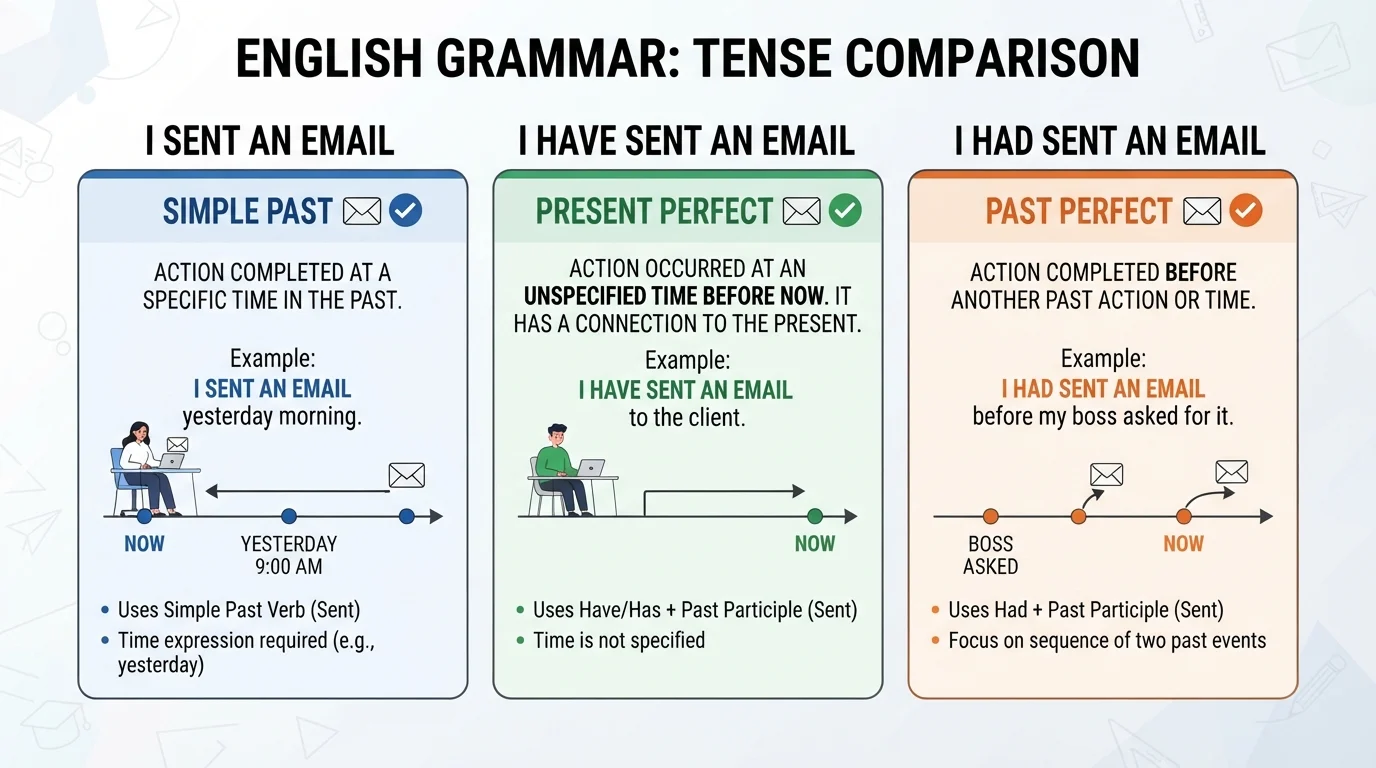
Should you say “I sent an email,” “I have sent an email,” or “I had sent an email”? All three expressions are grammatically correct, but they refer to different time relationships. Choosing the right one depends on when the email was sent and how that action relates to the present or another past event.
For example, you can say “I sent an email yesterday” when talking about a completed action at a specific time. You can say “I have sent an email” when the action is complete and relevant to the present. However, “I had sent an email” is appropriate when you want to show that the email was sent before another event or point in the past.
Understanding these differences will help you communicate more naturally in emails, workplace conversations, academic writing, and everyday English. This guide explains all three expressions with simple rules, practical examples, and common mistakes.
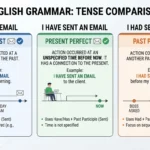
Quick Answer: What Is the Difference Between I Sent, I Have Sent, and I Had Sent an Email?
- I sent an email: Simple past tense. It describes a completed action in the past, often with a specific or understood past time.
- I have sent an email: Present perfect tense. It describes a completed action with a connection to the present.
- I had sent an email: Past perfect tense. It describes an action completed before another past event or point in time.
Examples:
- I sent an email yesterday.
- I have sent an email, so please check your inbox.
- I had sent an email before you called me.
The main difference is the relationship between the action and the time of speaking or another past event.
1. I Sent an Email: Simple Past Tense
“I sent an email” is in the simple past tense. Use it when you are talking about an email that you sent at a completed time in the past.
The action is finished, and you are simply reporting that it happened.
When Should You Use I Sent an Email?
Use this expression when:
- You mention a specific time in the past.
- You describe a completed action.
- You narrate past events.
- The conversation focuses on when the email was sent.
Examples of I Sent an Email
- I sent an email yesterday.
- I sent an email to the manager last night.
- I sent you an email two days ago.
- I sent the documents by email this morning.
- I sent an email after the meeting.
- I sent an email to the customer last week.
- I sent the application before the deadline.
- I sent an email, but I did not receive a reply.
Example in a Conversation
Person A: When did you send the email?
Person B: I sent it yesterday.
Here, the speaker uses the simple past because the question asks about a completed action and its time.
Common Time Expressions With I Sent
- Yesterday
- Last night
- Last week
- Two days ago
- This morning (when referring to a completed past time)
- In 2024
- Before the meeting
Example: I sent the email last Friday.
2. I Have Sent an Email: Present Perfect Tense
“I have sent an email” is in the present perfect tense. Use it when an action happened in the past but has a connection to the present.
You are emphasizing that the email has already been sent, rather than focusing on the exact time when you sent it.
When Should You Use I Have Sent an Email?
Use this expression when:
- You want to confirm that the email has been sent.
- The completed action is relevant to the present.
- You are reporting a recent action without specifying exactly when it happened.
- You want to emphasize the current result of the action.
Examples of I Have Sent an Email
- I have sent an email to the manager.
- I have sent you the requested documents.
- I have sent an email regarding the meeting.
- I have already sent the application.
- I have sent the details to your email address.
- I have sent the invoice, so please check your inbox.
- I have sent an email, but I am still waiting for a response.
- I have sent the report for your review.
Example in a Conversation
Person A: Have you sent the email?
Person B: Yes, I have sent it.
Here, the speaker confirms that the action is complete. The exact time is not important.
Common Time Expressions With I Have Sent
- Already
- Just
- Recently
- Yet (usually in questions and negative sentences)
- So far
- Today (when the time period is still ongoing)
Examples:
- I have just sent the email.
- I have already sent the documents.
- Have you sent the email yet?
- I have not sent the email yet.
Important Rule: Avoid Specific Finished Past Times With the Present Perfect
In standard English, do not normally combine the present perfect with a specific finished past time.
Incorrect: I have sent the email yesterday.
Correct: I sent the email yesterday.
Correct: I have sent the email.
The first correct sentence uses the simple past because yesterday is a finished past time. The second uses the present perfect because no specific finished past time is mentioned.
3. I Had Sent an Email: Past Perfect Tense
“I had sent an email” is in the past perfect tense. Use it when you want to show that an email was sent before another event or point in the past.
The past perfect makes the order of two past events clear.
When Should You Use I Had Sent an Email?
Use this expression when:
- You describe an action completed before another past action.
- You explain what had already happened at a particular point in the past.
- You narrate events in chronological order.
- You want to emphasize that the email was sent earlier than another past event.
Examples of I Had Sent an Email
- I had sent an email before you called me.
- I had sent the documents before the deadline.
- I had already sent the email when he asked me about it.
- I had sent an email to the manager before the meeting started.
- I had sent the invitation before they changed the date.
- I had sent the report before my supervisor requested it.
- I had sent the email, but nobody had responded by then.
- I had sent the details before the office closed.
Example in a Conversation
Person A: Why didn’t you send the email after the meeting?
Person B: I had already sent it before the meeting started.
The past perfect shows that sending the email happened before the meeting started.
Common Time Expressions With I Had Sent
- Before
- By the time
- Already
- Earlier
- Until then
- When (to connect two past events)
Examples:
- I had already sent the email when she contacted me.
- By the time he arrived, I had sent the documents.
- I had sent the message earlier that morning.
I Sent vs. I Have Sent vs. I Had Sent: Comparison Table
Here is a simple comparison of all three expressions.
| Expression | Tense | Main use | Example |
|---|---|---|---|
| I sent an email | Simple past | Completed past action | I sent it yesterday. |
| I have sent an email | Present perfect | Past action connected to the present | I have sent it already. |
| I had sent an email | Past perfect | Action completed before another past event | I had sent it before you called. |
How to Choose the Correct Expression
The easiest way to choose the correct tense is to consider what you want to communicate.
Situation 1: You Want to Say That You Sent the Email Yesterday
Correct: I sent an email yesterday.
Why? Yesterday is a specific, completed time in the past, so the simple past is appropriate.
Situation 2: Someone Asks Whether You Have Sent the Email
Correct: I have sent the email.
Why? You are confirming that the action is complete and relevant to the present.
Situation 3: You Sent the Email Before Someone Called You
Correct: I had sent the email before you called me.
Why? The email was sent first, and the phone call happened later. The past perfect establishes that sequence.
Situation 4: You Want to Tell Someone That You Already Sent the Email
Both of these can be correct, depending on the context:
- I already sent the email.
- I have already sent the email.
The first is simple past and is especially common in American English. The second is present perfect and emphasizes the current relevance of the completed action.
Can You Say I Have Sent an Email Yesterday?
No. In standard English, “I have sent an email yesterday” is generally incorrect because the present perfect is not normally used with a specific finished past time such as yesterday.
Use one of these alternatives:
- I sent an email yesterday.
- I have sent an email.
- I had sent an email before yesterday’s meeting.
Remember that the simple past is the natural choice when you specify exactly when a completed action happened.
Can You Say I Had Sent an Email Without Mentioning Another Past Event?
Yes, it is grammatically possible, but the past perfect usually needs a clear past reference point.
For example:
I had sent the email.
This sentence can be correct if the listener already knows the past situation being discussed.
However, if you are simply reporting that you sent an email, the simple past or present perfect is usually more natural.
- I sent the email.
- I have sent the email.
Use the past perfect when the earlier timing matters.
Common Mistakes to Avoid
Mistake 1: Using Present Perfect With Yesterday
Incorrect: I have sent the email yesterday.
Correct: I sent the email yesterday.
Explanation: Yesterday refers to a completed time in the past, so use the simple past.
Mistake 2: Using Past Perfect Without a Clear Past Reference
Less natural: I had sent an email.
More natural when reporting a completed action: I sent an email.
Explanation: The past perfect is most useful when another past event or reference point helps establish the sequence.
Mistake 3: Using Simple Past When You Want to Emphasize a Present Result
Possible: I sent the email, so check your inbox.
Often more suitable: I have sent the email, so check your inbox.
Explanation: Both may work, but the present perfect naturally emphasizes the current result.
Mistake 4: Confusing Have Sent With Had Sent
- I have sent the email. (Present perfect, connected to now.)
- I had sent the email. (Past perfect, completed before another past point.)
The helping verb changes the time relationship.
Frequently Asked Questions
1. Should I say I sent an email or I have sent an email?
Both are correct. Use I sent an email when reporting a completed past action, especially when mentioning when it happened. Use I have sent an email when confirming that the action is complete and relevant to the present.
2. Is I have sent an email grammatically correct?
Yes. It is the present perfect tense, formed with have and the past participle sent. It indicates that the email was sent and that the action has a connection to the present.
3. Is I had sent an email correct?
Yes. It is the past perfect tense. Use it to describe an email sent before another past event or point in time.
Example: I had sent the email before the meeting began.
4. Can I say I have sent you an email?
Yes. This is a natural and grammatically correct expression. It is commonly used to inform someone that an email has been sent and is now available for them to check.
5. Is I sent you an email yesterday correct?
Yes. This is correct because yesterday identifies a specific completed time in the past. The simple past tense is appropriate.
6. What is the difference between I have sent and I had sent?
I have sent is present perfect and connects a past action to the present. I had sent is past perfect and describes an action completed before another past event.
Examples:
- I have sent the email, so you can check it now.
- I had sent the email before you contacted me.
7. Can I use I already sent instead of I have already sent?
Yes. Both expressions are correct in many contexts. I already sent is especially common in American English, while I have already sent is also widely used and emphasizes the present relevance of the action.
8. Which is more professional: I sent the email or I have sent the email?
Both are professional. Use I have sent the email when confirming completion in a current conversation. Use I sent the email when mentioning a specific past time or reporting what happened earlier.
Conclusion
The expressions I sent an email, I have sent an email, and I had sent an email are all grammatically correct, but they serve different purposes.
- I sent an email: Use the simple past for a completed action in the past.
- I have sent an email: Use the present perfect when the completed action is connected to the present.
- I had sent an email: Use the past perfect when the email was sent before another past event.
The easiest way to remember the difference is to focus on time. If you are talking about a completed past action, use sent. If you are connecting the action to the present, use have sent. If you are describing something completed before another past event, use had sent.