English has several expressions that seem almost identical but can differ in meaning, tone, and usage. Two such expressions are “in respect of” and “with respect to.” Both are used to refer to a particular subject, matter, or issue, which is why English learners sometimes find it difficult to choose between them. However, they are not always interchangeable in every sentence.
The good news is that both expressions are grammatically correct. “In respect of” generally means concerning, regarding, or in relation to something. “With respect to” also means concerning or regarding, but it is often used to introduce a specific topic, point, or aspect of a discussion. Understanding their similarities and differences will help you use them naturally in formal writing, business communication, academic work, and everyday English.
Quick Answer: In Respect Of vs. With Respect To
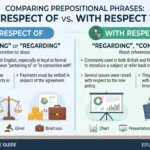
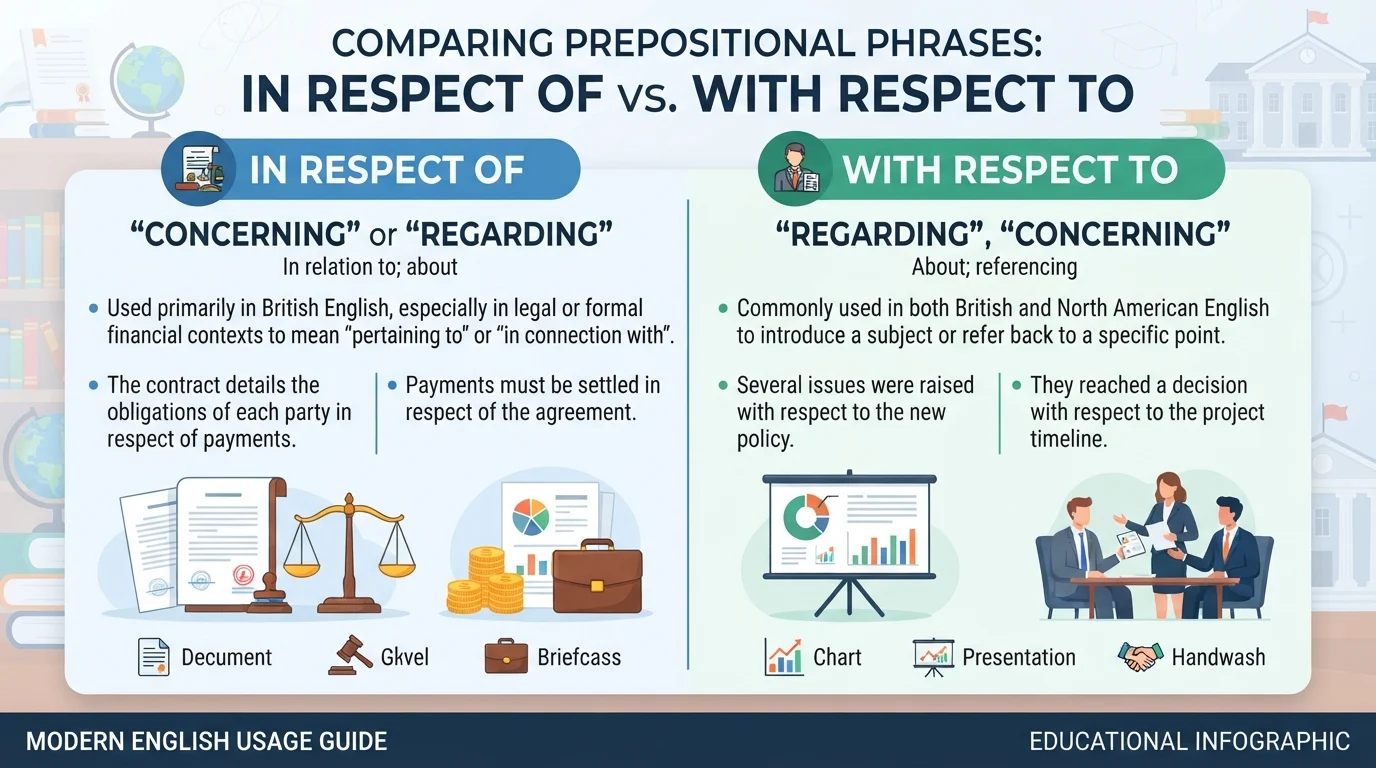
“In respect of” and “with respect to” both mean concerning, regarding, or in relation to something. They are often interchangeable, especially in formal English. However, “with respect to” is generally more common in modern professional and academic writing, while “in respect of” is frequently found in legal, administrative, and formal contexts.
Why Do People Confuse In Respect Of and With Respect To?
People confuse these expressions because they perform a similar grammatical function. Both introduce a subject or matter that someone wants to discuss, explain, or refer to.
For example:
- In respect of your application, we will contact you soon.
- With respect to your application, we will contact you soon.
Both sentences communicate that the message concerns the application.
The confusion also comes from the word “respect.” In everyday English, respect usually means admiration, consideration, or politeness. However, in these expressions, it has a different meaning. It refers to a connection, relationship, or particular aspect of something.
1. In Respect Of: Meaning and Definition
“In respect of” is a formal expression that means concerning, regarding, relating to, or in connection with something.
It is used to identify the particular subject, issue, or matter being discussed. The expression is especially common in formal documents, legal language, official correspondence, and administrative writing.
Examples of In Respect Of
- In respect of your complaint, we have started an investigation.
- The company has introduced new policies in respect of employee safety.
- We need further information in respect of your application.
- The manager made several changes in respect of the project.
- In respect of payment, customers must follow the stated instructions.
- The agreement contains important conditions in respect of property ownership.
- The government announced new regulations in respect of public transportation.
- We have received your comments in respect of the proposed changes.
- The school has updated its rules in respect of student attendance.
- In respect of your request, we will provide an official response shortly.
When Should You Use In Respect Of?
Use “in respect of” when you want to refer to a particular subject or matter in a formal context.
It is particularly suitable for:
- Legal documents and contracts
- Official letters and notices
- Administrative communication
- Business policies and regulations
- Formal reports
Example:
“The company has revised its policies in respect of workplace safety.”
This sentence means that the company has revised policies concerning workplace safety.
2. With Respect To: Meaning and Definition
“With respect to” is a formal expression that means concerning, regarding, relating to, or in reference to something.
It introduces the subject or specific aspect being discussed. It is widely used in academic writing, professional communication, business discussions, and formal explanations.
Examples of With Respect To
- With respect to your question, I would like to clarify one point.
- The report provides useful information with respect to climate change.
- We have made several improvements with respect to customer service.
- With respect to your application, everything appears to be in order.
- The teacher explained the rules with respect to examination procedures.
- There are several differences with respect to quality and performance.
- The company has introduced new measures with respect to employee benefits.
- With respect to the budget, we need to make a few adjustments.
- The research focuses on changes with respect to consumer behavior.
- With respect to your suggestion, we will consider it carefully.
When Should You Use With Respect To?
Use “with respect to” when introducing a topic, question, issue, or particular aspect of a discussion.
It is especially useful in:
- Academic writing
- Business communication
- Professional emails
- Reports and presentations
- Formal discussions
- Explanations involving different aspects of a subject
Example:
“With respect to your proposal, we have identified three areas that need improvement.”
This means that the three areas of improvement relate to your proposal.
3. Comparison Table: In Respect Of vs. With Respect To
| Point | In Respect Of | With Respect To |
|---|---|---|
| Meaning | Concerning or regarding | Concerning or regarding |
| Grammar | Correct expression | Correct expression |
| Formality | Formal | Formal |
| Common contexts | Legal and administrative writing | Academic and professional writing |
| Modern usage | Less common in some contexts | Generally more common |
| Function | Introduces a subject or matter | Introduces a subject or specific aspect |
| Interchangeability | Often interchangeable | Often interchangeable |
4. When to Use Each Expression
Although both expressions have similar meanings, choosing the right one can make your writing sound more natural.
Use In Respect Of in Formal and Legal Contexts
“In respect of” is particularly suitable for official, legal, and administrative language.
Examples:
- The contract includes provisions in respect of confidential information.
- The company has received several complaints in respect of its services.
- New regulations have been introduced in respect of workplace conditions.
Use With Respect To in Academic and Professional Writing
“With respect to” is a natural choice when discussing a particular subject, point, or aspect.
Examples:
- With respect to the research findings, further analysis is necessary.
- We need to make improvements with respect to product quality.
- With respect to your question, the answer depends on the circumstances.
Can You Use Them Interchangeably?
Yes. In many sentences, both expressions are grammatically correct and communicate essentially the same meaning.
For example:
- In respect of the new policy, employees must follow the updated guidelines.
- With respect to the new policy, employees must follow the updated guidelines.
Both sentences refer to the new policy.
However, the expressions may not always sound equally natural in every context. Consider your audience, writing style, and the type of document you are preparing.
5. Common Mistakes to Avoid
Even though these expressions are easy to understand, English learners sometimes make mistakes when using them.
Mistake 1: Thinking Respect Always Means Admiration
Incorrect understanding: Both expressions must refer to showing admiration or politeness.
Correct understanding: In these expressions, “respect” means relation, connection, or reference to a subject.
Mistake 2: Assuming One Expression Is Grammatically Incorrect
Some people believe that “in respect of” is incorrect and that only “with respect to” is acceptable.
That is not true. Both expressions are established and grammatically correct.
Mistake 3: Confusing With Respect To and With Respect
These expressions have different meanings.
- With respect to: Concerning or regarding something.
- With respect: In a polite or considerate manner, or showing admiration.
Examples:
- With respect to your request, we will respond tomorrow.
- I disagree with your opinion, but I will discuss it with respect.
Mistake 4: Using Them Too Frequently
Both expressions are relatively formal. Repeating them throughout a paragraph can make your writing sound unnecessarily complicated.
Instead, consider simpler alternatives such as “about,” “regarding,” or “concerning.”
6. Memory Trick: How to Remember the Difference
Use this simple memory trick:
- In respect of = In connection with something.
- With respect to = Regarding a particular subject or aspect.
Remember that both expressions can mean “concerning” or “regarding.” The distinction is mainly about context and writing style, not a strict difference in meaning.
If you are unsure which expression to choose, “with respect to” is often a natural option in modern formal and professional writing.
7. American vs. British English
Both “in respect of” and “with respect to” are used in British and American English.
There is no major difference in their basic meanings between the two varieties of English.
However, “in respect of” is particularly familiar in British legal and administrative writing. “With respect to” is widely used in both American and British academic and professional contexts.
Examples:
- British English: The regulations were amended in respect of employee protection.
- American English: With respect to employee protection, the regulations were amended.
These are tendencies in usage, not strict regional rules. Both expressions can be understood by English speakers in either variety.
8. Similar Words and Expressions
If you want to avoid repeating “in respect of” or “with respect to,” you can use several alternatives.
| Expression | Meaning | Example |
|---|---|---|
| Regarding | Concerning something | Regarding your request, we need more information. |
| Concerning | About a particular subject | I received an email concerning the meeting. |
| In relation to | Connected with something | We discussed the changes in relation to the project. |
| In connection with | Associated with something | The investigation concerns an incident in connection with the contract. |
| As regards | Regarding or concerning | As regards your application, we will contact you soon. |
| About | On the subject of something | We need to talk about your proposal. |
| Pertaining to | Relating to something | Please read the instructions pertaining to safety. |
9. Final Verdict: In Respect Of or With Respect To?
Both “in respect of” and “with respect to” are correct English expressions. They generally mean concerning, regarding, or in relation to something.
The main difference is their typical usage and tone:
- Use “in respect of” when referring to a matter in formal, legal, or administrative writing.
- Use “with respect to” when introducing a subject, question, or particular aspect in academic, professional, or business communication.
If you want a broadly suitable expression for modern formal writing, “with respect to” is often a good choice. However, “in respect of” is equally valid when it fits the context.
10. Frequently Asked Questions (FAQs)
1. Is it in respect of or with respect to?
Both are correct. They generally mean concerning, regarding, or relating to something. The choice depends mainly on context and writing style.
2. What does in respect of mean?
“In respect of” means concerning, regarding, or in connection with something. It is commonly used in formal, legal, and administrative writing.
Example: In respect of your complaint, we will provide an update soon.
3. What does with respect to mean?
“With respect to” means concerning, regarding, or in reference to a particular subject or aspect.
Example: With respect to your question, I have an additional explanation.
4. Is with respect to more formal than in respect of?
Both expressions are formal. “With respect to” is widely used in professional and academic writing, while “in respect of” is particularly common in legal and administrative contexts.
5. Can I use in respect of and with respect to interchangeably?
Yes. They are interchangeable in many sentences because they have similar meanings. However, one may sound more natural than the other depending on the context.
6. Is with respect to grammatically correct?
Yes. “With respect to” is a standard English expression used to introduce a subject, issue, or specific aspect.
7. What is a simpler alternative to with respect to?
You can use “about,” “regarding,” or “concerning.” These alternatives are often shorter and more natural, especially in everyday communication.
Remember This
- “In respect of” means concerning or in connection with something.
- “With respect to” means concerning or regarding a particular subject.
- Both expressions are grammatically correct.
- Both are used in British and American English.
- “In respect of” is common in legal and administrative writing.
- “With respect to” is widely used in academic and professional communication.
- You can often use them interchangeably.
Conclusion
“In respect of” and “with respect to” are two formal English expressions with very similar meanings. Both are used to introduce a subject, matter, or issue that someone wants to discuss. Although they are often interchangeable, their typical contexts and levels of naturalness can vary. “In respect of” is frequently associated with legal and administrative language, while “with respect to” is widely used in academic, business, and professional writing.
The easiest way to remember their usage is to understand that both can mean “concerning” or “regarding.” Choose the expression that sounds most natural in your sentence, and do not use either one simply to make your writing sound more formal. Clear and straightforward English is usually the best choice.