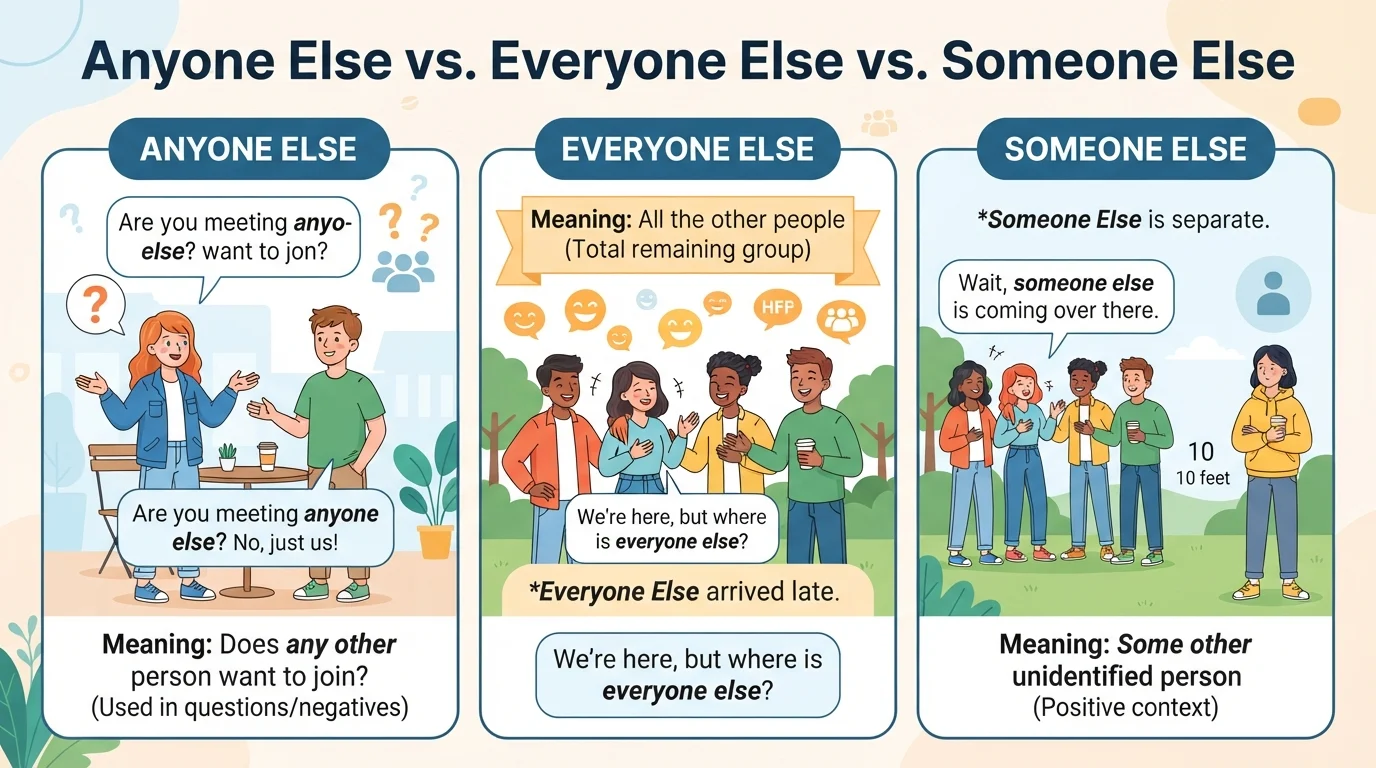
Do you sometimes get confused about If to say “anyone else,” “everyone else,” or “someone else”? These three expressions are common in everyday English, but they have different meanings. Choosing the wrong one can change the meaning of your sentence or make your message unclear.
The main difference is that anyone else refers to any other person, everyone else refers to all the other people in a group, and someone else refers to another person whose identity is not specified.
For example, “Does anyone else want coffee?” asks whether another person wants coffee. “Everyone else wants coffee” means all the other people want it. Meanwhile, “Someone else wants coffee” means another person wants it, but you do not identify that person.
In this guide, you will learn the meanings, grammatical differences, sentence structures, and practical examples of all three expressions.
Quick Answer: Anyone Else vs. Everyone Else vs. Someone Else
Here is the simplest way to understand these expressions:
- Anyone else: Any other person. Commonly used in questions and negative statements.
- Everyone else: All the other people in a particular group.
- Someone else: Another person whose identity is unknown or not mentioned.
Examples:
- Does anyone else know the answer?
- Everyone else has already left.
- Someone else took my seat.
The key difference is that anyone refers to any person, everyone refers to all people in a group, and someone refers to one unspecified person.
What Does Anyone Else Mean?
“Anyone else” means any other person besides the person or people already mentioned or considered.
It is commonly used in questions to ask whether another person shares an opinion, has a particular experience, or wants to do something.
It can also appear in negative statements to mean not another person.
Examples of Anyone Else in Sentences
- Does anyone else want to join us?
Is there another person who wants to join us? - Is anyone else coming to the party?
Are any other people coming to the party? - Does anyone else have a question?
Is there another person who wants to ask something? - I don’t think anyone else knows about this.
I think no other person knows about it. - Has anyone else experienced this problem?
Have any other people experienced the same problem? - Would anyone else like a cup of tea?
Is there another person who wants tea? - I couldn’t find anyone else to help me.
I couldn’t find another person who could help.
When Should You Use Anyone Else?
Use “anyone else” when:
- Asking whether another person is interested in something.
- Asking whether another person has a particular experience.
- Finding out whether any other person is available.
- Making a negative statement about other people.
For example:
- Does anyone else agree with me?
- Is anyone else working today?
- I don’t know if anyone else noticed the mistake.
What Does Everyone Else Mean?
“Everyone else” means all the other people in a particular group, excluding the person or people already mentioned.
Unlike “anyone else,” which refers to any possible additional person, “everyone else” refers to the entire remaining group.
Examples of Everyone Else in Sentences
- Everyone else has already arrived.
All the other people have arrived. - Everyone else agreed with the decision.
All the other people supported the decision. - I finished my work before everyone else.
I completed my work before all the other people. - Everyone else was invited to the wedding.
All the other people received invitations. - She stayed home while everyone else went shopping.
All the other people went shopping, but she did not. - Everyone else knows what happened.
All the other people know about the situation. - He arrived earlier than everyone else.
He arrived before all the other people.
When Should You Use Everyone Else?
Use “everyone else” when you are talking about all the remaining people in a group.
For example:
- Everyone else is ready.
- Everyone else has completed the assignment.
- I want to be treated like everyone else.
- Everyone else went home after the meeting.
What Does Someone Else Mean?
“Someone else” means another person whose identity is unknown, unspecified, or not important to the conversation.
It generally refers to one additional person, rather than an entire group.
Examples of Someone Else in Sentences
- Someone else took my umbrella.
Another person took my umbrella, but I do not know who. - You should ask someone else for help.
You should ask another person to help you. - I thought someone else was responsible for the task.
I believed another person was responsible. - Someone else called while you were away.
Another person called, but their identity is not mentioned. - She wants to work with someone else.
She wants to work with another person. - Someone else has already booked the room.
Another person has booked the room. - If you don’t like this option, choose someone else.
Select another person instead.
When Should You Use Someone Else?
Use “someone else” when:
- Referring to another person without identifying them.
- Suggesting that another person should do something.
- Explaining that an unidentified person performed an action.
- Referring to a person other than the one already mentioned.
For example:
- Someone else can answer that question.
- I need someone else to review this document.
- Perhaps someone else knows the way.
Anyone Else vs. Everyone Else vs. Someone Else: Key Differences
Although these expressions look similar, they are not interchangeable.
| Expression | Meaning | Common Use | Example |
|---|---|---|---|
| Anyone else | Any other person | Questions and negative statements | Does anyone else agree? |
| Everyone else | All the other people | Referring to an entire remaining group | Everyone else is waiting. |
| Someone else | Another unspecified person | Referring to one unidentified person | Someone else called you. |
Compare These Three Sentences
Consider the following examples:
1. Does anyone else want to come?
You are asking whether any additional person wants to come. The answer could be yes or no.
2. Everyone else wants to come.
You are saying that all the other people in the group want to come.
3. Someone else wants to come.
You are saying that another person wants to come, but you are not identifying that person.
These sentences may describe a similar situation, but they communicate different information.
Anyone Else vs. Someone Else
These two expressions are sometimes confusing because both can refer to another person.
However, their meanings are different.
- Anyone else refers to any other person, without specifying who.
- Someone else refers to one unspecified person.
Compare:
- Does anyone else want to participate?
- Someone else wants to participate.
The first sentence asks whether any additional person wants to participate. The second states that another person wants to participate.
More examples:
| Anyone Else | Someone Else |
|---|---|
| Does anyone else know him? | Someone else knows him. |
| Is anyone else coming? | Someone else is coming. |
| I don’t think anyone else can help. | I think someone else can help. |
| Did anyone else call? | Someone else called. |
Everyone Else vs. Someone Else
The main difference is the number of people being referred to.
- Everyone else means all the other people in a group.
- Someone else means one other unspecified person.
Examples:
Everyone else has left the office.
All the other people have left.
Someone else has left the office.
Another person has left, but you do not know or mention who.
Compare these examples:
- Everyone else passed the exam.
- Someone else passed the exam.
- Everyone else received an invitation.
- Someone else received an invitation.
The first sentence in each pair refers to all the other people, while the second refers to one unspecified person.
Is Anyone Else Singular or Plural?
Although “anyone else” can refer to any person in a group, it is grammatically singular in standard English.
Therefore, it usually takes a singular verb.
Examples:
- Is anyone else available?
- Does anyone else know the answer?
- Has anyone else arrived?
The same grammatical rule applies to “everyone else” and “someone else.”
Examples:
- Everyone else is ready.
- Someone else has called.
- Everyone else was invited.
Important: Words ending in -one are generally treated as singular in standard English, even when they refer to people collectively.
Common Mistakes to Avoid
Mistake 1: Using a Plural Verb with Anyone Else
Incorrect: Does anyone else know the answers?
Correct: Does anyone else know the answers?
Explanation: The subject “anyone else” is singular, so use “does,” not “do.” The verb “know” remains in its base form after “does.”
Mistake 2: Confusing Someone Else with Everyone Else
Incorrect meaning: Someone else means all the other people.
Correct meaning: Someone else refers to another unspecified person, while everyone else refers to all the other people in a group.
Mistake 3: Using Anyone Else in Place of Everyone Else
Incorrect for the intended meaning: Anyone else has finished the assignment.
Correct: Everyone else has finished the assignment.
Explanation: If you mean that all the other people have finished, use “everyone else.”
Mistake 4: Forgetting the Word Else
The word “else” adds the meaning of another or additional person.
Compare:
- Does anyone know?
- Does anyone else know?
The first asks whether any person knows. The second asks whether any additional person knows.
Easy Ways to Remember the Difference
Here is a simple memory trick:
- Anyone else = Any other person?
- Everyone else = All the other people.
- Someone else = One other person.
Think about a classroom:
- Does anyone else have a question? You are asking whether another student has a question.
- Everyone else has completed the test. All the other students have finished.
- Someone else borrowed my pen. One unidentified student borrowed it.
This simple distinction will help you use all three expressions correctly.
Frequently Asked Questions
1. What is the difference between anyone else and everyone else?
“Anyone else” refers to any additional person and is commonly used in questions. “Everyone else” refers to all the other people in a group. For example, “Does anyone else agree?” asks about additional people, while “Everyone else agrees” describes the whole remaining group.
2. What is the difference between anyone else and someone else?
“Anyone else” refers to any other person, often in a question or negative statement. “Someone else” refers to one unspecified person. For example, “Does anyone else want coffee?” is a question, while “Someone else wants coffee” is a statement.
3. What is the difference between everyone else and someone else?
“Everyone else” means all the other people in a group, while “someone else” means another unspecified person. For example, “Everyone else has left” means all the other people have gone, while “Someone else has left” means one other person has gone.
4. Is anyone else singular or plural?
“Anyone else” is grammatically singular in standard English. It takes singular verb forms, such as “is,” “does,” and “has.” For example, “Is anyone else coming?”
5. Is everyone else singular or plural?
“Everyone else” is grammatically singular, even though it refers to all the other people in a group. For example, say “Everyone else is ready,” not “Everyone else are ready.”
6. Is someone else singular or plural?
“Someone else” is singular because it refers to one unspecified person. For example, “Someone else has taken my seat.”
7. Can I use anyone else in a positive sentence?
Yes. Although “anyone else” is especially common in questions and negative statements, it can also appear in positive sentences. For example, “Anyone else interested in joining can contact me.”
8. Can everyone else and anybody else mean the same thing?
Not usually. “Everybody else” means all the other people, while “anybody else” refers to any other person. For example, “Everybody else is here” means all the other people have arrived. “Is anybody else here?” asks whether another person is present.
Conclusion
“Anyone else,” “everyone else,” and “someone else” are common English expressions that refer to other people, but they have different meanings.
Use anyone else when asking If any additional person is involved or when making a negative statement. Use everyone else when referring to all the other people in a group. Use someone else when referring to one unspecified person.
Remember these simple meanings:
- Anyone else means any other person.
- Everyone else means all the other people.
- Someone else means another unspecified person.
Once you understand these distinctions, you can use all three expressions naturally and confidently in everyday English conversations and writing.