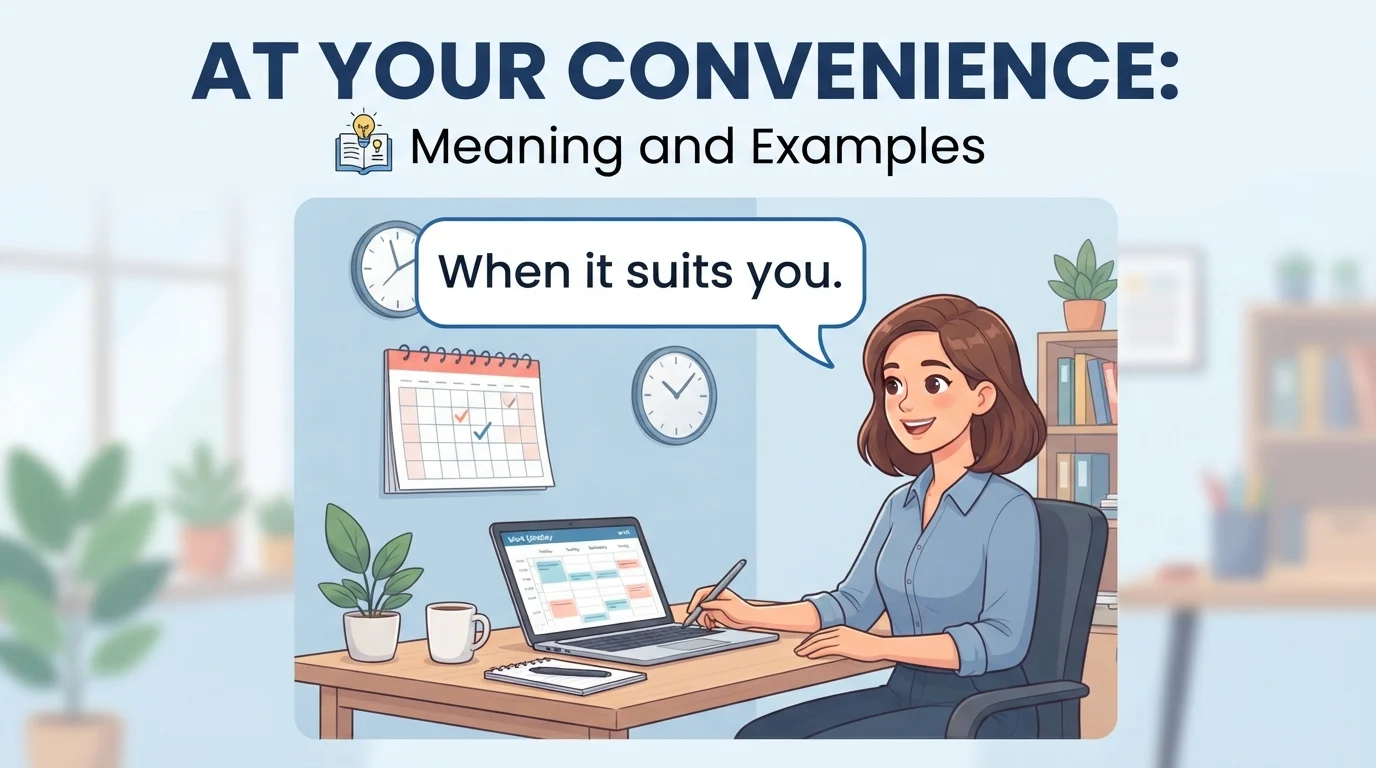
The phrase “at your convenience” is commonly used in English to make polite requests, arrange meetings, and communicate professionally. It means that someone can do something at a time that suits them or when they have time available. You will often see this expression in emails, workplace conversations, business messages, and formal requests.
For example, if someone says, “Please call me at your convenience,” they are asking you to call whenever it is suitable for you, rather than demanding an immediate response. The phrase sounds polite and respectful because it acknowledges that the other person may have other responsibilities.
However, “at your convenience” does not always mean “whenever you want.” Depending on the situation, there may still be an expectation that the task will be completed within a reasonable period. In this guide, you will learn the exact meaning of the phrase, how to use it naturally, common mistakes to avoid, and how it differs from similar expressions.
Quick Answer: At Your Convenience Meaning
“At your convenience” means at a time that is suitable or convenient for you. It is a polite expression used when asking someone to do something, contact you, arrange a meeting, or complete a task whenever they have time.
Examples:
- Please call me at your convenience.
- You can visit my office at your convenience.
- Kindly review the document at your convenience.
What Does “At Your Convenience” Mean?
The phrase “at your convenience” means when it is suitable for you or when you have time available to do something.
It is often used to show politeness and flexibility. Instead of telling someone to do something immediately, you allow them to choose a suitable time.
For example:
“Please send me the report at your convenience.”
This means that the person should send the report when they have a suitable opportunity to do so. It does not necessarily mean that they can delay it indefinitely. If the report has a deadline, that deadline should be stated separately.
The expression is especially useful when communicating with colleagues, clients, managers, teachers, customers, or people you do not know very well.
Examples of “At Your Convenience” in Sentences
Here are 15 examples showing how to use the phrase in everyday and professional English.
- Please call me at your convenience.
- You may visit my office at your convenience.
- Kindly review the attached document at your convenience.
- Please let me know your availability at your convenience.
- You can complete the form at your convenience.
- I would appreciate it if you could reply at your convenience.
- Feel free to contact me at your convenience.
- Please schedule a meeting at your convenience.
- You can collect your documents at your convenience.
- Kindly send me the details at your convenience.
- Please check the information at your convenience.
- You may contact our support team at your convenience.
- I would like to discuss this matter with you at your convenience.
- Please arrange a suitable time to meet at your convenience.
- Let me know when you are available, and we can talk at your convenience.
These examples demonstrate how the expression can make requests sound less demanding and more respectful.
How to Use “At Your Convenience” in Different Situations
1. In Professional Emails
“At your convenience” is frequently used in workplace emails because it sounds courteous and professional.
Examples:
- Please review the proposal at your convenience.
- I would appreciate your feedback at your convenience.
- Kindly share the updated file at your convenience.
- Please let me know when you can discuss this matter at your convenience.
Example email:
Subject: Request for Document Review
Dear Alex,
I have attached the revised document for your review. Kindly review it at your convenience and share any suggestions you may have.
Best regards,
Sam
2. In Everyday Conversations
Although the phrase is common in formal situations, it can also be used in ordinary conversations.
Examples:
- Call me at your convenience.
- Visit whenever it is convenient for you.
- You can come over at your convenience.
- Let me know when you have time to talk.
In casual conversations, people often use simpler alternatives such as “when you have time” or “whenever you’re free.”
3. In Business Communication
The phrase is useful when communicating with clients, customers, suppliers, or business partners.
Examples:
- Please confirm your order at your convenience.
- You may schedule a consultation at your convenience.
- Kindly review the contract at your convenience.
- Please contact our office at your convenience.
However, if the task is urgent, it is better to provide a clear deadline instead of relying on this phrase alone.
4. When Arranging Meetings
You can use “at your convenience” when offering flexibility about meeting times.
Examples:
- I would be happy to meet with you at your convenience.
- Please suggest a suitable time for a meeting.
- We can discuss the proposal at your convenience.
A more natural alternative when scheduling an actual meeting is often:
“Please let me know a time that works for you.”
This makes it easier for the other person to suggest a specific date and time.
“At Your Convenience” vs “Whenever You Are Free”
Both expressions suggest flexibility, but they differ slightly in tone.
| Expression | Meaning | Tone |
|---|---|---|
| At your convenience | When it suits you | Polite and professional |
| Whenever you are free | When you have free time | Friendly and conversational |
| When you have time | When you can spare some time | Natural and informal |
| At a suitable time | At an appropriate time | Neutral or formal |
| As soon as possible | As quickly as possible | Urgent |
| At your earliest convenience | As soon as reasonably possible for you | Polite, often with some urgency |
Examples:
- Formal: Please review the report at your convenience.
- Casual: Check the report whenever you’re free.
- Urgent: Please review the report as soon as possible.
Choose the expression that matches the tone and urgency of your message.
“At Your Convenience” vs “At Your Earliest Convenience”
These phrases are similar, but they do not communicate exactly the same level of urgency.
At your convenience means that the person can do something when it suits them.
Example: “Please call me at your convenience.”
At your earliest convenience means that the person should do something as soon as they reasonably can.
Example: “Please send the signed contract at your earliest convenience.”
The second phrase suggests a stronger expectation of prompt action, even though it remains polite.
If you need something by a specific time, provide the deadline clearly.
For example: “Please send the signed contract by Thursday.”
Is “At Your Convenience” Formal or Informal?
“At your convenience” is generally considered polite and somewhat formal. It is especially appropriate in professional communication, business emails, official requests, and conversations where courtesy matters.
It can also be used in everyday speech, but it may sound more formal than necessary among close friends.
Compare these examples:
- Professional: Kindly contact me at your convenience.
- Neutral: Please call me when you have time.
- Casual: Give me a call when you’re free.
All three expressions are understandable. The best choice depends on your relationship with the other person and the situation.
Common Mistakes When Using “At Your Convenience”
Mistake 1: Saying “On Your Convenience”
Incorrect: Please call me on your convenience.
Correct: Please call me at your convenience.
The standard expression uses the preposition “at,” not “on.”
Mistake 2: Saying “In Your Convenience”
Incorrect: Please send the file in your convenience.
Correct: Please send the file at your convenience.
Use “at” when referring to a time that suits someone.
Mistake 3: Using It for an Urgent Request Without a Deadline
“At your convenience” usually suggests flexibility. If something is urgent, the phrase may not communicate the required urgency clearly enough.
Unclear: Please fix this issue at your convenience.
Clearer: Please fix this issue by 3 p.m. today.
You can still be polite while giving a deadline.
Mistake 4: Assuming It Means “Whenever You Want”
The phrase gives someone flexibility, but it does not automatically remove all expectations or deadlines.
For example, if a manager asks you to submit a report at your convenience, you should consider the work context and any previously agreed deadline.
Mistake 5: Using It Too Often
Repeating the phrase in every sentence can make your email sound stiff or repetitive.
Instead, you can use alternatives such as:
- When you have a moment
- Whenever you are available
- When it suits you
- At a suitable time
Synonyms and Alternatives for “At Your Convenience”
Here are some useful alternatives with their meanings.
| Alternative | Best use |
|---|---|
| When you have time | Everyday conversations |
| Whenever you’re free | Friendly messages |
| When it suits you | Flexible arrangements |
| At a time that works for you | Scheduling meetings |
| When convenient for you | Polite requests |
| At your earliest convenience | Requests that need prompt attention |
| When you get a chance | Casual requests |
| At a mutually convenient time | Formal meeting arrangements |
Examples:
- Please reply when you have time.
- We can meet at a time that works for you.
- Please send the information when you get a chance.
- Let us arrange a meeting at a mutually convenient time.
Remember that these alternatives are similar but not identical. Some sound more casual, while others suggest greater urgency.
How to Reply to “At Your Convenience”
If someone asks you to do something at your convenience, you can respond in several ways.
If you can do it soon:
- Sure, I will take care of it shortly.
- Of course, I will send it today.
- Certainly, I will review it and get back to you.
If you need to arrange a time:
- Thank you. I am available tomorrow afternoon.
- Certainly. Please let me know which time works best for you.
- I can discuss this with you on Friday.
If you are busy:
- Thank you for your patience. I will get back to you when I am available.
- I am currently occupied, but I will respond as soon as I can.
- I should be able to review it by tomorrow.
Choose a response that accurately reflects your availability and any deadline you need to meet.
Frequently Asked Questions
1. What does “at your convenience” mean in simple English?
It means “when you have time” or “when it suits you.” It allows someone to choose a suitable time to do something.
2. Is “at your convenience” polite?
Yes. It is a polite expression often used in emails, business communication, and professional requests.
3. Can I use “at your convenience” in an email?
Yes. You can use it when asking someone to review a document, return a call, send information, or arrange a meeting.
Example: “Please review the attached file at your convenience.”
4. Is “at your convenience” the same as “as soon as possible”?
No. “At your convenience” suggests flexibility, while “as soon as possible” communicates greater urgency.
5. Is “at your earliest convenience” more urgent?
Yes. It politely asks the other person to act as soon as they reasonably can.
6. Is it correct to say “on your convenience”?
No. The standard expression is “at your convenience.”
7. Can I use “at your convenience” with my boss?
Yes. It is suitable for professional communication with a manager or supervisor. However, if you need a decision by a particular date, mention the deadline.
8. What is a simple alternative to “at your convenience”?
“When you have time” is a simple and natural alternative. “Whenever you’re free” is another good option for informal conversations.
Remember This
- Meaning: At a time that suits someone.
- Tone: Polite and professional.
- Correct expression: At your convenience.
- Incorrect expression: On your convenience.
- For urgency: Use “at your earliest convenience” or give a clear deadline.
- For casual conversations: Use “when you have time” or “whenever you’re free.”
Conclusion
“At your convenience” is a useful English expression that allows someone to choose a suitable time to complete a task, contact you, or arrange a meeting. It is especially helpful in professional emails and polite requests because it communicates respect for the other person’s time and responsibilities.
To use it correctly, remember that the standard phrase is “at your convenience,” not “on your convenience.” Also, consider the urgency of your request before using it. If you need something quickly, use “at your earliest convenience” or provide a specific deadline. With these simple rules, you can use the phrase confidently in both professional and everyday communication.