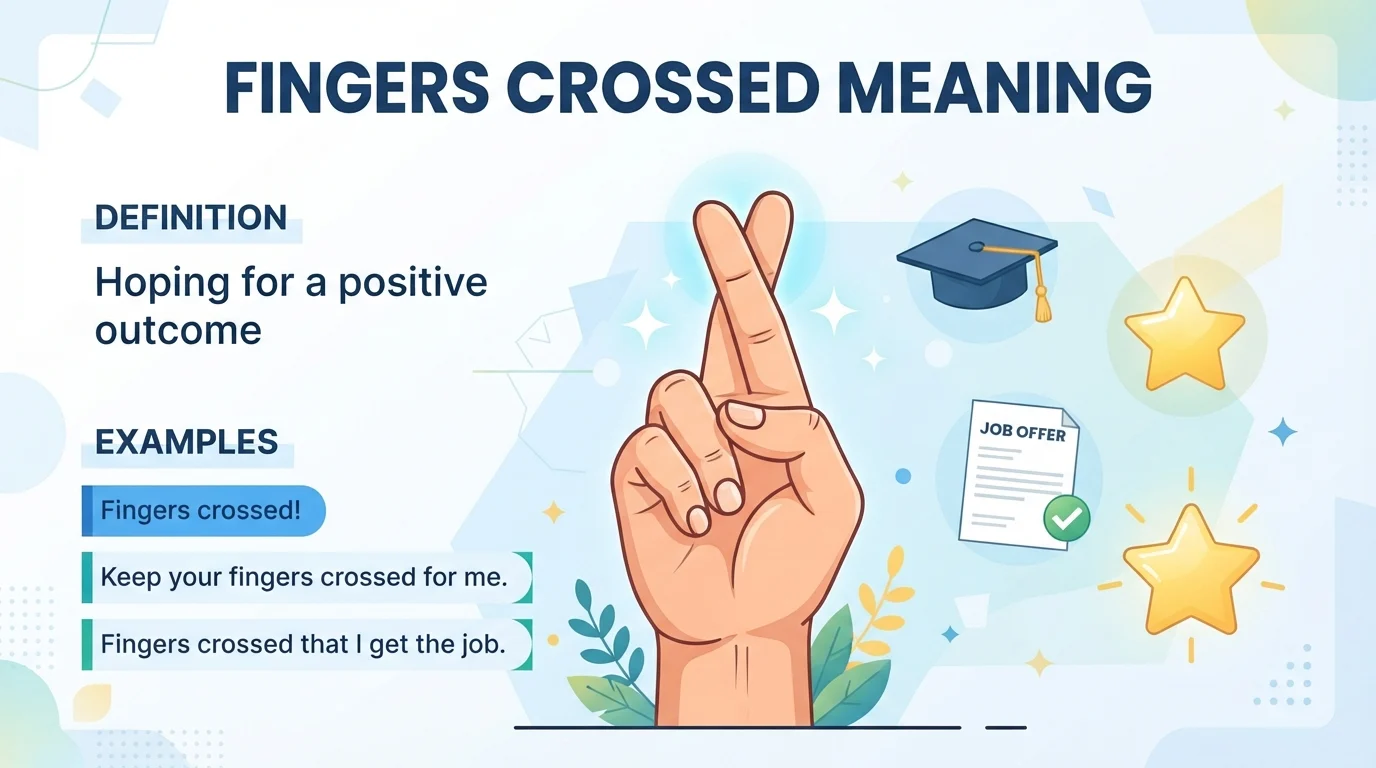
Have you ever heard someone say “Fingers crossed” before an exam, job interview, important meeting, or big announcement? This common English expression is used to express hope that something good will happen. When someone says “Fingers crossed,” they are wishing for good luck or hoping for a positive outcome.
For example, if your friend is waiting for the results of an examination, you might say, “Fingers crossed! I hope you pass.” The expression is often accompanied by a physical gesture in which a person crosses their index and middle fingers. Although it is informal, it is widely understood in everyday conversations, text messages, social media posts, and friendly communication. In this guide, you will learn the meaning of fingers crossed, its origin, correct usage, common examples, and the difference between related expressions such as “good luck” and “keep your fingers crossed.”
Quick Answer: What Does “Fingers Crossed” Mean?
“Fingers crossed” is an informal English expression that means hoping for good luck or a positive result. People use it when they want something to happen successfully but are not certain about the outcome.
Examples:
- Fingers crossed! I hope you get the job.
- My exam results come out tomorrow. Fingers crossed!
- We are waiting for good news. Keep your fingers crossed.
- Fingers crossed that everything goes well.
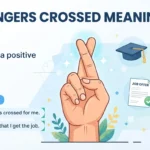
The expression is often accompanied by crossing the index and middle fingers as a gesture of hope or good luck.
Simple meaning: Fingers crossed = I hope things go well.
Why Do People Use the Expression “Fingers Crossed”?
People use this expression when they are hoping for something positive, especially when the outcome is uncertain or outside their control.
For example:
- Someone waiting for a job offer may say, “Fingers crossed!”
- A student waiting for examination results may say, “Fingers crossed that I pass.”
- A traveler hoping for good weather may say, “Fingers crossed for sunshine.”
The expression communicates hope without guaranteeing success. It is a friendly way to show optimism and support.
Fingers Crossed: Meaning, Definition, and Usage
Fingers crossed is an idiomatic expression used to wish for good luck or express hope that something will happen successfully.
It is associated with a physical gesture: crossing the index finger over the middle finger, or sometimes crossing the fingers of both hands.
What Does the Gesture Mean?
<AsyncImage query=”close up hand gesture crossing index finger over middle finger fingers crossed good luck white background” aspectRatio=”16:9″ width=”100%”/>
The crossed-fingers gesture is commonly associated with:
- Good luck
- Hope
- Positive expectations
- Wishing for success
- Hoping for a favorable result
For example, someone might physically cross their fingers while saying, “Fingers crossed, I hope everything works out.”
Examples of Fingers Crossed in Sentences
- Fingers crossed! I hope you get the job.
- I have my fingers crossed for your examination results.
- Fingers crossed that the weather stays sunny.
- We are hoping for good news, so fingers crossed.
- She has her fingers crossed for a successful interview.
- Fingers crossed that our team wins the final.
- I am keeping my fingers crossed for you.
- Fingers crossed that everything goes according to plan.
- He crossed his fingers before opening the envelope.
- We have our fingers crossed for a positive response.
- Fingers crossed that the flight is not delayed.
- I hope you get the promotion. Fingers crossed!
- They are keeping their fingers crossed for better results.
- Fingers crossed that we find a solution soon.
- She kept her fingers crossed while waiting for the announcement.
Origin of “Fingers Crossed”
The exact origin of the expression is uncertain, but crossing fingers has a long history as a symbol associated with luck, protection, and hope.
One commonly discussed explanation connects the gesture with the Christian cross. Over time, crossing fingers became a familiar way of expressing a wish for good fortune or protection.
Another explanation links the gesture to older European customs in which people crossed fingers to symbolize a shared wish or hope.
Today, the expression is widely used in English-speaking countries, and people do not necessarily associate it with any religious meaning. It is generally understood as a casual way to express hope for a good outcome.
When Should You Use “Fingers Crossed”?
Use this expression when you are hoping for something positive, particularly when the outcome is uncertain.
1. Before an Examination
Students often use this expression when waiting for a test, exam, or result.
Examples:
- My final examination is tomorrow. Fingers crossed!
- Fingers crossed that I get good marks.
- I have studied hard, so I am keeping my fingers crossed.
2. During a Job Search
You can use it when waiting for an interview result, job offer, or promotion.
Examples:
- I had a great interview today. Fingers crossed!
- Fingers crossed that I get the position.
- I am waiting for the company’s response. Keep your fingers crossed.
3. Before an Important Event
Use it when hoping that a planned event will go smoothly.
Examples:
- Fingers crossed that everything goes well at the wedding.
- We are hoping for good weather on Saturday.
- Fingers crossed that the event is a success.
4. When Waiting for Good News
It is suitable when someone is expecting an important decision or announcement.
Examples:
- I am waiting for my university admission letter. Fingers crossed!
- Fingers crossed that the medical test results are good.
- We hope to receive positive news soon.
5. In Everyday Conversations
You can also use it in casual conversations about ordinary situations.
Examples:
- Fingers crossed that the traffic is light.
- I hope the restaurant has a table available. Fingers crossed!
- Fingers crossed that I find my lost keys.
“Fingers Crossed” vs. “Keep Your Fingers Crossed”: What Is the Difference?
Both expressions communicate hope and good wishes, but they are used slightly differently.
Fingers crossed is a short expression of hope. It can be used independently as a reaction or comment.
Keep your fingers crossed is an instruction or request asking someone to continue hoping for a positive outcome.
| Expression | Meaning | Example |
|---|---|---|
| Fingers crossed | I hope things go well. | Fingers crossed! |
| Keep your fingers crossed | Continue hoping for good luck. | Keep your fingers crossed for me. |
| I’ve got my fingers crossed | I am hoping for success. | I’ve got my fingers crossed for the interview. |
| Cross your fingers | Make the gesture or hope for luck. | Cross your fingers that we win. |
| My fingers are crossed | I am wishing for a positive result. | My fingers are crossed for you. |
Compare These Sentences
- Fingers crossed! (I hope something good happens.)
- Keep your fingers crossed for me. (Please hope that things go well for me.)
- I’ve got my fingers crossed. (I am hoping for a positive result.)
- Cross your fingers! (Hope for good luck.)
All these expressions are natural in informal English.
“Fingers Crossed” vs. “Good Luck”: What Is the Difference?
Both expressions are used to communicate positive wishes, but they have slightly different meanings.
Good luck directly wishes someone success or a favorable outcome.
Fingers crossed expresses hope that something will happen successfully, especially when the result is uncertain.
| Expression | Meaning | Example |
|---|---|---|
| Fingers crossed | Hoping for a good outcome | Fingers crossed that you pass. |
| Good luck | Wishing someone success | Good luck with your exam! |
| Best of luck | Expressing strong good wishes | Best of luck with your interview. |
| All the best | Wishing someone success and happiness | All the best for your new job. |
| I hope so | Expressing a desire for something to happen | I hope you get the position. |
| Here’s hoping | Expressing hope for a positive result | Here’s hoping for good news. |
Remember: You can use “good luck” to wish someone success directly, while “fingers crossed” emphasizes hope when the outcome is not certain.
50 Examples of “Fingers Crossed” in Different Situations
Here are practical examples to help you understand and use this expression naturally.
Everyday Conversations
- Fingers crossed that the weather stays nice.
- Fingers crossed that we reach on time.
- I hope the shop is still open. Fingers crossed!
- Fingers crossed that I find my wallet.
- Let’s keep our fingers crossed.
- Fingers crossed that everything works out.
- I have my fingers crossed for a good day.
- Fingers crossed that the traffic is not too bad.
- Hopefully, we will get a table. Fingers crossed!
- Fingers crossed that nothing goes wrong.
Education and Examinations
- Fingers crossed that I pass my final exam.
- I have my fingers crossed for my examination results.
- Fingers crossed that our teacher likes the project.
- I hope I get admission to my dream university. Fingers crossed!
- Keep your fingers crossed for my scholarship application.
- Fingers crossed that I score well in mathematics.
- We have studied hard. Now, fingers crossed!
- Fingers crossed that the results are announced soon.
- I am waiting for my grades. Fingers crossed!
- Fingers crossed that I get selected for the program.
Jobs and Career
- Fingers crossed that I get the job.
- I had a successful interview. Fingers crossed!
- Keep your fingers crossed for my promotion.
- Fingers crossed that the company accepts my application.
- I hope they offer me the position. Fingers crossed!
- Fingers crossed that my business proposal is approved.
- We are waiting for the client’s response. Fingers crossed!
- Fingers crossed that the meeting goes well.
- I hope my manager appreciates my work. Fingers crossed!
- Fingers crossed that we sign the contract.
Relationships and Personal Life
- Fingers crossed that everything works out between us.
- I hope she says yes. Fingers crossed!
- Fingers crossed that we can meet this weekend.
- Keep your fingers crossed for our family.
- Fingers crossed that our plans work out.
- I hope he arrives safely. Fingers crossed!
- Fingers crossed that we have a wonderful holiday.
- I am hoping for a positive response. Fingers crossed!
- Fingers crossed that our friendship stays strong.
- I hope everything goes smoothly at the wedding.
Travel, Health, and Special Events
- Fingers crossed that our flight is on time.
- Fingers crossed that we get good weather.
- I hope the road is clear. Fingers crossed!
- Fingers crossed that the doctor gives us good news.
- Keep your fingers crossed for a successful operation.
- Fingers crossed that the event attracts a big audience.
- I hope the concert is not canceled. Fingers crossed!
- Fingers crossed that the delivery arrives today.
- We are hoping for a safe journey. Fingers crossed!
- Fingers crossed that the new project is successful.
Common Mistakes When Using “Fingers Crossed”
Although the expression is simple, learners sometimes make mistakes with its form and meaning.
Mistake 1: Saying “Finger Crossed”
Incorrect: Finger crossed!
Correct: Fingers crossed!
Why? The conventional idiom uses the plural noun fingers.
Mistake 2: Using “Fingers Cross” Instead of “Fingers Crossed”
Incorrect: Fingers cross!
Correct: Fingers crossed!
Why? The fixed expression uses crossed, the past participle of cross.
Mistake 3: Thinking “Fingers Crossed” Guarantees Success
Incorrect understanding: Fingers crossed means something will definitely happen.
Correct understanding: It means you hope something good will happen.
Why? The expression communicates hope, not certainty.
Mistake 4: Using It in Every Formal Situation
“Fingers crossed” is generally informal. In highly formal writing, alternatives such as “We hope for a positive outcome” or “We wish you every success” may be more appropriate.
Mistake 5: Confusing “Fingers Crossed” With “Cross Your Fingers”
Both are correct, but their sentence structures differ.
- Fingers crossed! (A short expression of hope.)
- Cross your fingers! (An instruction or request.)
Can “Fingers Crossed” Be Used in Formal Writing?
Yes, but it is more common in informal and conversational English.
You can use it in:
- Text messages
- Friendly emails
- Social media captions
- Casual workplace conversations
- Everyday discussions
For formal business letters, academic writing, or official announcements, more professional alternatives are often better.
Examples:
Informal: Fingers crossed that the proposal gets approved!
Formal: We hope that the proposal will receive approval.
Informal: Fingers crossed for your success!
Formal: We wish you every success in your future endeavors.
Does “Fingers Crossed” Have a Physical Gesture?
Yes. The expression is associated with a hand gesture in which the index finger crosses over the middle finger.
<AsyncImage query=”person holding fingers crossed gesture index finger over middle finger close up hand” aspectRatio=”16:9″ width=”100%”/>
People use this gesture to express hope, wish for good luck, or show that they are hoping for a favorable result.
For example, someone waiting for an examination result might cross their fingers and say, “Fingers crossed!”
The gesture can also appear in photographs, cartoons, and social media posts as a symbol of hope.
Can “Fingers Crossed” Mean Something Different?
Yes. In some contexts, crossing your fingers behind your back has been associated with dishonesty or with secretly indicating that a promise should not count.
However, this is different from the usual expression “Fingers crossed,” which generally communicates hope or good luck.
For example:
- Fingers crossed that I get the job. (Hoping for success.)
- He crossed his fingers behind his back while making the promise. (A gesture traditionally associated with not intending to keep the promise.)
Context and the position of the gesture help determine the meaning.
American English vs. British English
There is no significant difference between American and British English in the meaning or everyday use of “fingers crossed.”
Both varieties use the expression to communicate hope or a wish for good luck.
Examples:
- American English: Fingers crossed that I get the job!
- British English: Fingers crossed that I get the job!
The expression is widely understood in both varieties and is also familiar to English speakers around the world.
Similar Idioms and Expressions
Learning similar expressions will help you expand your vocabulary and communicate more naturally.
| Expression | Meaning | Example |
|---|---|---|
| Fingers crossed | Hoping for good luck | Fingers crossed that we win. |
| Good luck | Wishing someone success | Good luck with your exam. |
| Best of luck | Wishing someone the best possible outcome | Best of luck with your new job. |
| Here’s hoping | Expressing hope | Here’s hoping for good news. |
| Touch wood | Hoping good fortune continues | I’ve never missed a flight, touch wood. |
| Knock on wood | Hoping to avoid bad luck | Everything is going well, knock on wood. |
| Keep your hopes up | Continue to feel optimistic | Keep your hopes up. |
| Wish me luck | Asking someone to hope for your success | Wish me luck for my interview. |
| In good hands | Being cared for by capable people | Your project is in good hands. |
| Break a leg | Wishing someone good luck, especially before a performance | Break a leg tonight! |
Final Verdict: What Does Fingers Crossed Mean?
“Fingers crossed” is a common English idiom that means hoping for good luck or wishing for a positive outcome. People use it when they are waiting for something important, such as examination results, a job offer, a business decision, or good news.
It is an informal expression that can stand alone or appear in a complete sentence.
Remember these examples:
- Fingers crossed! (I hope things go well.)
- Keep your fingers crossed for me. (Please hope that I succeed.)
- I’ve got my fingers crossed. (I am hoping for a good result.)
The expression does not guarantee success. It simply communicates hope, optimism, and good wishes.
Remember This
- Fingers crossed means hoping for good luck or a positive result.
- It is an informal English idiom.
- It is often accompanied by crossing the index and middle fingers.
- Use it when waiting for uncertain results or outcomes.
- Keep your fingers crossed asks someone to hope for your success.
- Good luck is a direct expression of positive wishes.
- The expression is common in both American and British English.
- It communicates hope, not certainty.
Frequently Asked Questions (FAQs)
1. What does fingers crossed mean in simple words?
“Fingers crossed” means hoping that something good will happen. It is commonly used when someone is waiting for a positive result or wishing for good luck.
2. Is fingers crossed a positive expression?
Yes. It is generally a positive expression that communicates hope, optimism, and good wishes.
3. How do you use fingers crossed in a sentence?
You can use it as a short expression or within a complete sentence.
Examples:
- Fingers crossed that I pass the exam.
- I have my fingers crossed for your success.
- Keep your fingers crossed for me.
4. What is the difference between fingers crossed and keep your fingers crossed?
“Fingers crossed” expresses your own hope for a positive outcome. “Keep your fingers crossed” asks someone else to continue hoping for a good result.
5. Is fingers crossed formal or informal?
It is mainly informal. It is suitable for conversations, text messages, friendly emails, and social media. In highly formal writing, “We hope for a positive outcome” may be more appropriate.
6. What does the fingers crossed hand gesture mean?
The gesture of crossing the index and middle fingers is commonly associated with good luck, hope, and positive expectations.
7. Can I say fingers crossed for you?
Yes. “Fingers crossed for you” is a natural informal expression. It means that you hope things go well for someone.
Example: I hope your interview goes well. Fingers crossed for you!
8. What is another way to say fingers crossed?
You can use:
- Good luck!
- Best of luck!
- Here’s hoping!
- I hope everything works out.
- Wishing you success.
- Keep your hopes up.
9. Does fingers crossed mean something will definitely happen?
No. It expresses hope that something will happen, not certainty. The outcome may still be uncertain.
10. Is fingers crossed used in American and British English?
Yes. The expression is commonly used in both American and British English with essentially the same meaning.
11. What does “I’ve got my fingers crossed” mean?
It means that you are hoping for a positive result or wishing for good luck.
Example: I’ve got my fingers crossed that the application gets approved.
12. Can I use fingers crossed in a text message?
Absolutely. It is very common in text messages and online conversations.
Example: My results come out tomorrow. Fingers crossed! 🤞
Conclusion
“Fingers crossed” is a popular English idiom that expresses hope, optimism, and a wish for good luck. It is commonly used when someone is waiting for an uncertain outcome, such as an examination result, job offer, interview decision, or important announcement. The expression can be used independently or as part of a complete sentence.
Remember that “fingers crossed” does not mean success is guaranteed. It simply communicates that you are hoping for the best. If you use it in a friendly conversation, text message, or social media post, it is a natural and widely understood way to express positive expectations.