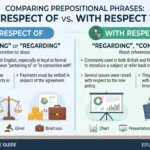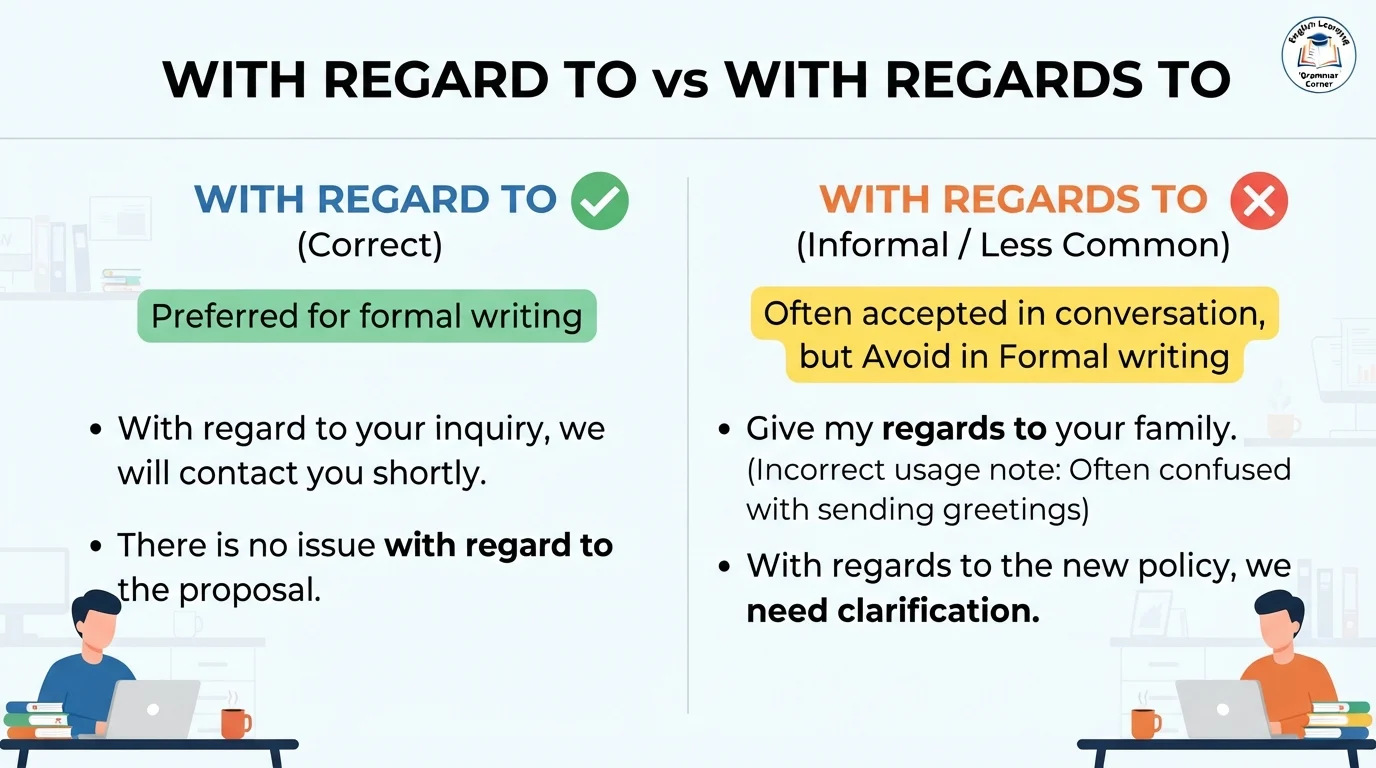
“With regard to” and “with regards to” are commonly used English expressions that mean “concerning,” “about,” or “in relation to” something. You may encounter them in professional emails, business conversations, academic writing, and everyday communication. Although the two phrases look almost identical, many English learners wonder which one is grammatically correct and which one they should use.
The main difference is that “with regard to” is the more widely recommended form in formal writing, while “with regards to” is also widely used with the same meaning. However, some traditional grammar guides consider the plural form less desirable in this expression. The word “regards” is perfectly correct in other contexts, such as “Give my regards to your family.”
In this guide, you will learn the meanings of both expressions, their differences, practical examples, common mistakes, and which phrase is best for professional emails and formal writing.
Quick Answer: With Regard To vs With Regards To
“With regard to” and “with regards to” are both commonly used to mean “about” or “concerning.” However, “with regard to” is the safer choice in formal and academic writing because it is the traditional preferred form.
Examples:
- With regard to your application, we will contact you soon.
- With regards to your application, we will contact you soon.
The first version is generally preferred in formal writing.
What Does “With Regard To” Mean?
“With regard to” means “concerning,” “about,” or “in relation to” a particular subject.
It is used to introduce the topic you are discussing. The expression is especially common in professional emails, official letters, reports, meetings, and academic writing.
Examples:
- With regard to your request, we will respond tomorrow.
- I am writing with regard to your recent application.
- With regard to the meeting, the time has been changed.
- We have received your feedback with regard to the new policy.
- With regard to your question, I would like to clarify one point.
- The company has introduced new rules with regard to employee safety.
- With regard to the payment, please contact our accounts department.
- I have a concern with regard to the proposed changes.
- With regard to your performance, the manager has shared positive feedback.
- Please contact us if you have any questions with regard to this matter.
In each sentence, “with regard to” introduces or refers to a specific topic.
What Does “With Regards To” Mean?
“With regards to” is also commonly used to mean “about,” “concerning,” or “in relation to.”
In modern English, many speakers and writers use it interchangeably with “with regard to.” However, some traditional style guides recommend using the singular “regard” in this particular expression.
Examples:
- With regards to your email, I will reply shortly.
- I am contacting you with regards to your order.
- With regards to the project, we need more information.
- She asked several questions with regards to the new policy.
- With regards to your appointment, please arrive early.
- We have received your message with regards to the payment.
- With regards to the issue, we are investigating the matter.
- He contacted the office with regards to his application.
These sentences are commonly understood, but in formal writing, it is better to replace “with regards to” with “with regard to.”
With Regard To vs With Regards To: Main Differences
| Feature | With regard to | With regards to |
|---|---|---|
| Meaning | About or concerning | About or concerning |
| Common usage | Standard and widely recommended | Commonly used |
| Formal writing | Preferred | Often avoided by traditional style guides |
| Professional emails | Recommended | Understandable, but less preferred |
| Academic writing | Safer choice | Usually better replaced |
| Meaning difference | No significant difference in the intended meaning | No significant difference in the intended meaning |
The key point: The two expressions generally communicate the same idea. The main distinction is a matter of conventional usage and style rather than a difference in meaning.
Why Is “With Regard To” Preferred?
The expression “with regard to” is an established phrase in English. In this construction, “regard” is singular and means consideration or reference to a subject.
Many traditional grammar guides prefer this form because it is the conventional expression.
For example:
Preferred: With regard to your complaint, we are reviewing the matter.
Less preferred in formal writing: With regards to your complaint, we are reviewing the matter.
The second sentence is widely used and understandable, but the first is a safer choice when writing formal documents, academic assignments, reports, and business emails.
When Should You Use “With Regard To”?
Use “with regard to” when you want to refer to a specific issue, subject, request, or matter.
1. In Professional Emails
Examples:
- I am writing with regard to your recent inquiry.
- With regard to your application, we need some additional documents.
- Please see the attached file with regard to the proposed changes.
2. In Business Communication
Examples:
- With regard to the contract, we need your approval.
- The manager has provided new instructions with regard to the project.
- We would like to discuss a few matters with regard to the agreement.
3. In Academic Writing
Examples:
- The study provides useful information with regard to climate change.
- Several concerns were raised with regard to the research method.
- The results differ with regard to age and experience.
4. In Official Letters
Examples:
- I am writing with regard to your reference number.
- With regard to your request, please find the required information attached.
- We are contacting you with regard to the outstanding payment.
In all these situations, “with regard to” is a clear and professional option.
With Regard To vs Regarding vs In Regard To
Several expressions have similar meanings, but their usage differs slightly.
| Expression | Meaning | Example |
|---|---|---|
| With regard to | Concerning or about | With regard to your request, we will respond soon. |
| Regarding | About or concerning | Regarding your request, we will respond soon. |
| In regard to | Concerning or in relation to | In regard to your request, we will respond soon. |
| As regards | Concerning | As regards your request, we will respond soon. |
| In relation to | Connected with or concerning | In relation to your request, we will respond soon. |
“Regarding” is often the simplest and most natural alternative. If you want your writing to sound direct and professional, you can frequently use “regarding” instead of “with regard to.”
For example:
Wordier: I am writing with regard to your recent application.
Simpler: I am writing regarding your recent application.
Both sentences are correct.
With Regard To vs In Regard To
“With regard to” and “in regard to” are both established expressions meaning “concerning” or “about.”
Examples:
- With regard to your request, we will contact you shortly.
- In regard to your request, we will contact you shortly.
Both are acceptable, but “with regard to” is a familiar and widely recommended choice.
Be careful not to confuse either expression with “in regards to,” which is also used by many speakers but is generally less preferred in formal writing.
With Regards To vs Best Regards
Although these expressions look similar, they are used differently.
“With regards to” is used to introduce a topic.
Example: With regards to your order, it will be delivered tomorrow.
“Best regards” is a polite closing used at the end of a letter or email.
Example:
Dear Sarah,
Thank you for your message. I will review the document and reply tomorrow.
Best regards,
Alex
In the email closing, “regards” is correctly plural. This does not mean that “with regards to” is the preferred form for introducing a topic.
Another common expression is “give my regards to someone,” which means to send greetings to that person.
Example: Please give my regards to your parents.
Common Mistakes to Avoid
Mistake 1: Using “With Regards To” in Formal Writing
Although it is common, some style guides discourage this form.
Less preferred: With regards to your application, we need more information.
Recommended: With regard to your application, we need more information.
Mistake 2: Confusing “Regards” With Email Greetings
Incorrect understanding: “With regards to” and “best regards” mean the same thing.
Correct understanding: “With regard to” introduces a topic, while “best regards” is an email closing.
Mistake 3: Using the Phrase Too Often
Repeating “with regard to” throughout a paragraph can make your writing sound unnecessarily complicated.
Wordy: With regard to the project, we have concerns. With regard to the deadline, we need more time.
Better: Regarding the project, we have concerns. We also need more time before the deadline.
Mistake 4: Using It When a Simple Word Is Better
The phrase is grammatically useful, but it is not always necessary.
Formal: With regard to your question, the answer is yes.
Direct: Regarding your question, the answer is yes.
Simple: The answer to your question is yes.
Choose the version that sounds most natural for your situation.
Synonyms and Alternatives
If you want to avoid repeating “with regard to,” consider these alternatives.
| Alternative | Example |
|---|---|
| Regarding | Regarding your application, we need more information. |
| Concerning | Concerning the issue, we will provide an update. |
| About | I am writing about your recent order. |
| In relation to | In relation to the policy, we have a few questions. |
| As for | As for your request, we can approve it. |
| On the subject of | On the subject of payment, please contact our office. |
“Regarding” and “about” are often the clearest choices. “Concerning” and “in relation to” may sound more formal, depending on the sentence.
Frequently Asked Questions
1. Which is correct: “with regard to” or “with regards to”?
Both forms are widely used with the meaning “concerning” or “about.” However, “with regard to” is traditionally preferred and is the safer choice in formal writing.
2. Is “with regards to” grammatically wrong?
It is widely used and understood, but traditional grammar advice often recommends “with regard to” instead. For formal or academic writing, use the singular form.
3. What is the meaning of “with regard to”?
It means “about,” “concerning,” or “in relation to” a subject.
Example: With regard to your request, we will respond tomorrow.
4. Can I use “with regard to” in an email?
Yes. It is suitable for professional emails, official correspondence, and formal requests.
Example: I am writing with regard to your recent inquiry.
5. Is “regarding” better than “with regard to”?
Both are correct. “Regarding” is shorter and often sounds more direct, while “with regard to” can sound more formal.
6. What is the difference between “with regard to” and “best regards”?
“With regard to” means “concerning” and introduces a subject. “Best regards” is a polite expression used to close an email or letter.
7. Is “in regard to” correct?
Yes. “In regard to” is an established expression meaning “concerning.” “With regard to” is another common and widely recommended option.
8. Can I start a sentence with “with regard to”?
Yes. You can use it at the beginning of a sentence to introduce the topic.
Example: With regard to your application, we will contact you next week.
Remember This
- With regard to: The traditional preferred form for formal writing.
- With regards to: Commonly used and understood, but less preferred by some style guides.
- Regarding: A shorter and often more natural alternative.
- Best regards: A polite email closing, not a synonym for “with regard to.”
- Main meaning: About, concerning, or in relation to something.
Conclusion
“With regard to” and “with regards to” are commonly used to refer to a subject or matter. In most contexts, they communicate the same meaning, but “with regard to” is the more traditional and widely recommended choice for formal writing. It is especially suitable for professional emails, academic assignments, business documents, and official correspondence.
If you want to make your writing simpler and more natural, you can often use “regarding” or “about” instead. Remember that “best regards” serves a different purpose because it is used to close an email or letter. Choosing the right expression will help you communicate clearly, professionally, and confidently.