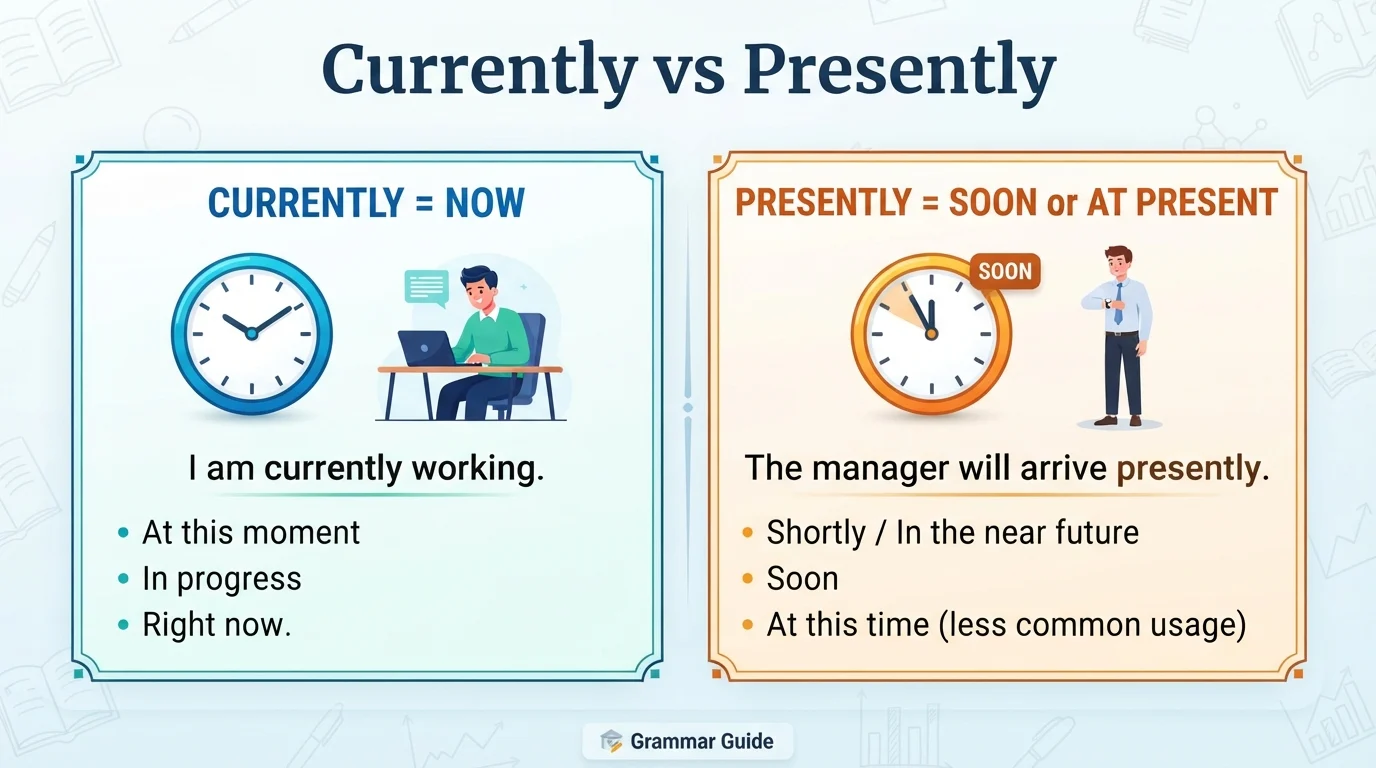
Are currently and presently interchangeable, or is there a difference between these two commonly confused English words? Both words are related to time, but they do not always mean exactly the same thing. Currently means at the present time or now, while presently can mean soon or before long in traditional and especially American English. In some contexts, particularly British English, presently can also mean at the moment.
The confusion occurs because both words can refer to the present, but their meanings and usage depend on context and regional English conventions. Choosing the right word is important in professional emails, academic writing, everyday conversations, and formal communication. This guide explains the difference between currently and presently, provides practical examples, and shows you when to use each word correctly.
Quick Answer: What Is the Difference Between Currently and Presently?
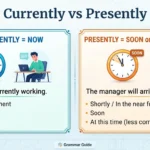
Currently means now or at the present time. It describes something happening or being true at this moment.
Presently can mean soon or in a short time, especially in American English. It can also mean at the moment in some varieties and contexts, particularly British English.
Examples:
- I am currently working on a new project. (I am working on it now.)
- The manager will be with you presently. (The manager will be with you soon.)
- She is presently employed at a university. (She is employed there now, in a context where this sense is used.)
Simple rule: Use currently when you mean “now.” Use presently when you mean “soon,” unless you are deliberately using its less common “at present” meaning.
Why Do People Confuse Currently and Presently?
People confuse these words because both are associated with the present or near future.
For example:
- I am currently unavailable.
- I am presently unavailable.
Both sentences can mean that the speaker is unavailable now, although currently is clearer and more widely understood in this sense.
However, consider this sentence:
- The doctor will see you presently.
Here, presently traditionally means that the doctor will see you soon, not necessarily that the doctor is seeing you right now.
The overlap between their meanings makes the distinction confusing. Regional usage adds another layer: American English often uses presently to mean “soon,” while British English has traditionally used it to mean “at present” as well.
Currently: Meaning, Definition, and Usage
Currently is an adverb that means now, at the present time, or during the period happening at this moment.
It describes a situation, activity, condition, or fact that is true at the time of speaking or writing.
Examples of Currently in Sentences
- I am currently studying English grammar.
- She is currently working in London.
- The company is currently hiring new employees.
- We are currently reviewing your application.
- He is currently living with his parents.
- The website is currently unavailable.
- They are currently developing a new product.
- My brother is currently attending university.
- The restaurant is currently closed for renovations.
- I am currently looking for a better job.
- The team is currently preparing for the competition.
- Our office is currently accepting applications.
- She is currently learning how to drive.
- The government is currently reviewing the proposal.
- This product is currently out of stock.
When Should You Use Currently?
Use currently when you want to communicate that something is true or happening now.
Common situations include:
- Describing employment: I am currently working as a teacher.
- Explaining ongoing activities: She is currently writing a book.
- Giving business updates: We are currently processing your order.
- Describing availability: The service is currently unavailable.
- Explaining present circumstances: He is currently living abroad.
Currently is especially useful in professional and academic writing because its meaning is clear and rarely misunderstood.
Presently: Meaning, Definition, and Usage
Presently is an adverb with two established meanings:
- Soon or shortly: In a short time or before long.
- At present or currently: At the moment or during the present period.
The first meaning is particularly common in American English. The second is also established, especially in British English and in some formal contexts.
Meaning 1: Presently Means Soon
When presently means soon, it refers to something expected to happen after a short period.
Examples:
- The manager will be with you presently.
- The meeting will begin presently.
- Your order will arrive presently.
- The doctor will see you presently.
- The announcement will be made presently.
- The guests should arrive presently.
- The train is expected to depart presently.
- The teacher will return presently.
- The results will be announced presently.
- The show will start presently.
In these examples, presently means that something will happen soon, not that it is happening at this exact moment.
Meaning 2: Presently Means At Present
In some varieties of English, presently can also mean now or at the present time.
Examples:
- She is presently working as a university lecturer.
- The company is presently facing financial difficulties.
- He is presently living in Canada.
- The project is presently under review.
- We are presently considering several options.
- The school is presently closed for the holidays.
- The building is presently being renovated.
- I am presently unable to answer your question.
- The organization is presently recruiting new staff.
- They are presently staying with relatives.
Although these examples are understandable, currently is usually the clearer choice when you want to express “now,” especially for an international audience.
Currently vs Presently: Key Differences
The main difference is that currently consistently refers to the present, while presently can refer to either the present or the near future.
| Feature | Currently | Presently |
|---|---|---|
| Part of speech | Adverb | Adverb |
| Main meaning | Now; at present | Soon; shortly |
| Additional meaning | No common separate future meaning | At present; now |
| Refers to the present | Yes | Yes, in some contexts |
| Refers to the near future | No | Yes |
| Clarity | Very clear | Depends on context |
| Formal writing | Common and suitable | Suitable, but can be ambiguous |
| Best general use | Describing what is happening now | Describing something expected soon |
The key distinction: Currently means something is happening now. Presently may mean something is happening now or will happen soon.
Currently vs Presently: When to Use Each Word
Knowing the meanings is helpful, but understanding when to use each word makes your writing more accurate.
Use Currently When You Mean Now
Choose currently when describing an existing situation, ongoing activity, or present condition.
Examples:
- I am currently working from home.
- The company is currently expanding its operations.
- She is currently studying medicine.
- We are currently experiencing technical problems.
- He is currently unavailable.
Use Presently When You Mean Soon
Choose presently when you want to say that something will happen shortly.
Examples:
- The director will arrive presently.
- Your food will be served presently.
- The meeting will start presently.
- The doctor will call you presently.
- The results will be available presently.
Use Presently to Mean Now Only When the Context Is Clear
You can use presently to mean “at present,” but currently is often more straightforward.
Compare:
- She is presently working at a hospital.
- She is currently working at a hospital.
Both can mean that she works there now. The second sentence is more direct and widely understood.
20+ Examples of Currently vs Presently in Sentences
The following examples show how the two words work in everyday and professional English.
| Currently | Presently |
|---|---|
| I am currently busy. | I will be available presently. |
| She is currently studying. | The class will begin presently. |
| We are currently hiring. | The manager will return presently. |
| The office is currently closed. | The office will reopen presently. |
| He is currently working abroad. | The guests will arrive presently. |
| The website is currently unavailable. | The website will be updated presently. |
| They are currently discussing the issue. | They will discuss the issue presently. |
| I am currently reading a novel. | I will finish reading it presently. |
| The company is currently expanding. | The announcement will be made presently. |
| The doctor is currently examining a patient. | The doctor will see you presently. |
More Examples With Currently
- I currently live in Islamabad.
- Our school is currently accepting admissions.
- She currently works for an international company.
- The application is currently being processed.
- We currently have no vacancies.
- He is currently preparing for his final examination.
- The service is currently unavailable.
- They are currently planning their wedding.
- My parents are currently visiting relatives.
- The project is currently in its final stage.
More Examples With Presently
- The principal will address the students presently.
- The guests will be arriving presently.
- Your appointment will begin presently.
- The announcement will follow presently.
- The manager will speak to you presently.
- The train will be leaving presently.
- The ceremony will commence presently.
- The doctor will be available presently.
- The meeting will resume presently.
- The new arrangements will be announced presently.
Common Mistakes When Using Currently and Presently
Even experienced English speakers sometimes use these words incorrectly or choose one when a clearer alternative would be better.
Mistake 1: Using Currently to Mean Soon
Incorrect: The manager will meet you currently.
Correct: The manager will meet you presently.
More natural: The manager will meet you soon.
Why? Currently means now, not soon. If the meeting will happen after a short wait, use soon or presently.
Mistake 2: Assuming Presently Always Means Soon
Incorrect assumption: Presently can only mean soon.
Correct understanding: Presently can mean either “soon” or “at present,” depending on context and regional usage.
For example:
- The doctor will see you presently. (Soon.)
- She is presently employed at a bank. (At present.)
Mistake 3: Using Presently When Currently Is Clearer
Less clear: I am presently working on my assignment.
Clearer: I am currently working on my assignment.
Why? Some readers may interpret presently as “soon.” Use currently when you want to avoid ambiguity.
Mistake 4: Confusing Presently With At the Present Moment
Incorrect: I will finish the task at the present moment. (If you mean you will finish it soon.)
Better: I will finish the task presently.
More natural: I will finish the task soon.
Why? The expression at the present moment refers to now, while presently can refer to the near future.
Mistake 5: Using Currently and Presently Together Unnecessarily
Wordy: I am currently working on the project presently.
Better: I am currently working on the project.
Why? Both words can refer to the present, so using them together is usually repetitive.
Currently vs Presently in American and British English
Regional usage is one of the most important points to understand when comparing these words.
| Variety | Currently | Presently |
|---|---|---|
| American English | Commonly means now | Often means soon; can also mean now |
| British English | Commonly means now | Traditionally means now; can also mean soon |
| International English | Clear and widely understood | May be ambiguous |
American English
In American English, currently is the usual word for “now.” Presently is often used to mean “soon” or “shortly.”
Examples:
- I am currently working on a new project.
- The manager will be with you presently.
British English
In British English, presently has traditionally been used to mean “at present” or “now,” although the “soon” meaning is also recognized.
Examples:
- She is presently working in Manchester.
- The train will arrive presently.
Which Word Should International English Learners Prefer?
If you are writing for an international audience, currently is generally the safest choice when you mean “now.”
If you mean that something will happen soon, use soon or shortly instead of presently when clarity is especially important.
Currently vs Presently vs Soon vs At Present
These expressions are related, but they are not identical.
| Expression | Meaning | Example |
|---|---|---|
| Currently | Now | I am currently studying. |
| Presently | Soon or now, depending on context | The manager will arrive presently. |
| Soon | In a short time | The manager will arrive soon. |
| Shortly | In a short time | The meeting will begin shortly. |
| At present | Now; at this time | I am not available at present. |
Currently vs At Present
Both expressions mean “now.”
- I am currently working.
- I am working at present.
Both are correct, although currently is often more natural in everyday modern English.
Presently vs Soon
When presently means “soon,” it is similar to soon and shortly.
- The doctor will see you presently.
- The doctor will see you soon.
Both communicate that the doctor is expected to see you after a short wait.
How to Remember the Difference Between Currently and Presently
Here is a simple memory trick:
Currently = Current time = Now
Think of the word current as something happening at this moment.
Presently = Presently arriving = Soon
Remember that presently can indicate that something is about to happen.
Examples:
- I am currently studying. (I am studying now.)
- I will call you presently. (I will call you soon.)
One important reminder: presently can also mean “at present,” so always consider the sentence context.
Similar Words and Expressions
Learning related words can help you understand the difference more clearly.
| Word or Phrase | Meaning | Example |
|---|---|---|
| Now | At this moment | I am busy now. |
| Currently | At the present time | She is currently working. |
| At present | At this time | We have no vacancies at present. |
| Nowadays | In the present period or modern times | People nowadays use smartphones. |
| Presently | Soon or at present | The manager will arrive presently. |
| Soon | After a short time | I will call you soon. |
| Shortly | In a short time | The meeting will begin shortly. |
| At the moment | Right now | I am busy at the moment. |
| Temporarily | For a limited period | The office is temporarily closed. |
| Immediately | Without delay | Please respond immediately. |
Final Verdict: Currently or Presently?
Both currently and presently are correct English words, but they have different uses.
Use currently when you mean now or at the present time. It is the clearer and more widely understood option for describing ongoing situations and present conditions.
Use presently when you mean soon or shortly. You can also use it to mean at present, particularly in British English and certain formal contexts, but this meaning may be less clear to some readers.
For everyday and professional communication, remember these examples:
- I am currently working. (I am working now.)
- I will be working presently. (I will start working soon, depending on context.)
The easiest way to avoid confusion is to use currently for now and soon for the near future.
Remember This
- Currently means now or at the present time.
- Presently can mean soon or at present.
- In American English, presently often means soon.
- In British English, presently has traditionally also meant at present.
- Use currently when you want to express “now” clearly.
- Use soon or shortly when you want to avoid ambiguity about the near future.
- Do not use currently and presently together unnecessarily.
Frequently Asked Questions (FAQs)
1. Are currently and presently interchangeable?
Not always. Currently means now, while presently can mean either now or soon. They are interchangeable only when presently is being used in its “at present” sense.
2. Does presently mean now or soon?
It can mean both. In American English, it often means soon or shortly. In British English, it has traditionally also meant at present. The intended meaning depends on context.
3. Is currently more formal than presently?
Neither word is automatically more formal. Both can appear in formal writing. However, currently is usually clearer when referring to the present time.
4. Can I say “I am presently working”?
Yes. This sentence is grammatically correct and can mean that you are working now. However, I am currently working is clearer for a broad international audience.
5. Can I use currently for the future?
No. Currently refers to the present, not the future. If something will happen after a short time, use soon, shortly, or presently.
6. Is “I will see you presently” correct?
Yes. It is grammatically correct and traditionally means “I will see you soon.” However, I will see you shortly or I will see you soon may sound more natural in everyday conversation.
7. Which word is better in professional emails: currently or presently?
Use currently when describing a situation that exists now. For example, “We are currently reviewing your application.” If you mean something will happen soon, use shortly or soon for clarity.
8. What is the difference between presently and at present?
Presently can mean either soon or at present, depending on context. At present has a much more specific meaning: now or at this time.
Examples:
- The manager will return presently. (Soon.)
- The manager is unavailable at present. (Now.)
Conclusion
The difference between currently and presently is mainly about time and context. Currently means “now” or “at the present time,” while presently can mean “soon” or “at present.” Although the words sometimes overlap, they are not always interchangeable.
For clear everyday and professional English, use currently when describing something happening now and soon or shortly when describing something that will happen in the near future. Use presently when its intended meaning is clear. Understanding these distinctions will help you communicate more accurately and confidently.