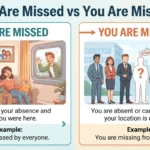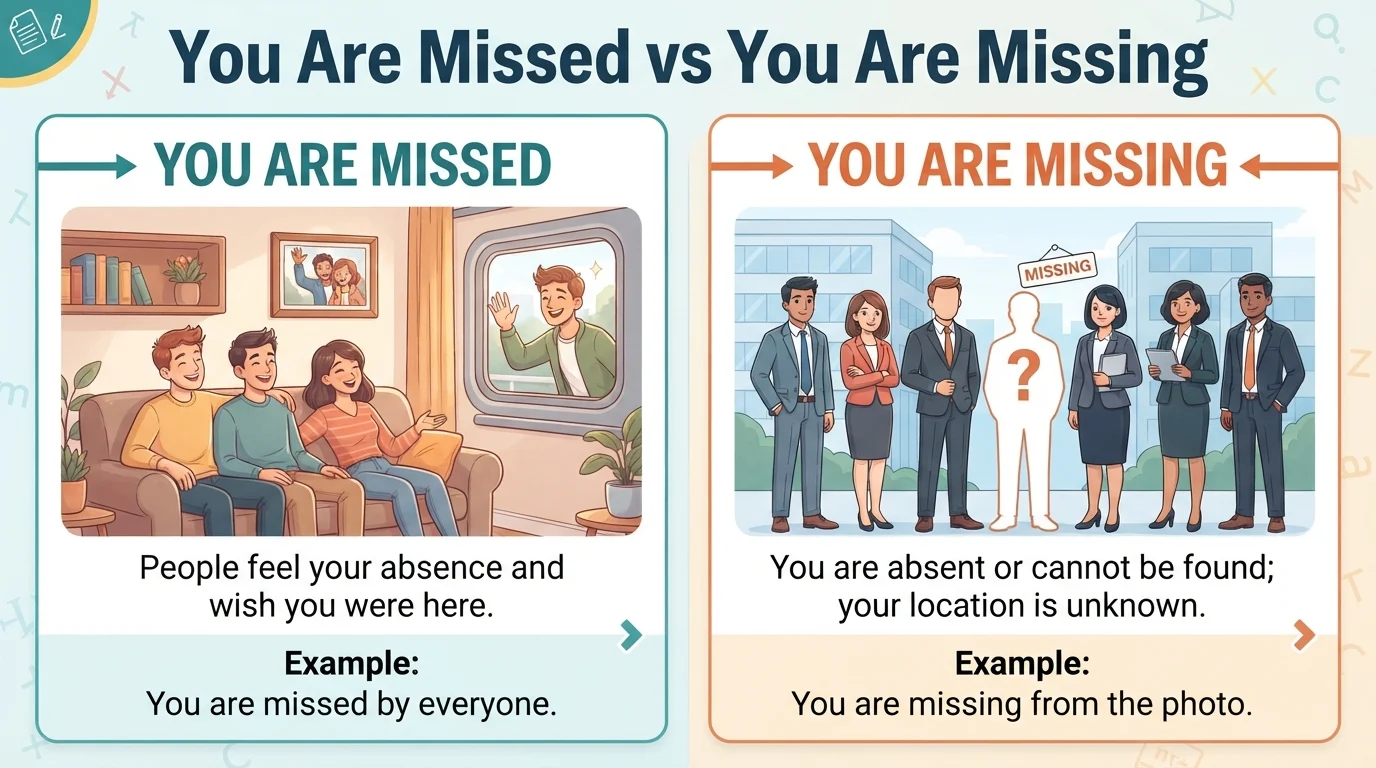
Is “you are missed” grammatically correct, or should you say “you are missing” when someone is not around? These expressions look similar, but they communicate very different ideas. “You are missed” means that people feel your absence and wish you were with them. “You are missing” usually means that someone cannot find you, that you are absent from a particular place, or that you are not included in something. The correct expression depends on what you want to communicate.
For example, if you want to tell a friend that you think about them and wish they were nearby, you can say, “You are missed.” However, if you cannot find someone, you might say, “You are missing.” Understanding this distinction will help you write heartfelt messages, communicate naturally, and avoid common English grammar mistakes.
Quick Answer: What Does “You Are Missed” Mean?
“You are missed” means that someone feels your absence, remembers you, or wishes you were present. It is grammatically correct and commonly used in emotional messages, farewell notes, family conversations, and personal communication.
Examples:
- You are missed by everyone here.
- You are truly missed.
- You are missed more than you know.
- You are missed at family gatherings.
The expression uses the passive voice: people miss you, so you are missed.
Remember: Use “you are missed” to express affection or sadness about someone’s absence. Use “you are missing” when referring to someone who cannot be found or is absent from an expected place.
Why Do People Confuse “You Are Missed” and “You Are Missing”?
People often confuse these expressions because both contain the word miss and describe situations involving someone’s absence.
However, their grammatical structures and meanings are different.
- You are missed: People miss you. They feel your absence.
- You are missing: You are not present, or someone cannot find you.
Consider these examples:
- You are missed by your friends. (Your friends wish you were there.)
- You are missing from the group photo. (You are not in the photo.)
- You are missing. (People cannot find you or do not know where you are.)
The first expression communicates emotion, while the second usually describes a situation or condition.
You Are Missed: Meaning, Definition, and Usage
“You are missed” is a passive-voice expression that means people miss you, feel your absence, or wish you were present.
It is formed using:
Subject + am/is/are + past participle
In this expression:
- You: Subject
- Are: Present form of the verb be
- Missed: Past participle of miss
The active sentence is:
- People miss you.
The passive sentence is:
- You are missed.
Both sentences communicate the same basic idea, but the passive version puts the focus on the person who is being missed.
Examples of “You Are Missed” in Sentences
- You are missed by everyone at the office.
- You are truly missed by your family.
- You are missed more than you can imagine.
- You are missed at our weekly meetings.
- You are missed by all your old friends.
- You are greatly missed around here.
- You are missed every day.
- You are missed whenever we get together.
- You are missed by your colleagues.
- You are missed, especially during the holidays.
- You are missed at family celebrations.
- You are missed by everyone who knows you.
- You are missed more than words can express.
- You are missed whenever we talk about old times.
- You are missed, and we hope to see you soon.
When Should You Use “You Are Missed”?
Use this expression when you want to communicate that someone is important to you and their absence is noticeable.
1. In Personal Messages
- You are missed, my dear friend.
- You are missed more than you know.
- You are truly missed by all of us.
2. In Family Conversations
- You are missed at every family gathering.
- You are missed by everyone at home.
- You are missed, especially during the holidays.
3. In Workplace Messages
- You are missed by the entire team.
- You are missed at our office meetings.
- You are missed, and we look forward to your return.
4. In Farewell Messages
- You are missed already.
- You will be missed by everyone here.
- You are missed, and we wish you success in your new journey.
5. In Memorial Messages
- You are deeply missed and will never be forgotten.
- You are missed every single day.
- You are missed by everyone whose life you touched.
You Are Missing: Meaning, Definition, and Usage
“You are missing” usually means that someone is absent, cannot be found, or is not where they are expected to be.
It can also describe something that is not included in a particular place or situation.
The expression is formed using:
Subject + are + missing
Here, missing functions as an adjective or as part of a verb construction, depending on the sentence.
Examples of “You Are Missing” in Sentences
- You are missing from the family photograph.
- You are missing from today’s meeting.
- You are missing from the attendance list.
- You are missing from our group chat.
- You are missing from the team picture.
- You are missing from the guest list.
- You are missing an important detail.
- You are missing the point of the discussion.
- You are missing from the classroom.
- You are missing from the final report.
Notice that you are missing does not necessarily mean someone feels emotional sadness. It often describes absence or something that is not included.
When Should You Use “You Are Missing”?
Use this expression when someone is not present, cannot be located, or is absent from something.
Examples:
- You are missing from the group photograph.
- You are missing from the attendance record.
- You are missing an important part of the story.
- You are missing from the meeting today.
If you mean that someone cannot be found, you can also say:
- You are missing, and we are worried about you.
In this sentence, missing describes the person’s situation rather than expressing that others feel their absence.
“You Are Missed” vs. “You Are Missing”: Key Differences
The most important difference is that “you are missed” expresses how people feel about your absence, while “you are missing” describes your absence or the fact that you cannot be found.
| Feature | You Are Missed | You Are Missing |
|---|---|---|
| Main meaning | People feel your absence | You are absent or cannot be found |
| Grammar | Passive voice | Adjective or verb construction |
| Focus | Other people’s feelings | Your absence or location |
| Emotional meaning | Usually affectionate or emotional | Usually factual or situational |
| Common context | Personal messages and farewells | Attendance, photographs, searches |
| Example | You are missed by your friends. | You are missing from the photo. |
Compare These Sentences
- You are missed by everyone. (Everyone wishes you were there.)
- You are missing from the meeting. (You are not attending the meeting.)
- You are missed at home. (Your family feels your absence.)
- You are missing from the list. (Your name is not included.)
The difference becomes clear when you identify whether you are describing an emotion or a situation.
Is “You Are Missed” Grammatically Correct?
Yes. “You are missed” is grammatically correct English.
It is an example of the present simple passive voice.
The active voice is:
- Your friends miss you.
The passive voice is:
- You are missed by your friends.
The passive version focuses on the person receiving the action rather than the people performing it.
You can also use the expression without mentioning who misses you:
- You are missed.
- You are deeply missed.
- You are greatly missed.
- You are missed by everyone.
All these sentences are grammatically correct.
Is “You Are Missed” Better Than “I Miss You”?
Both expressions are correct, but they have slightly different tones.
“I miss you” is direct and personal. It tells someone that you personally feel their absence.
“You are missed” is more indirect and can sound collective, formal, or sentimental. It may suggest that several people miss the person.
Compare:
| Expression | Meaning | Tone |
|---|---|---|
| I miss you. | I feel your absence. | Personal and direct |
| You are missed. | Someone or some people feel your absence. | Indirect and sentimental |
| We miss you. | We feel your absence. | Warm and personal |
| You are deeply missed. | Your absence is felt strongly. | Emotional |
| You will be missed. | People will feel your absence in the future. | Farewell or future-oriented |
For an everyday personal message, “I miss you” or “We miss you” may sound more natural. For a farewell card or group message, “You are missed” can work very well.
“You Are Missed” vs. “You Will Be Missed”
These expressions are also commonly confused.
You are missed refers to a present feeling. People already feel your absence.
You will be missed refers to a future feeling. People expect to miss you after you leave.
Examples:
- You are missed by everyone at work. (People miss you now.)
- You will be missed by everyone at work. (People will miss you after you leave.)
| Expression | Meaning | Example |
|---|---|---|
| You are missed. | People miss you now. | You are missed at home. |
| You were missed. | People missed you in the past. | You were missed at yesterday’s event. |
| You will be missed. | People will miss you in the future. | You will be missed when you leave. |
| You have been missed. | People have felt your absence over a period of time. | You have been missed since you moved away. |
50 Examples of “You Are Missed” in Different Situations
Here are practical examples to help you use this expression naturally.
Short and Simple Messages
- You are missed.
- You are truly missed.
- You are greatly missed.
- You are deeply missed.
- You are missed every day.
- You are missed more than you know.
- You are missed around here.
- You are missed by everyone.
- You are missed so much.
- You are always missed.
Messages for Friends
- You are missed by all your friends.
- You are missed whenever we hang out.
- You are missed at our weekend gatherings.
- You are missed more than words can say.
- You are missed, and we hope to see you soon.
- You are missed at our old meeting place.
- You are missed whenever we remember our school days.
- You are missed by the whole group.
- You are missed, buddy.
- You are missed, and things are not quite the same without you.
Messages for Family Members
- You are missed by everyone at home.
- You are missed at every family dinner.
- You are missed during the holidays.
- You are missed by your brothers and sisters.
- You are missed, especially on special occasions.
- You are missed whenever the family gets together.
- You are missed more than you can imagine.
- You are missed by all of us.
- You are missed at every celebration.
- You are missed, and we cannot wait to see you again.
Professional and Farewell Messages
- You are missed by the entire team.
- You are missed at our daily meetings.
- You are missed in the office.
- You are missed by your colleagues.
- You are missed, and we wish you continued success.
- You are missed already.
- You are missed by everyone in the department.
- You are missed, and we hope to work together again.
- You are missed at our team gatherings.
- You are missed, and your contributions are remembered.
Emotional and Heartfelt Messages
- You are deeply missed and dearly remembered.
- You are missed every moment of every day.
- You are missed more than words can express.
- You are missed, but your memories remain with us.
- You are missed by everyone whose life you touched.
- You are missed, and your presence can never be replaced.
- You are missed in ways words cannot describe.
- You are missed today and always.
- You are missed, and you will never be forgotten.
- You are missed more than you will ever know.
Common Mistakes When Using “You Are Missed”
Mistake 1: Using “You Are Missing” When You Mean “You Are Missed”
Incorrect for the intended emotional meaning: You are missing by everyone.
Correct: You are missed by everyone.
Why? The passive form of miss is are missed, not are missing, when you mean that people feel someone’s absence.
Mistake 2: Saying “You Are Missed Me”
Incorrect: You are missed me.
Correct: I miss you.
Also correct: You are missed by me.
Why? The sentence “You are missed” is passive. If you want to identify the person who misses someone, use by before that person.
Mistake 3: Confusing “You Are Missed” With “You Are Missing”
Incorrect interpretation: “You are missed” means someone cannot find you.
Correct understanding: “You are missed” means someone feels your absence.
Why? These expressions have different meanings, even though they use the same root word.
Mistake 4: Writing “You Is Missed”
Incorrect: You is missed.
Correct: You are missed.
Why? The pronoun you takes the verb are, not is, in standard English.
Mistake 5: Using “You Will Be Missed” for a Present Feeling
Less suitable if you mean people miss the person right now: You will be missed.
Better: You are missed.
Why? Will be missed refers to the future, while are missed describes a present feeling.
How to Remember the Difference Between “You Are Missed” and “You Are Missing”
Use this simple memory trick:
You are missed = People miss you.
You are missing = People cannot find you, or you are absent.
Think of these examples:
- You are missed by your family. (Your family feels your absence.)
- You are missing from the family photo. (You are not in the picture.)
Another useful trick is to remember the active and passive forms:
- Active: We miss you.
- Passive: You are missed by us.
This makes the grammar easier to understand and remember.
American English vs. British English
There is no significant difference between American and British English in the meaning or grammatical correctness of “you are missed.”
Both varieties use the expression to communicate that someone feels another person’s absence.
Examples:
- American English: You are missed by everyone here.
- British English: You are missed by everyone here.
The same is true for “you are missing.” Both varieties use it to describe someone who is absent or cannot be found.
The main difference is not regional but contextual: choose the expression according to the meaning you want to communicate.
Similar Expressions and Their Meanings
Learning related expressions can help you communicate your feelings more naturally.
| Expression | Meaning | Example |
|---|---|---|
| I miss you | I feel your absence | I miss you every day. |
| We miss you | We feel your absence | We miss you at home. |
| You are missed | People feel your absence | You are missed by everyone. |
| You are deeply missed | People feel your absence strongly | You are deeply missed. |
| You will be missed | People will miss you in the future | You will be missed at work. |
| You have been missed | People have missed you over a period | You have been missed since you left. |
| You are absent | You are not present | You are absent from class. |
| You are nowhere to be found | Nobody can locate you | You are nowhere to be found. |
| We wish you were here | We want you to be with us | We wish you were here today. |
| Your presence is missed | People notice and feel your absence | Your presence is missed at every gathering. |
Final Verdict: You Are Missed or You Are Missing?
Both “you are missed” and “you are missing” are grammatically correct, but they express different ideas.
Use “you are missed” when you want to say that people feel your absence, care about you, or wish you were present. It is especially suitable for emotional messages, farewell notes, family conversations, and personal communication.
Use “you are missing” when someone is absent from a place, not included in something, or cannot be found.
Remember these two examples:
- You are missed by everyone. (Everyone feels your absence.)
- You are missing from the group photo. (You are not in the photograph.)
Once you understand this distinction, you can use both expressions confidently and correctly.
Remember This
- You are missed means people miss you.
- You are missing means you are absent or cannot be found.
- You are missed is grammatically correct and uses the passive voice.
- I miss you is a direct and personal alternative.
- You will be missed refers to a future feeling.
- Use you are missed in heartfelt messages and farewell notes.
- Use you are missing when describing someone’s absence or location.
Frequently Asked Questions (FAQs)
1. Is “You are missed” grammatically correct?
Yes. “You are missed” is grammatically correct. It uses the present simple passive voice and means that people feel your absence or wish you were present.
2. What does “You are missed” mean?
It means that someone or a group of people misses you. It communicates that your absence is noticed and that people wish you were there.
Example: You are missed by everyone at home.
3. Is “You are missed” the same as “I miss you”?
They communicate similar feelings, but their structures are different. “I miss you” is active and personal, while “you are missed” is passive and can refer to one person or a group of people.
4. Should I say “You are missed” or “You are missing”?
Use “you are missed” when expressing affection or sadness about someone’s absence. Use “you are missing” when someone is absent from a place or cannot be found.
5. What is the difference between “You are missed” and “You will be missed”?
“You are missed” describes a present feeling, while “you will be missed” describes a feeling expected in the future.
Example:
- You are missed at work. (People miss you now.)
- You will be missed at work. (People will miss you after you leave.)
6. Can I write “You are deeply missed”?
Yes. “You are deeply missed” is correct and expresses strong feelings of affection, sadness, or longing. It is often used in emotional messages and memorial tributes.
7. Is “You are missed by everyone” correct?
Yes. It is a grammatically correct passive sentence. It means that everyone misses you.
8. Can I say “You are missed already”?
Yes. This is a natural expression, especially when someone has recently left a place or group. It means people have started feeling that person’s absence.
9. What is the past tense of “You are missed”?
The past-tense passive form is “You were missed.”
Example: You were missed at yesterday’s celebration.
10. What is the active voice of “You are missed”?
The active voice depends on who is doing the action.
Examples:
- We miss you.
- Your friends miss you.
- Everyone misses you.
11. Is “You are missed” romantic?
It can be romantic, but it is not exclusively romantic. You can use it for a partner, friend, family member, colleague, or anyone whose absence you feel.
12. What is a more natural way to say “You are missed”?
Depending on the situation, you can say:
- I miss you.
- We miss you.
- We wish you were here.
- Everyone misses you.
- You are deeply missed.
Conclusion
“You are missed” is a correct and meaningful English expression used to tell someone that people feel their absence. It is appropriate for personal messages, family conversations, farewell notes, and emotional situations. The expression is in the passive voice and focuses on the person who is being missed.
On the other hand, “you are missing” usually describes someone who is absent, not included, or cannot be found. Remember that “you are missed” expresses a feeling, while “you are missing” describes a situation. Understanding this simple difference will help you choose the right expression in everyday English.