Understanding the difference between is and are is an important part of learning English grammar. Both words are forms of the verb “to be,” but they are used with different subjects. Knowing when to use “is” and when to use “are” can help you speak more naturally, write correct sentences, and avoid common grammar mistakes.
Many English learners find this rule confusing, especially when a sentence contains multiple nouns, collective expressions, or words such as “everyone,” “each,” and “people.” The good news is that the basic rule is simple. Once you understand subject verb agreement and learn a few exceptions, choosing between “is” and “are” becomes much easier.
In this guide, you will learn the meanings of “is” and “are,” their grammar rules, practical examples, common mistakes, and easy tricks to remember the difference.
Quick Answer: Is vs Are
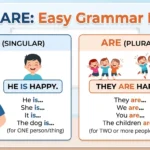
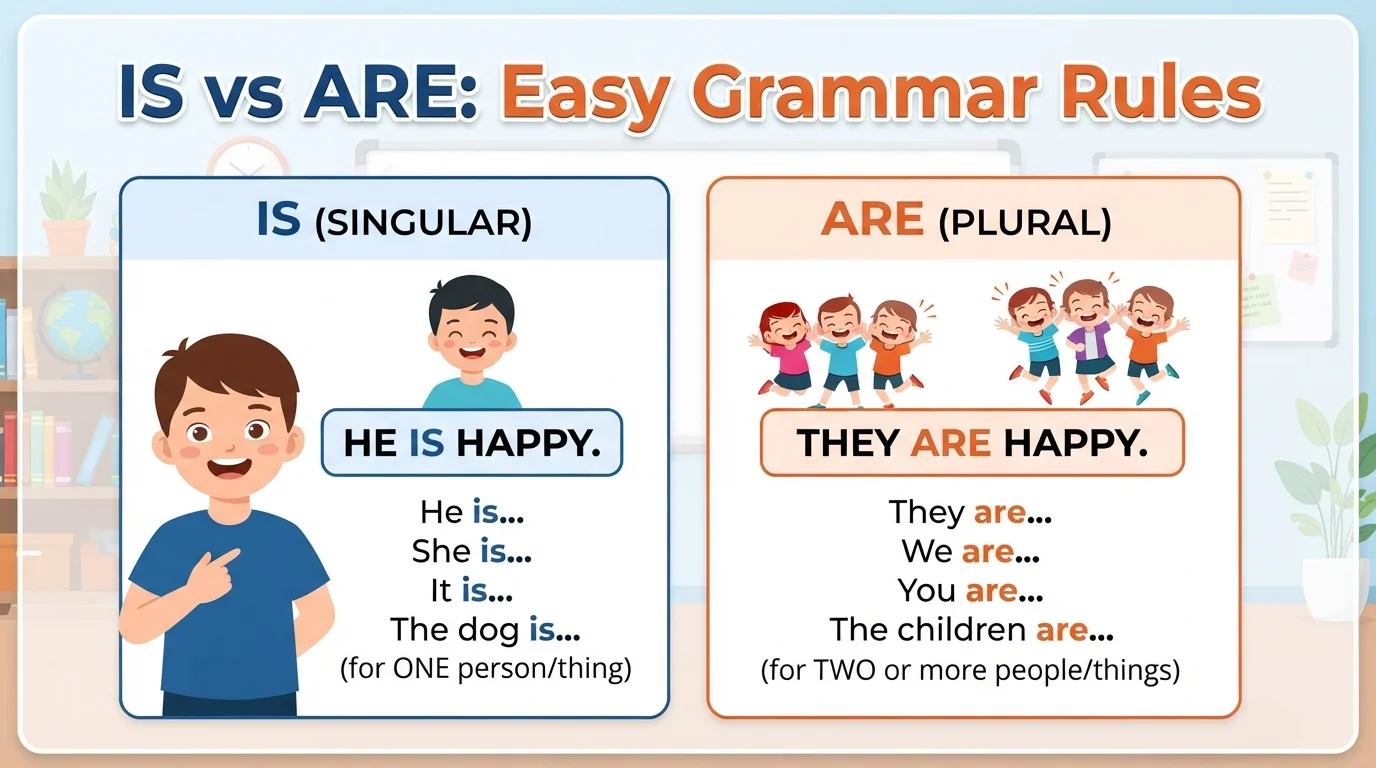
Is is used with singular subjects, such as he, she, it, and one person or thing. Are is used with plural subjects, such as we, they, and plural nouns. You also use “are” with you, even when speaking to one person.
Examples:
- She is happy.
- The book is interesting.
- They are ready.
- The students are studying.
- You are correct.
What Does “Is” Mean?
“Is” is a present tense form of the verb “to be.” It connects a singular subject with information about that person, place, thing, or situation.
You can use “is” to describe someone, identify something, explain a condition, or show where something is located.
Examples:
- He is my brother.
- She is a teacher.
- The weather is pleasant.
- My phone is on the table.
- This question is easy.
- The baby is sleeping.
- It is cold outside.
- My friend is at home.
- The food is delicious.
- The movie is interesting.
In each example, “is” agrees with a singular subject.
What Does “Are” Mean?
“Are” is another present tense form of the verb “to be.” It is generally used with plural subjects and with the pronoun “you.”
Use “are” when talking about two or more people or things, or when addressing one person or several people as “you.”
Examples:
- They are my friends.
- We are ready.
- You are very helpful.
- The children are playing.
- The books are expensive.
- My parents are at home.
- These shoes are comfortable.
- The students are learning English.
- We are happy today.
- You are welcome.
In these examples, “are” agrees with a plural subject or the pronoun “you.”
Is vs Are: Main Grammar Rules
1. Use “Is” With Singular Subjects
Use “is” when the subject refers to one person, animal, place, or thing.
Examples:
- The boy is hungry.
- My sister is a doctor.
- The cat is sleeping.
- This chair is broken.
- The house is beautiful.
Remember that a singular subject usually takes “is” in the simple present tense.
2. Use “Are” With Plural Subjects
Use “are” when the subject refers to more than one person or thing.
Examples:
- The boys are hungry.
- My sisters are doctors.
- The cats are sleeping.
- These chairs are broken.
- The houses are beautiful.
A plural subject usually takes “are.”
3. Use “Are” With “You”
One of the most important rules is that “you” takes “are,” whether you are speaking to one person or more than one person.
Correct examples:
- You are my best friend.
- You are a good student.
- You are very kind.
- You are all invited.
Incorrect: You is my best friend.
Correct: You are my best friend.
4. Use “Is” With “He,” “She,” and “It”
These three pronouns take “is” in the simple present tense.
Examples:
- He is busy.
- She is intelligent.
- It is raining.
- He is working.
- She is reading a book.
5. Use “Are” With “We” and “They”
The pronouns “we” and “they” take “are.”
Examples:
- We are classmates.
- We are learning together.
- They are outside.
- They are watching television.
- We are ready to leave.
Is vs Are: Comparison Table
| Subject | Correct verb | Example |
|---|---|---|
| I | Am | I am tired. |
| He | Is | He is tired. |
| She | Is | She is tired. |
| It | Is | It is cold. |
| You | Are | You are tired. |
| We | Are | We are tired. |
| They | Are | They are tired. |
| The boy | Is | The boy is happy. |
| The boys | Are | The boys are happy. |
| The book | Is | The book is new. |
| The books | Are | The books are new. |
Important: “I” takes “am,” not “is” or “are,” in ordinary present tense sentences.
Is vs Are in Different Types of Sentences
1. Positive Sentences
Use “is” or “are” to make a statement.
Examples:
- She is at school.
- He is my cousin.
- The room is clean.
- They are at school.
- We are cousins.
- The rooms are clean.
2. Negative Sentences
Add “not” after “is” or “are” to make a sentence negative.
Examples:
- She is not busy.
- He is not ready.
- It is not expensive.
- They are not busy.
- We are not ready.
- The shoes are not expensive.
Common contractions include:
- Is not = isn’t
- Are not = aren’t
Examples:
- He isn’t here.
- They aren’t ready.
3. Questions
To make a question, place “is” or “are” before the subject.
Examples:
- Is she your sister?
- Is he at home?
- Is the food ready?
- Are they your friends?
- Are you okay?
- Are the children asleep?
Do not use the normal statement order when forming a simple yes or no question with these verbs.
Incorrect: She is happy?
Correct: Is she happy?
The first sentence can appear as an informal way to express surprise, but “Is she happy?” is the standard question form.
4. Short Answers
Use “is” or “are” in short answers to questions.
Examples:
- Is he busy? Yes, he is.
- Is she at home? No, she isn’t.
- Are they ready? Yes, they are.
- Are you tired? No, I am not.
Notice that the answer to “Are you tired?” is usually “No, I am not,” because the speaker refers to themselves as “I.”
Is vs Are With There
Both “there is” and “there are” are used to say that something exists or is present somewhere.
Use there is with a singular countable noun or an uncountable noun.
Examples:
- There is a book on the desk.
- There is a problem.
- There is some water in the bottle.
- There is enough time.
Use there are with plural countable nouns.
Examples:
- There are two books on the desk.
- There are several problems.
- There are many people outside.
- There are three apples in the basket.
Compare:
- There is a student in the classroom.
- There are ten students in the classroom.
The noun after “there” helps determine which verb to use.
Is vs Are With Uncountable Nouns
Uncountable nouns usually take “is” when they are the subject of a simple present tense sentence.
Examples:
- Water is essential.
- Information is useful.
- Money is important.
- Advice is helpful.
- Furniture is expensive.
Although these nouns may refer to large amounts or many individual items, English grammar generally treats them as singular.
Incorrect: The information are useful.
Correct: The information is useful.
If you use a plural countable expression, the verb may change.
- The pieces of furniture are expensive.
- The bottles of water are empty.
Here, “pieces” and “bottles” are plural, so “are” is correct.
Is vs Are With Everyone, Everybody, and Each
Words such as “everyone,” “everybody,” “someone,” “somebody,” “anyone,” “nobody,” and “each” generally take “is” in the simple present tense.
Examples:
- Everyone is welcome.
- Everybody is ready.
- Someone is calling you.
- Nobody is perfect.
- Each student is responsible.
- Every room is clean.
These words may refer to several people or things, but grammar treats them as singular.
Incorrect: Everyone are happy.
Correct: Everyone is happy.
However, when you use a plural subject such as “all the students,” use “are.”
- All the students are happy.
- Each student is happy.
Is vs Are With Two Subjects
When two singular nouns are joined by “and,” they usually form a plural subject and take “are.”
Examples:
- Tom and Jerry are friends.
- My mother and father are at home.
- The pen and pencil are on the desk.
- Sara and Ali are classmates.
However, when two words refer to one combined item, concept, or dish, a singular verb may be appropriate.
Example:
- Macaroni and cheese is my favorite dish.
Here, the phrase refers to one dish.
When subjects are joined by “or” or “nor,” the verb often agrees with the subject closest to it.
Examples:
- Either the teacher or the students are responsible.
- Either the students or the teacher is responsible.
For longer sentences, rewriting the sentence can make the agreement clearer.
Is vs Are in Continuous Tenses
“Is” and “are” are also used as helping verbs in the present continuous tense.
Use this structure:
Subject + is/are + verb ending in -ing
Examples with “is”:
- He is studying English.
- She is cooking dinner.
- The dog is barking.
- My brother is working today.
Examples with “are”:
- They are studying English.
- We are cooking dinner.
- The dogs are barking.
- My brothers are working today.
The verb “is” or “are” agrees with the subject, while the main verb ends in “-ing.”
Common Mistakes With Is and Are
| Incorrect sentence | Correct sentence | Reason |
|---|---|---|
| He are happy. | He is happy. | “He” is singular. |
| They is ready. | They are ready. | “They” is plural. |
| You is kind. | You are kind. | “You” takes “are.” |
| The students is here. | The students are here. | “Students” is plural. |
| Everyone are welcome. | Everyone is welcome. | “Everyone” is grammatically singular. |
| The information are correct. | The information is correct. | “Information” is uncountable. |
| There is two cars. | There are two cars. | “Cars” is plural. |
| My friend and I is ready. | My friend and I are ready. | The subject is plural. |
Easy Tricks to Remember Is vs Are
Here are some simple ways to remember the difference.
Trick 1: Remember the pronouns
- He, she, it = is
- You, we, they = are
- I = am
Trick 2: Look at the noun
- One student is present.
- Five students are present.
Trick 3: Check the meaning of the subject
Ask yourself whether the subject is grammatically singular or plural. Do not choose the verb just because the sentence describes a large quantity.
For example:
- The water is cold.
- The bottles are cold.
Trick 4: Remember “you are”
Even when speaking to only one person, always use “you are” in standard English.
Is vs Are in American and British English
The basic rules for “is” and “are” are the same in American and British English.
Both varieties use:
- He is here.
- They are here.
- The book is interesting.
- The books are interesting.
Some collective nouns, such as “team,” “family,” and “government,” can differ in usage. British English more readily uses a plural verb when the group is considered as individual members, while American English more commonly uses a singular verb when the group is treated as one unit.
Examples:
- American English: The team is playing well.
- British English: The team are playing well.
Both patterns can be correct in their respective varieties, depending on the intended meaning and context. This variation does not change the basic rules for ordinary singular and plural subjects.
Is vs Are: Synonyms and Related Forms
“Is” and “are” do not have exact synonyms in every sentence because they are grammatical forms of the verb “to be.” However, other verbs or expressions may replace them depending on the meaning.
| Expression | Example |
|---|---|
| Seems | She seems happy. |
| Looks | He looks tired. |
| Remains | The door remains open. |
| Becomes | The weather becomes colder. |
| Exists | A problem exists. |
These alternatives are not always interchangeable with “is” or “are.” Choose them according to the meaning you want to express.
Frequently Asked Questions
1. What is the main difference between is and are?
“Is” is generally used with singular subjects, such as “he,” “she,” “it,” and one person or thing. “Are” is used with plural subjects and with “you.”
2. Is it “you is” or “you are”?
The correct form is “you are.” This rule applies whether you are speaking to one person or several people.
Example: You are my friend.
3. Is it “everyone is” or “everyone are”?
The correct form is “everyone is.” Although “everyone” refers to all people in a group, it is grammatically singular.
4. Is it “there is” or “there are”?
Use “there is” with singular nouns and uncountable nouns. Use “there are” with plural countable nouns.
Examples:
- There is a chair.
- There are two chairs.
5. Is it “the information is” or “the information are”?
The correct form is “the information is” because “information” is an uncountable noun in standard English.
6. Can “is” and “are” be used in questions?
Yes. Put the verb before the subject to form a standard yes or no question.
Examples:
- Is he ready?
- Are they ready?
7. Can “is” and “are” be used with verbs ending in -ing?
Yes. They are used to form the present continuous tense.
Examples:
- She is reading.
- They are reading.
8. Is it “the team is” or “the team are”?
Both can be correct, depending on the variety of English and the intended meaning. American English commonly treats a team as one unit and uses “is.” British English may use “are” when emphasizing the individual members.
Remember This
- I = am
- He, she, it = is
- You, we, they = are
- Singular nouns usually take is.
- Plural nouns usually take are.
- “Everyone,” “everybody,” and “each” generally take is.
- Uncountable nouns such as “water,” “money,” and “information” generally take is.
- Use there is for singular and uncountable nouns, and there are for plural nouns.
Conclusion
The difference between “is” and “are” becomes easy when you focus on the subject of the sentence. Use “is” with singular subjects such as “he,” “she,” “it,” and most uncountable nouns. Use “are” with plural subjects such as “we,” “they,” and plural nouns. Always remember that “you” takes “are,” even when you are talking to one person.
To improve your grammar, practice making positive sentences, negative sentences, and questions with both words. Pay special attention to expressions such as “everyone is,” “there are,” and “the information is.” With regular practice, you will be able to choose the correct form naturally and confidently.