Is it “copywritten” or “copyrighted”? These two words look and sound similar, so it is easy to confuse them. However, they have very different meanings. Copyrighted is the correct term when referring to creative work that is protected by copyright law. Copywritten, on the other hand, is sometimes used to describe text written for advertising or marketing, although it is not the standard term for this purpose.
The confusion often occurs because both words contain the word “copy.” However, copyright and copywriting are two separate concepts. One concerns legal protection for creative work, while the other concerns writing persuasive content to promote a product, service, or brand.
In this article, you will learn what “copywritten” and “copyrighted” mean, how they differ, when to use each expression, and how to avoid common spelling and grammar mistakes.
Quick Answer: Copywritten vs. Copyrighted
Copyrighted means legally protected by copyright. It is used for creative works such as books, photographs, music, videos, and articles.
Copywritten is sometimes used to mean written as advertising or marketing copy, but it is not the standard term. The preferred word is usually copywritten only when referring to the past participle of the verb copywrite, which is itself uncommon. In most situations, use written as copy or written by a copywriter instead.
Examples:
- Correct: This photograph is copyrighted.
- Correct: The book is protected by copyright.
- Better wording: The advertisement was written by a copywriter.
- Not recommended: This advertisement is copywritten.
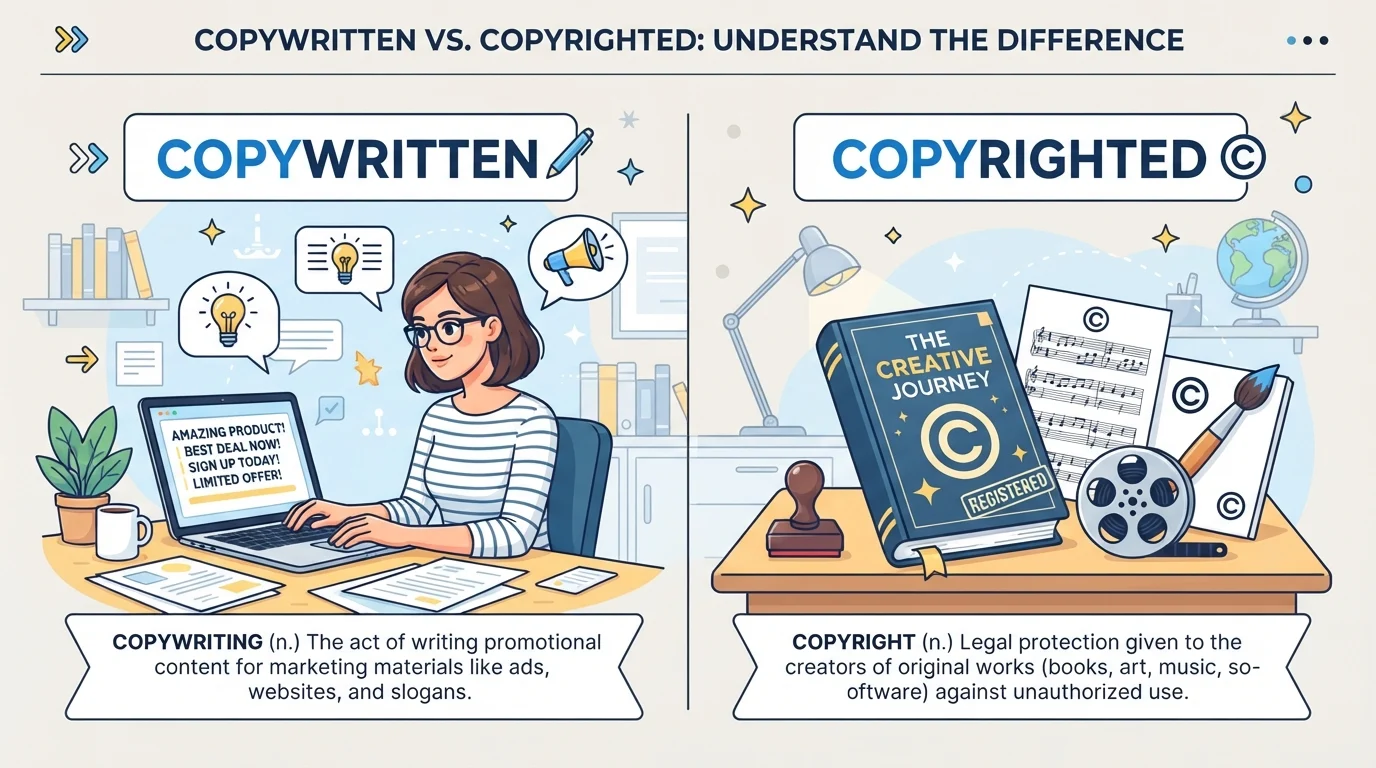
The key distinction is that copyrighted refers to legal protection, while copywriting refers to writing promotional content.
What Does Copyrighted Mean?
“Copyrighted” is the past tense and past participle form of the verb copyright. It means that a creative work is protected by copyright law.
Copyright generally gives the creator or copyright owner certain exclusive rights over how their original work is used, reproduced, distributed, or adapted, subject to applicable laws and exceptions.
Examples of works that may be protected by copyright include:
- Books and novels
- Articles and blog posts
- Photographs and illustrations
- Music and song recordings
- Films and videos
- Software and computer programs
- Original artwork
Examples of Copyrighted in Sentences
- This photograph is copyrighted.
The photograph is protected by copyright law. - The author owns the rights to the copyrighted book.
The book is legally protected, and the author owns its copyright. - You cannot reproduce copyrighted material without permission when permission is required.
You may need authorization to use protected work. - The company uses copyrighted images on its website.
The images are protected by copyright. - All the music in this film is copyrighted.
The music is protected by copyright law. - She created a copyrighted illustration for the magazine.
Her original illustration is protected by copyright.
What Does Copywritten Mean?
“Copywritten” is sometimes used to describe advertising or marketing content that has been written by a copywriter. However, it is not the standard expression most editors or writers would choose.
The more familiar term is copywriting, which means writing persuasive content intended to encourage readers to take action. That action might include buying a product, subscribing to a service, clicking a link, or contacting a business.
A person who writes this type of content is called a copywriter.
Examples of copywriting include:
- Website sales pages
- Product descriptions
- Advertising headlines
- Email marketing campaigns
- Social media advertisements
- Promotional brochures
- Landing page content
Examples of Better Usage
Instead of saying “The advertisement was copywritten by an expert,” use:
- The advertisement was written by an experienced copywriter.
- She wrote the promotional copy for the new product.
- The company hired a copywriter to create its website content.
- He specializes in writing advertising copy.
- The marketing campaign features professionally written copy.
These expressions sound more natural and professional in standard English.
Copywritten vs. Copyrighted: Key Differences
Although the two terms look similar, they refer to different concepts.
| Feature | Copywritten | Copyrighted |
|---|---|---|
| Main connection | Copywriting | Copyright |
| Meaning | Sometimes intended to mean written as advertising copy | Legally protected by copyright |
| Standard usage | Uncommon and often unclear | Common and established |
| Related term | Copywriter | Copyright owner |
| Main purpose | Writing promotional content | Protecting original creative work |
| Example | Written by a copywriter | The article is copyrighted. |
Remember: Copywriting is about creating persuasive content. Copyright is about legal rights over original creative work.
Copywriting vs. Copyright: What Is the Difference?
To understand the difference between “copywritten” and “copyrighted,” it helps to understand the words copywriting and copyright.
1. Copywriting
Copywriting is the process of writing promotional or persuasive content. Its goal is usually to encourage readers to take a particular action.
For example:
- A copywriter creates an advertisement for a new smartphone.
- A marketing writer prepares an email campaign.
- A business hires a copywriter to write product descriptions.
2. Copyright
Copyright is a legal concept that protects original creative expression. It gives copyright owners certain rights over the use of their work.
For example:
- A photographer owns copyright in an original photograph.
- An author may own copyright in a novel.
- A musician may own copyright in an original musical composition.
Can Copywriting Be Copyrighted?
Yes. Original copywriting can be protected by copyright because it is a form of creative writing.
For example, if a copywriter creates an original advertisement, the written content may qualify for copyright protection. Who owns the copyright can depend on the contract, employment arrangement, and applicable law.
This means a piece of writing can be both promotional copy and copyrighted work.
Common Mistakes to Avoid
Mistake 1: Using Copywritten When You Mean Copyrighted
Incorrect: This photograph is copywritten.
Correct: This photograph is copyrighted.
Explanation: If you mean that a photograph is legally protected, use “copyrighted.”
Mistake 2: Confusing Copywriting with Copyright
Incorrect understanding: Copywriting and copyright mean the same thing.
Correct understanding: Copywriting is the creation of persuasive promotional content, while copyright refers to legal protection for original creative work.
Mistake 3: Assuming All Online Content Is Free to Use
Just because an article, photograph, or video is available online does not mean it is free to reproduce or distribute. Copyright protection may apply even when a work does not display a copyright notice.
Mistake 4: Assuming Copywriting Automatically Gives the Writer Ownership
Writing promotional content does not automatically establish who owns its copyright. Ownership can depend on agreements, employment arrangements, and applicable copyright law.
Easy Ways to Remember Copywritten vs. Copyrighted
Use these simple memory tricks:
- Copyrighted = Protected by copyright law.
- Copywriting = Writing promotional content.
- Copywriter = A person who writes advertising or marketing content.
Think of it this way:
A copywriter writes an advertisement. That original advertisement may also be copyrighted.
For example:
- She is a copywriter.
- She wrote the advertising copy.
- The original advertisement is copyrighted.
This example shows how the two concepts are related but not interchangeable.
Frequently Asked Questions
1. Is it copywritten or copyrighted?
If you mean legally protected creative work, the correct word is copyrighted. If you mean advertising or promotional writing, use copywriting, advertising copy, or written by a copywriter.
2. What does copywritten mean?
“Copywritten” is sometimes used to describe text written as advertising or marketing copy. However, it is uncommon and can be confusing. “Written by a copywriter” is usually clearer.
3. What does copyrighted mean?
“Copyrighted” means legally protected by copyright. It commonly describes original creative works such as books, articles, photographs, music, films, and artwork.
4. Is copywriting the same as copyright?
No. Copywriting is the process of writing persuasive promotional content. Copyright is a legal protection for original creative expression.
5. Can a copywriter copyright their work?
An original piece of copywriting may qualify for copyright protection. However, ownership may belong to the writer, an employer, or a client, depending on the agreement and applicable law.
6. Is copywritten a real word?
It is sometimes used, but it is uncommon and often considered unclear or nonstandard in professional writing. When discussing advertising content, expressions such as “written by a copywriter” are generally preferable.
7. Does copyrighted mean someone owns the content?
Copyrighted means that copyright protection applies to the work. A copyright owner generally holds certain legal rights over its use, but the creator and the current copyright owner are not necessarily the same person.
8. What is the opposite of copyrighted?
There is no single perfect opposite. Depending on the context, you might say “not protected by copyright,” “in the public domain,” or “free to use under a particular license.” These expressions do not all mean the same thing.
Conclusion
“Copywritten” and “copyrighted” may look similar, but they have different meanings.
Copyrighted is the established term for creative work protected by copyright law. Copywritten is an uncommon expression sometimes used to describe promotional writing, but “written by a copywriter” or “written as advertising copy” is usually clearer.
Remember that copywriting involves creating persuasive content, while copyright concerns the legal protection of original creative work. A piece of advertising copy can be both written by a copywriter and protected by copyright.
Understanding this distinction will help you choose the correct wording in professional writing, marketing, and everyday English.