“Zeros” and “zeroes” are two accepted plural forms of the word “zero.” Both can refer to more than one zero, if you are talking about numbers, mathematical calculations, or the digit 0. However, many English learners wonder which spelling is correct and if there is a difference between American and British English.
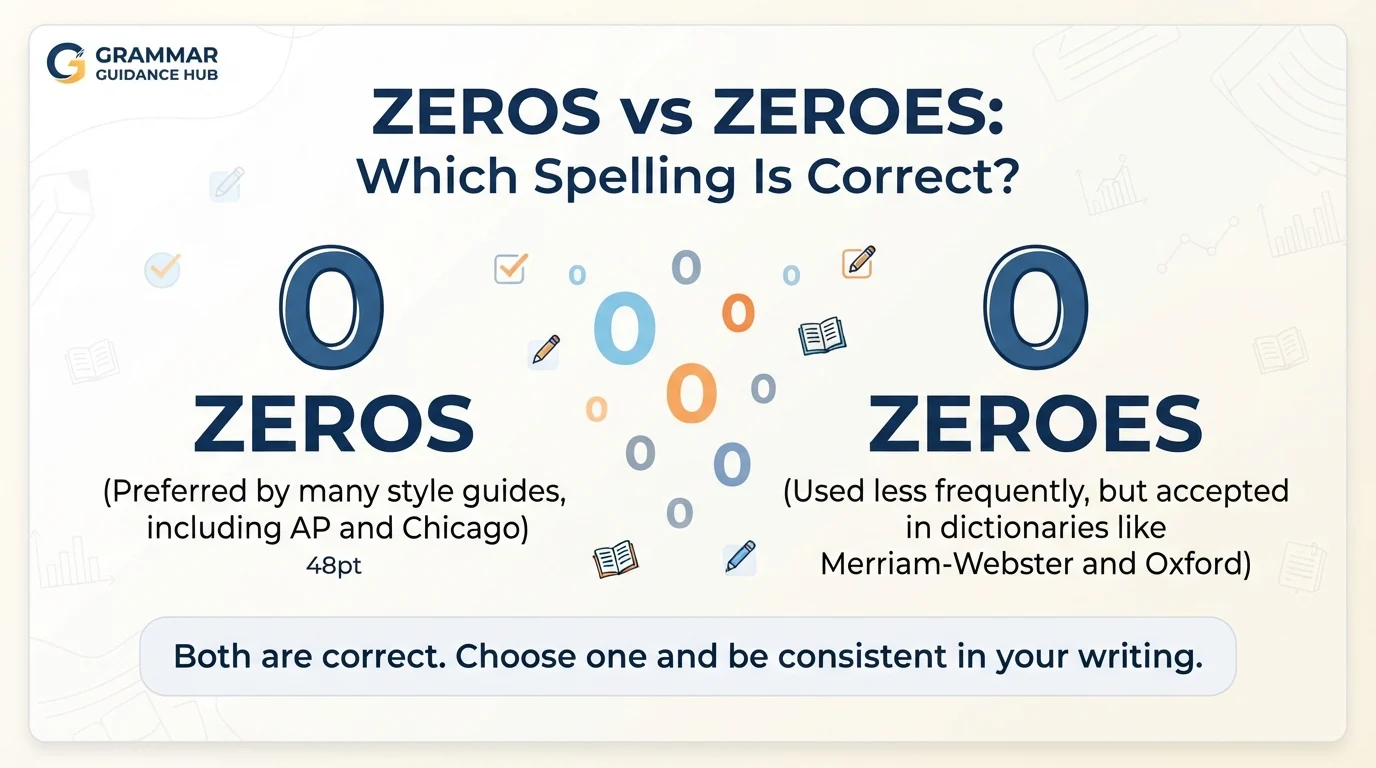
The good news is that both “zeros” and “zeroes” are correct, and they generally have the same meaning. The spelling “zeros” is more common in modern American English, while “zeroes” is also widely accepted in British English and other varieties. In practice, the choice often depends on personal preference, regional conventions, and the style guide you follow.
In this guide, you will learn the meanings of both words, their spelling rules, how to use them in sentences, and which form is best for academic writing, business communication, and everyday English.
Quick Answer: Zeros vs Zeroes
Zeros and zeroes are both correct plural forms of zero. They mean more than one zero and can usually be used interchangeably.
Examples:
- The number 100 contains two zeros.
- The number 100 contains two zeroes.
- There are three zeros at the end of this number.
- There are three zeroes at the end of this number.
The spelling “zeros” is generally the more common choice in American English. Both forms are acceptable in British English, too.
What Does “Zeros” Mean?
“Zeros” is the plural form of “zero.” It refers to multiple instances of the digit 0 or to values of zero in mathematical or other contexts.
Examples:
- The number 1,000 contains three zeros.
- I accidentally added two extra zeros to the amount.
- The calculator displayed several zeros.
- There are four zeros in this numerical sequence.
- The answer contains two zeros after the decimal point.
- The company reported zero profits for two years.
- The temperature dropped to zero degrees.
- The student wrote three zeros in the answer.
- The computer program returned a series of zeros.
- The account balance showed several zeros.
In most everyday writing, “zeros” is a simple and natural choice.
What Does “Zeroes” Mean?
“Zeroes” has the same plural meaning as “zeros.” It is another accepted spelling of the plural noun “zero.”
Examples:
- The number 10,000 contains four zeroes.
- The calculator displayed three zeroes.
- She counted the zeroes in the number.
- The sequence ends with two zeroes.
- He wrote several zeroes on the board.
- The teacher explained how zeroes work in place value.
- The number has five zeroes after the leading digit.
- The student checked the number of zeroes twice.
These sentences are grammatically correct. However, if you are following a specific publication’s style guide, use the spelling it recommends.
Zeros vs Zeroes: Main Differences
| Feature | Zeros | Zeroes |
|---|---|---|
| Correct spelling | Yes | Yes |
| Meaning | More than one zero | More than one zero |
| American English | More common | Also accepted |
| British English | Accepted | Also accepted |
| Mathematical writing | Commonly used | Also correct |
| Everyday writing | Very common | Correct |
| Meaning difference | None in ordinary usage | None in ordinary usage |
The main difference is spelling preference, not meaning.
Is “Zeros” American or British English?
“Zeros” is especially common in American English. “Zeroes” is also used in British English, but it is not exclusively British. Both spellings appear across English-speaking regions.
For example:
- American English: The number contains three zeros.
- British English: The number contains three zeroes.
Both sentences are correct regardless of location. If you are writing for a particular audience, follow the spelling conventions of your chosen variety of English and remain consistent throughout your document.
Why Are Both Spellings Correct?
English has different ways of forming plurals. Most nouns take “s” or “es,” but some words have more than one accepted plural spelling.
The word “zero” can form its plural in two ways:
- Zero + s = zeros
- Zero + es = zeroes
Both forms are recognized in standard English. The shorter form, “zeros,” is often preferred because it is widely used and straightforward.
Other nouns also have alternative plural forms, although their meanings or usage may vary depending on the word.
Zeros vs Zeroes in Mathematics
In mathematics, both spellings can refer to the digit 0 or to multiple zero values.
Examples:
- The number 5,000 contains three zeros.
- The number 5,000 contains three zeroes.
- Add two zeros to the end of the number.
- Add two zeroes to the end of the number.
However, when discussing the zeros of a function, the word has a specific mathematical meaning. A zero of a function is an input value at which the function’s output equals zero.
For example, the function (f(x)=x-2) has a zero at (x=2), because (f(2)=0).
When discussing multiple such values, mathematicians commonly use the term “zeros of the function.” Follow the terminology used in your textbook, course, or mathematical publication.
Zeros vs Zeroes in Money and Accounting
Both forms can be used when discussing amounts, balances, or financial figures.
Examples:
- The account balance has several zeros.
- I accidentally added an extra zero to the price.
- The report contains three zeroes in the total.
- Please check the number of zeros in this amount.
In business and financial writing, “zeros” is a natural, widely used choice. More importantly, check numerical values carefully because adding or removing a single zero can substantially change an amount.
Common Mistakes to Avoid
Mistake 1: Thinking “Zeroes” Is Incorrect
Incorrect assumption: Only “zeros” is correct.
Correct understanding: Both “zeros” and “zeroes” are accepted plural forms.
Mistake 2: Thinking the Words Have Different Meanings
In ordinary usage, there is no meaningful difference between “zeros” and “zeroes.”
Example:
- The number contains two zeros.
- The number contains two zeroes.
Both sentences mean the same thing.
Mistake 3: Mixing Spellings Without a Reason
Although both spellings are correct, switching between them in the same document can look inconsistent.
For example, use “zeros” throughout a report if that is your chosen spelling, unless a quotation or a source requires a different form.
Mistake 4: Confusing “Zero” With “Zeros”
“Zero” is singular, while “zeros” and “zeroes” are plural nouns.
Examples:
- There is one zero in this number.
- There are two zeros in this number.
Zeros vs Zeroes: Examples in Sentences
Here are more examples to help you understand the usage.
| Sentence | Explanation |
|---|---|
| The number 100 has two zeros. | Correct plural form |
| The number 100 has two zeroes. | Also correct |
| I forgot to add a zero to the price. | Singular form |
| The answer contains three zeros. | Refers to multiple digits |
| Count the zeroes in the sequence. | Alternative plural spelling |
| The function has two zeros. | Standard mathematical usage |
| The screen displayed a row of zeros. | Describes multiple zero digits |
| There are five zeroes in the number. | Correct alternative spelling |
Synonyms and Related Terms
“Zeros” and “zeroes” do not always have exact synonyms because they refer to a particular number or digit. Depending on the context, you may use related terms.
| Term | Meaning |
|---|---|
| Zero | The number 0 |
| Zeros | More than one zero |
| Zeroes | Another plural spelling of zero |
| Zero digits | The digit 0 appearing multiple times |
| Noughts | A term for zeros, especially in British English |
| Nothing | An informal way to describe an absence or a value of zero in some contexts |
For example, “The number contains three noughts” is possible in British English, but “zeros” is more widely understood across international audiences.
Frequently Asked Questions
1. Which is correct: zeros or zeroes?
Both are correct. “Zeros” is more common in American English, while “zeroes” is also widely accepted.
2. Is “zeroes” British English?
It is used in British English, but it is not exclusively British. Both spellings are accepted in British and American English.
3. Is “zeros” more common than “zeroes”?
Yes, “zeros” is generally the more common spelling in modern usage, particularly in American English.
4. Do zeros and zeroes mean the same thing?
Yes. In ordinary usage, both words mean more than one zero.
5. Which spelling should I use in formal writing?
“Zeros” is a safe and widely accepted choice. If your organization, publisher, or academic style guide specifies “zeroes,” follow that guidance instead.
6. What is the plural of zero in mathematics?
Both “zeros” and “zeroes” are correct. In mathematical contexts, “zeros” is a common spelling, especially in the phrase “zeros of a function.”
7. Is “zeroes” grammatically wrong?
No. “Zeroes” is an accepted plural spelling and is grammatically correct.
8. Can I use both spellings in the same document?
You can, but it is better to choose one spelling and use it consistently for a polished, professional result.
Remember This
- Zero is singular.
- Zeros is a correct plural form.
- Zeroes is also a correct plural form.
- Both spellings have the same meaning in ordinary usage.
- “Zeros” is generally more common in American English.
- “Zeroes” is also accepted in British English and other varieties.
- Choose one spelling and use it consistently.
Conclusion
“Zeros” and “zeroes” are both correct spellings of the plural form of “zero.” Neither spelling is inherently wrong, and both can be used when referring to multiple zero digits or zero values. The choice usually comes down to regional preference, personal style, or the requirements of a particular publication.
If you are unsure which form to use, choose “zeros” because it is widely used and readily understood. If your preferred style guide uses “zeroes,” that spelling is equally acceptable. The most important thing is to use the spelling consistently and focus on making your writing clear and accurate.