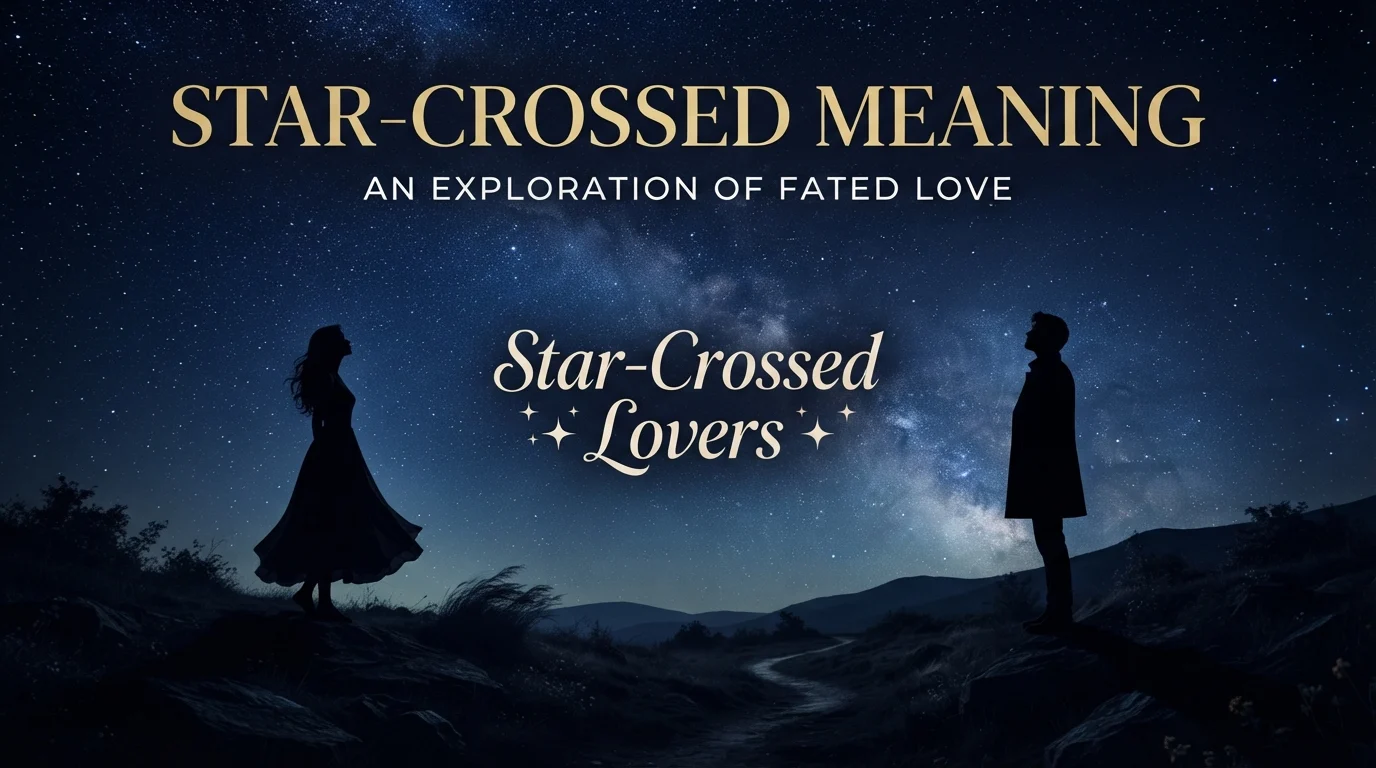
Have you ever heard someone describe two people as “star-crossed lovers”? This expression is often used to describe a couple who love each other but face serious obstacles that prevent them from being together. It is a poetic phrase commonly found in literature, romantic stories, movies, and everyday conversations.
The term “star-crossed” means destined to experience bad luck or difficulties, especially because circumstances seem to work against someone. It is often associated with love, fate, and tragic relationships. However, the expression can also describe friendships, plans, journeys, or other situations that seem doomed to fail despite people’s best efforts.
The phrase became especially famous through William Shakespeare’s play Romeo and Juliet, in which two young lovers belong to families that hate each other. Their love is powerful, but their circumstances lead to tragedy. In this article, you will learn the meaning of “star-crossed,” its origin, examples, synonyms, and how to use it correctly in English.
Quick Answer: Star-Crossed Meaning
Star-crossed means unlucky or seemingly destined to face misfortune because of circumstances beyond one’s control. It is most commonly used in the expression “star-crossed lovers,” referring to people who love each other but cannot be together because of unfortunate circumstances.
Example: “They were star-crossed lovers whose families refused to accept their relationship.”
What Does Star-Crossed Mean?
“Star-crossed” is an adjective used to describe someone or something that seems destined for misfortune.
The expression comes from the historical belief that the stars and planets influence human lives and determine people’s fortunes. If someone’s stars were thought to be unfavorably aligned, that person might be expected to experience bad luck.
Today, the phrase is usually figurative rather than literal. It describes situations in which circumstances repeatedly work against a person or prevent something from succeeding.
Examples:
- They were star-crossed lovers who could never live together.
- The star-crossed team lost every important match.
- Their star-crossed journey was filled with unexpected problems.
- It seemed that the star-crossed project was destined to fail.
The word often carries a dramatic, romantic, or literary tone.
What Does “Star-Crossed Lovers” Mean?
“Star-crossed lovers” refers to two people who love each other but face unfortunate circumstances that prevent them from having a happy relationship.
Their difficulties may come from family opposition, social expectations, distance, timing, conflict, or other obstacles beyond their control.
For example:
“Despite their deep love for each other, they were star-crossed lovers.”
This means that the couple’s relationship seemed doomed by unfortunate circumstances, even though they wanted to be together.
The phrase does not necessarily mean that the lovers do not love each other. In fact, their strong feelings often make their tragic situation more emotional.
Examples of Star-Crossed Lovers
- The young couple were star-crossed lovers because their families belonged to rival communities.
- Their story was about two star-crossed lovers separated by war.
- Everyone believed they were star-crossed lovers who would never find happiness together.
- The movie tells the story of star-crossed lovers who meet at the wrong time.
- They loved each other deeply, but fate seemed determined to keep them apart.
Origin of the Phrase “Star-Crossed”
The expression is associated with the old belief that the positions of stars and planets influence human destiny. In traditional astrology, unfavorable celestial arrangements were thought to bring bad luck or difficult circumstances.
The phrase became particularly famous through William Shakespeare’s tragedy Romeo and Juliet, published in the late sixteenth century.
In the play’s opening, Shakespeare describes Romeo and Juliet as “star-cross’d lovers.” Their relationship unfolds against a bitter conflict between their families, and the story ends tragically.
Because of this famous literary association, “star-crossed lovers” has become a widely recognized expression for people whose love is thwarted by circumstances that seem beyond their control.
Star-Crossed in a Sentence: 15 Examples
Here are 15 examples showing how to use “star-crossed” naturally.
- They were star-crossed lovers who could never overcome their families’ hatred.
- The novel tells the tragic story of two star-crossed lovers.
- Their star-crossed relationship ended despite their strong feelings.
- The movie follows a pair of star-crossed teenagers.
- He believed they were star-crossed lovers destined to part.
- The star-crossed journey was filled with delays and disappointments.
- Their star-crossed business venture failed because of a series of unexpected problems.
- The play explores the lives of star-crossed individuals struggling against fate.
- She wrote a poem about two star-crossed souls who never met again.
- Their plans seemed star-crossed from the very beginning.
- The story follows a star-crossed couple separated by a terrible misunderstanding.
- Despite years of effort, the star-crossed project never succeeded.
- The characters’ star-crossed romance gives the novel its tragic ending.
- They joked that their friendship was star-crossed because everything went wrong.
- The film presents a modern version of the classic star-crossed lovers story.
Although the phrase is especially common in romance and literature, it can also describe other unfortunate situations.
Star-Crossed vs Ill-Fated vs Doomed
These expressions are similar, but they have slightly different shades of meaning.
| Expression | Meaning | Example |
|---|---|---|
| Star-crossed | Seemingly destined for misfortune | They were star-crossed lovers. |
| Ill-fated | Unfortunate or ending badly | It was an ill-fated expedition. |
| Doomed | Certain or very likely to fail or end badly | Their plan was doomed from the start. |
| Unlucky | Experiencing bad luck | He was unlucky in the competition. |
| Tragic | Involving great sadness or suffering | It was a tragic love story. |
| Fated | Seemingly determined by destiny | They believed they were fated to meet. |
“Star-crossed” often suggests fate working against someone. “Ill-fated” emphasizes an unfortunate outcome, while “doomed” can sound stronger and suggest that failure is unavoidable.
Star-Crossed vs Soulmates
“Star-crossed” and “soulmates” are often used in romantic stories, but their meanings are different.
Star-crossed lovers are people who love each other but face circumstances that prevent their relationship from succeeding.
Soulmates are people who seem especially suited to each other or share a deep emotional connection.
Compare these examples:
- Star-crossed: They loved each other, but their families forced them apart.
- Soulmates: They understood each other perfectly and felt deeply connected.
A couple could be described as both star-crossed and soulmates if they have a strong connection but cannot remain together.
Is Star-Crossed Positive or Negative?
“Star-crossed” usually has a negative or tragic meaning because it suggests misfortune, obstacles, or an unhappy outcome.
However, when used to describe a love story, it can also sound romantic or poetic. The phrase emphasizes the intensity of the relationship and the difficulties the lovers face.
Examples:
- Negative: Their star-crossed business partnership ended in failure.
- Romantic and tragic: The novel tells the story of star-crossed lovers.
- Poetic: Their star-crossed paths crossed only once.
The emotional tone depends on the context, but the underlying idea generally involves unfortunate circumstances.
Common Mistakes When Using Star-Crossed
Mistake 1: Thinking It Means People Who Are Meant to Be Together
“Star-crossed” does not simply mean two people are destined to be together. It usually suggests that fate or circumstances work against them.
Incorrect interpretation: Star-crossed lovers always live happily together.
Better understanding: Star-crossed lovers often face obstacles that prevent them from being together.
Mistake 2: Using It as a Synonym for Soulmates
Soulmates share a deep connection, while star-crossed lovers face unfortunate circumstances that threaten or prevent their relationship.
The two expressions can overlap, but they are not interchangeable.
Mistake 3: Assuming It Only Applies to Romance
Although “star-crossed lovers” is the best-known expression, “star-crossed” can also describe a plan, journey, career, or project that seems destined for misfortune.
Example: Their star-crossed expedition was interrupted by storms and equipment failures.
Mistake 4: Writing “Star Crossed” Without a Hyphen
When used as the conventional compound adjective, the standard spelling is star-crossed.
Example: They were star-crossed lovers.
The hyphen helps show that the words function together as one descriptive expression.
Synonyms for Star-Crossed
Depending on the context, you can use these words and expressions instead of “star-crossed.”
- Ill-fated: Unfortunate or ending badly.
- Doomed: Likely or certain to fail.
- Unlucky: Experiencing bad luck.
- Tragic: Involving great sadness or suffering.
- Misfortunate: Experiencing or associated with misfortune.
- Fate-stricken: A literary expression suggesting that someone is overwhelmed by fate.
For romantic situations, “ill-fated lovers” is a particularly close alternative to “star-crossed lovers.”
Example: Their ill-fated romance ended before they could build a life together.
Frequently Asked Questions
1. What does star-crossed mean in simple English?
It means unlucky or seemingly destined to face difficulties. It is especially common when describing people whose love is prevented by unfortunate circumstances.
2. What does star-crossed lovers mean?
It describes two people who love each other but face obstacles that prevent them from being together or having a happy relationship.
3. Is star-crossed a romantic term?
It is often used in romantic stories, especially tragic love stories. However, it can also describe other situations that seem destined for failure.
4. Where did the phrase star-crossed come from?
The phrase reflects the old belief that the stars influence human destiny. It became particularly famous through Shakespeare’s Romeo and Juliet.
5. Does star-crossed mean doomed?
Not exactly, but the meanings overlap. “Star-crossed” suggests misfortune or circumstances working against someone, while “doomed” more strongly suggests that failure or disaster is inevitable.
6. Is star-crossed positive or negative?
It is generally negative because it suggests bad luck or unfortunate circumstances. In romantic contexts, it can also sound poetic and emotionally powerful.
7. Can I use star-crossed outside a love story?
Yes. You can use it to describe an unfortunate journey, unsuccessful project, or series of events that seem to work against someone.
8. What is another word for star-crossed lovers?
“Ill-fated lovers” is a close alternative. Both expressions describe lovers whose relationship faces unfortunate circumstances.
Remember This
- Star-crossed: Seemingly destined for misfortune.
- Star-crossed lovers: People who love each other but face obstacles that keep them apart.
- Origin: Associated with traditional beliefs about the influence of the stars on human destiny.
- Famous example: Romeo and Juliet by William Shakespeare.
- Similar expressions: Ill-fated, doomed, and unlucky.
- Spelling: Use a hyphen in “star-crossed” when writing the compound adjective.
Conclusion
“Star-crossed” is a descriptive English expression that refers to people or situations seemingly destined to experience misfortune. It is best known through the phrase “star-crossed lovers,” which describes a couple whose love is challenged by circumstances beyond their control. The expression is strongly associated with tragedy, fate, and romantic literature, particularly Shakespeare’s Romeo and Juliet.
To use the phrase correctly, remember that it does not simply mean two people are meant to be together. Instead, it suggests that unfortunate circumstances work against them. If you encounter it in a novel, a movie, or an everyday conversation, understanding this distinction will help you recognize its emotional and literary meaning.