The words state and status are often used in similar contexts, but they do not mean exactly the same thing. Both describe the condition or situation of a person, object, system, or process. However, state usually refers to the way something is at a particular time, while status often describes its current position, standing, progress, or official condition.
For example, you might ask about the state of someone’s health to understand their physical condition. However, you might ask about their health status to learn if they are healthy, ill, recovering, or receiving treatment.
Understanding the difference between state and status can help you choose the right word in everyday conversations, professional writing, academic work, and formal communication. This guide explains their meanings, grammatical uses, differences, and common examples so you can use both words correctly.
Quick Answer: What Is the Difference Between State and Status?
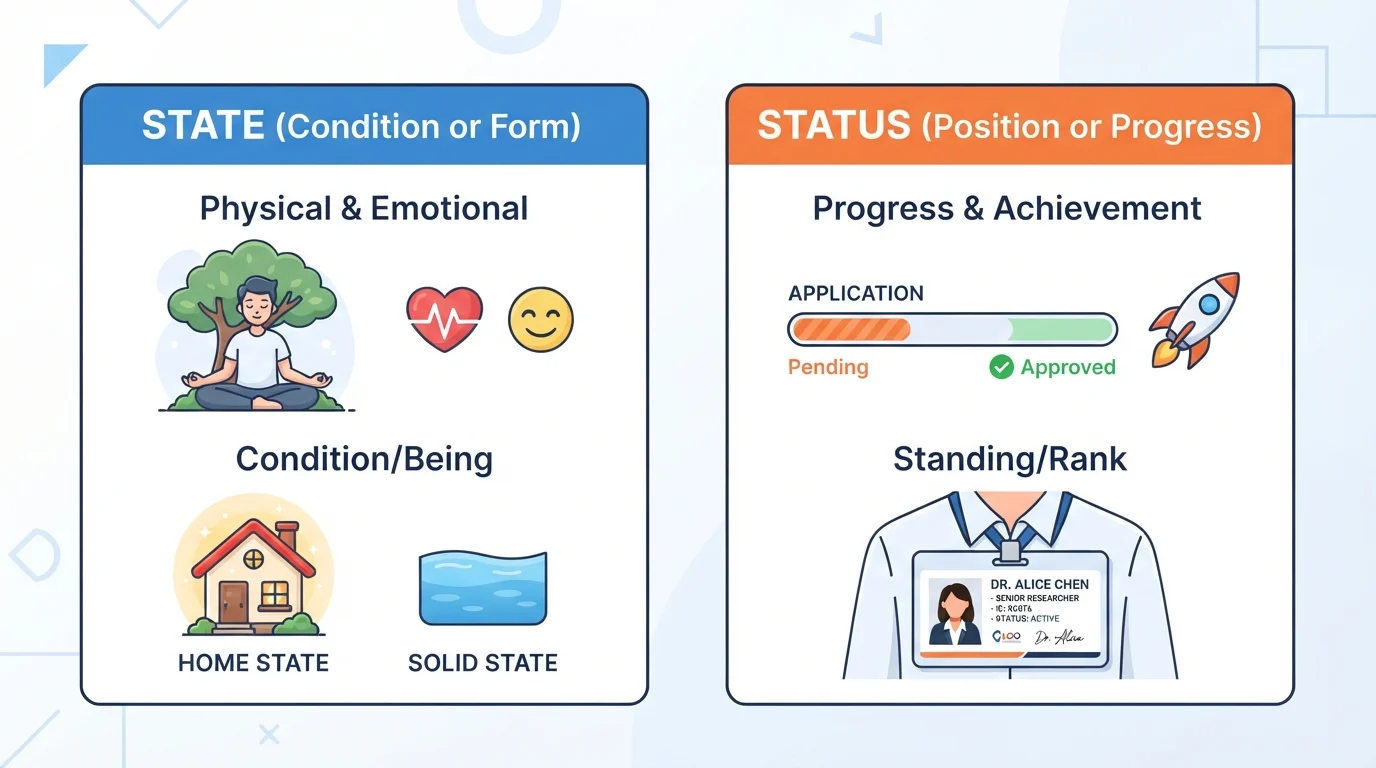
State refers to the condition or situation something is in at a particular time. Status refers to the position, standing, classification, or current progress of a person or thing.
For example:
- State: The house is in a poor state of repair.
- Status: What is the status of the house renovation?
In simple terms, state focuses mainly on condition, while status often focuses on position, standing, or progress.
What Does State Mean?
The noun state means the condition, situation, or form in which a person, object, or thing exists at a particular time.
It describes how something is, whether physically, mentally, emotionally, or functionally.
Examples of State in Sentences
- The car is in excellent state after the repair.
- She was in a state of confusion during the meeting.
- The building is in a dangerous state.
- His emotional state has improved recently.
- The machine must remain in a stable state.
- The country is in a state of emergency.
In these examples, state describes a condition or situation.
Common Expressions with State
Here are some common expressions that use the word state:
- State of mind: A person’s mental or emotional condition.
- State of health: Someone’s physical condition.
- State of affairs: The current situation or circumstances.
- State of emergency: An officially declared serious situation.
- In a state of shock: Experiencing extreme surprise or distress.
- Current state: The condition something is in now.
- Solid state: A physical form of matter or a condition involving solid material.
Is State a Verb?
Yes. State can also be used as a verb meaning to express, declare, or say something clearly.
Examples:
- Please state your full name.
- The report states that sales have increased.
- She stated her opinion during the discussion.
As a verb, state does not mean condition or position. It means to express information.
What Does Status Mean?
The noun status means the position, standing, classification, or current situation of a person or thing, especially in relation to a particular system, group, or process.
It often describes whether something is approved, pending, completed, active, inactive, or officially recognized.
Examples of Status in Sentences
- What is the status of your application?
- The company has achieved a strong market status.
- Her employment status changed last month.
- The delivery status shows that the package is on its way.
- He enjoys a high social status in his community.
- Please check the payment status before placing another order.
In these examples, status refers to position, classification, or progress.
Common Expressions with Status
Here are some frequently used expressions with status:
- Social status: A person’s position or standing in society.
- Employment status: Whether someone is employed, unemployed, or self employed.
- Relationship status: Whether someone is single, married, or in another relationship.
- Application status: The current stage or result of an application.
- Payment status: Whether a payment is pending, completed, or unsuccessful.
- Legal status: A person’s or organization’s position under the law.
- Current status: The present position or progress of something.
- Status update: New information about the progress or condition of a situation.
State vs Status: Key Differences
Although state and status sometimes overlap, their main difference lies in what they describe.
| State | Status |
|---|---|
| Refers mainly to a condition or situation. | Refers mainly to position, standing, or classification. |
| Describes how something is. | Describes where something stands or what position it holds. |
| Often relates to physical, mental, or emotional conditions. | Often relates to social, legal, professional, or administrative positions. |
| Can describe temporary or changing conditions. | Often identifies a recognized position or stage in a process. |
| Example: The patient is in a stable state. | Example: The patient’s status is improving. |
1. State Describes a Condition
Use state when you want to describe the way something or someone exists or feels.
Examples:
- The room was in a terrible state.
- He was in a relaxed state of mind.
- The water changed from a liquid state to a solid state.
2. Status Describes a Position or Standing
Use status when discussing someone’s position, classification, or progress within a particular situation or system.
Examples:
- Her immigration status is still being reviewed.
- The project status is currently pending.
- He has a high professional status.
3. State Can Describe Physical and Emotional Conditions
The word state is especially common when discussing physical, mental, and emotional conditions.
Examples:
- The patient is in a critical state.
- She was in a state of excitement.
- The equipment is in good working state.
4. Status Is Common in Official and Administrative Contexts
The word status frequently appears in forms, applications, reports, websites, and professional communication.
Examples:
- Check your order status online.
- His visa status has not changed.
- The employee’s status is listed as active.
When Should You Use State Instead of Status?
Use state when the main idea is the condition or quality of something at a particular time.
Consider these examples:
Correct: The old building is in a poor state.
Less natural: The old building is in a poor status.
The first sentence describes the building’s physical condition, so state is the appropriate choice.
More examples:
- The patient is in a stable state.
- The kitchen was left in a messy state.
- The country is in a difficult state.
- Her mental state is much better now.
- The device is in an inactive state.
When Should You Use Status Instead of State?
Use status when referring to a person’s position, official classification, social standing, or the progress of a process.
Consider these examples:
Correct: What is the status of my application?
Less natural: What is the state of my application?
The first sentence is more common when asking about whether an application is pending, approved, or rejected.
More examples:
- My employment status is full time.
- The payment status is still pending.
- His legal status has changed.
- What is your relationship status?
- The project status will be updated tomorrow.
Can State and Status Be Used Interchangeably?
Sometimes, yes. Both words can describe a current situation, but they are not interchangeable in every context.
For example:
- The state of the project is uncertain.
- The status of the project is uncertain.
Both sentences are grammatically correct, but their emphasis is slightly different.
The first focuses on the project’s overall condition. The second focuses more on its current position or progress.
Another example:
- The state of the economy is improving.
- The status of the economy is improving.
The first sentence is more natural because it refers to the economy’s overall condition. The second is possible in some contexts but sounds less common.
The best choice depends on what you want to communicate.
State vs Status in Different Contexts
The difference becomes easier to understand when you see how these words are used in specific situations.
1. In Health and Medicine
Both words are common in healthcare, but they can communicate different things.
- State of health: The person’s overall physical condition.
- Health status: The person’s health classification or current medical position.
Examples:
- The patient’s state of health is improving.
- The patient’s health status is listed as stable.
2. In Business and Work
State often describes the condition of a business, while status describes a project’s progress or an employee’s position.
Examples:
- The company is in a difficult financial state.
- The project status is awaiting approval.
3. In Technology
State often describes the condition of a system, application, or device. Status commonly communicates its current progress or availability.
Examples:
- The application is in an error state.
- The server status is currently online.
4. In Society
State can describe a person’s emotional or social condition, while status often refers to their social position or standing.
Examples:
- He was in a state of embarrassment.
- She has a respected social status.
5. In Government and Law
State can describe a country’s condition or an officially declared situation. Status often identifies a person’s legal classification or position.
Examples:
- The country is in a state of crisis.
- His legal status is under review.
Common Mistakes When Using State and Status
Even fluent English speakers sometimes confuse these words. Here are some mistakes to avoid.
Mistake 1: Using Status for Physical Condition
Incorrect: The furniture is in a bad status.
Correct: The furniture is in a bad state.
Use state to describe the physical condition of furniture, buildings, machines, and other objects.
Mistake 2: Using State for an Application’s Progress
Less natural: What is the state of my job application?
More natural: What is the status of my job application?
Use status when asking whether an application is pending, approved, rejected, or under review.
Mistake 3: Confusing Social State with Social Status
These expressions have different meanings.
- Social state: The condition or circumstances of society.
- Social status: A person’s position or standing in society.
Example: His social status has improved since he became a successful businessman.
Mistake 4: Assuming Status Always Means Condition
Although status can refer to a current situation, it often carries the additional meaning of position, standing, or classification.
For example, payment status tells you whether a payment is pending or completed. It does not simply describe the physical condition of the payment.
Easy Trick to Remember the Difference
Remember this simple distinction:
- State = Condition
- Status = Position or Progress
Ask yourself what information you want to communicate.
If you want to describe how something looks, feels, or functions, use state.
If you want to explain where someone or something stands in a system, process, or social structure, use status.
For example:
- The car is in a poor state. This describes its condition.
- The car’s registration status is pending. This describes its administrative position.
Frequently Asked Questions (FAQs)
1. What is the main difference between state and status?
State refers mainly to the condition or situation of something, while status refers mainly to its position, standing, classification, or progress. For example, the state of a building describes its physical condition, whereas the status of a building permit describes its approval stage.
2. Is state the same as status?
No. They have related meanings, but they are not exactly the same. State focuses on condition, while status usually focuses on position, standing, or progress. They can overlap when describing a general situation, but their usage depends on context.
3. Should I say current state or current status?
Both expressions are correct, but they are used differently. Use current state to describe the present condition of something. Use current status to describe its present position, classification, or progress.
Examples:
- The current state of the building is poor.
- The current status of the application is pending.
4. What is the difference between state of health and health status?
State of health generally refers to someone’s physical condition or overall well being. Health status often refers to their medical classification or current health position, such as healthy, stable, or recovering.
5. Is status more formal than state?
Not necessarily. Both words are used in formal and informal English. However, status is especially common in professional, administrative, legal, and social contexts, while state is widely used to describe physical, mental, and emotional conditions.
6. What does status quo mean?
Status quo means the existing situation or current state of affairs. It refers to the way things are at present, especially when discussing whether a situation should remain unchanged.
Example: The management decided to maintain the status quo.
7. Can I say the state of my application?
Yes, the phrase is grammatically possible, especially when discussing the general condition of an application. However, the status of my application is more natural and commonly used when asking whether it is pending, approved, or rejected.
Conclusion
The difference between state and status is mainly about condition versus position. State describes how someone or something is at a particular time, while status describes a person’s or thing’s position, standing, classification, or progress.
Use state when discussing physical, mental, emotional, or general conditions. Use status when talking about applications, payments, employment, legal positions, social standing, or project progress.
Remember this simple rule: State means condition, while status means position or progress. Understanding this distinction will help you use both words naturally and accurately in everyday and professional English.