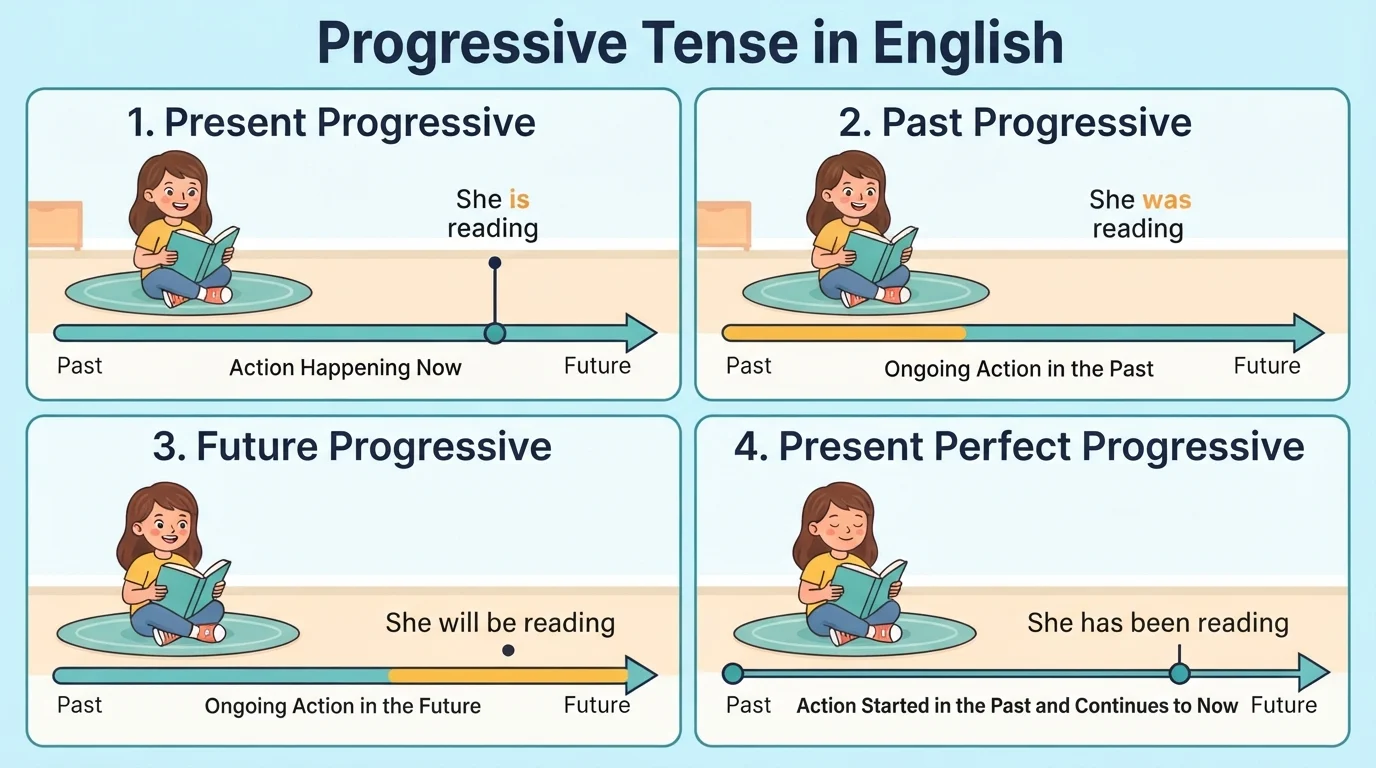
The progressive tense, also known as the continuous tense, is an important part of English grammar. It describes actions that are happening at a particular moment, were continuing in the past, will be happening in the future, or have been continuing for a period of time.
For example, in the sentence She is reading a book, the action of reading is in progress at the time of speaking. Similarly, They were playing football describes an action that was continuing at a particular time in the past.
Understanding the progressive tense helps you describe ongoing activities, explain what is happening, and communicate more naturally in English. In this guide, you will learn the meaning of progressive tense, its structure, all four types, useful examples, common mistakes, and the difference between progressive and simple tenses.
Quick Answer: What Is the Progressive Tense?
The progressive tense is a verb form used to describe an action that is ongoing or in progress at a particular time.
It is formed by combining a suitable form of the helping verb be with the present participle of the main verb, which usually ends in ing.
Examples:
- Present progressive: She is cooking dinner.
- Past progressive: She was cooking dinner.
- Future progressive: She will be cooking dinner.
- Present perfect progressive: She has been cooking dinner for an hour.
The progressive tense is also called the continuous tense. Both terms refer to the same grammatical forms.
What Does Progressive Tense Mean?
The word progressive refers to something that is developing, continuing, or moving forward.
In English grammar, the progressive tense shows that an action is happening over a period of time rather than being presented simply as a fact or completed event.
For example:
- Simple present: He plays football.
- Present progressive: He is playing football.
The first sentence describes a habit or regular activity. The second tells us that he is playing football now or around the present time.
Progressive forms can describe actions that are happening now, were happening in the past, will be happening in the future, or started earlier and are still continuing.
How Is the Progressive Tense Formed?
The progressive tense uses two main elements:
- A suitable form of the helping verb be.
- The present participle of the main verb, usually ending in ing.
The helping verb changes according to the subject and the time being described.
Basic Structure
Subject + be verb + verb ending in ing
Examples:
- I am studying.
- She is dancing.
- They are working.
- He was sleeping.
- We will be traveling.
Forms of the Helping Verb Be
| Form | Helping verb |
|---|---|
| Present | am, is, are |
| Past | was, were |
| Future | will be |
| Present perfect | has been, have been |
| Past perfect | had been |
The correct form depends on the tense and the subject of the sentence.
What Are the Four Types of Progressive Tense?
English grammar commonly teaches four progressive forms:
- Present progressive tense
- Past progressive tense
- Future progressive tense
- Present perfect progressive tense
Each form describes an ongoing action from a different time perspective.
1. Present Progressive Tense
The present progressive tense, also called the present continuous tense, describes an action happening now or around the current time.
It can also describe temporary situations and planned future arrangements.
Structure
Subject + am/is/are + verb ending in ing
| Subject | Helping verb | Example |
|---|---|---|
| I | am | I am learning English. |
| He/She/It | is | She is watching television. |
| You/We/They | are | They are playing outside. |
Examples of Present Progressive Tense
- I am writing an email.
- She is preparing breakfast.
- They are watching a movie.
- He is studying for his examination.
- We are waiting for the bus.
- The children are playing in the garden.
- It is raining outside.
Negative Sentences
To make a negative sentence, add not after the helping verb.
Structure: Subject + am/is/are + not + verb ending in ing.
Examples:
- I am not sleeping.
- She is not working today.
- They are not listening to music.
- He is not driving the car.
Interrogative Sentences
To ask a question, place the helping verb before the subject.
Structure: Am/Is/Are + subject + verb ending in ing?
Examples:
- Are you studying?
- Is she cooking dinner?
- Am I speaking too quickly?
- Are they coming with us?
2. Past Progressive Tense
The past progressive tense, also called the past continuous tense, describes an action that was happening at a particular time in the past.
It is often used when one action was in progress and another action interrupted it.
Structure
Subject + was/were + verb ending in ing
| Subject | Helping verb | Example |
|---|---|---|
| I/He/She/It | was | He was sleeping. |
| You/We/They | were | They were studying. |
Examples of Past Progressive Tense
- I was reading a book last night.
- She was cooking when I arrived.
- They were playing cricket at 5 p.m.
- He was watching television.
- We were traveling to Lahore.
- The baby was crying.
- It was raining when we left home.
Negative Sentences
Structure: Subject + was/were + not + verb ending in ing.
Examples:
- I was not sleeping.
- She was not paying attention.
- They were not working yesterday.
- We were not waiting outside.
Interrogative Sentences
Structure: Was/Were + subject + verb ending in ing?
Examples:
- Were you studying last night?
- Was he driving the car?
- Were they watching television?
- Was she waiting for you?
3. Future Progressive Tense
The future progressive tense, also called the future continuous tense, describes an action that will be in progress at a particular time in the future.
It is useful when discussing future activities that are expected to continue for some time.
Structure
Subject + will be + verb ending in ing
Examples of Future Progressive Tense
- I will be studying tonight.
- She will be traveling tomorrow.
- They will be playing football in the afternoon.
- He will be working at 9 a.m.
- We will be waiting for you.
- The children will be sleeping by then.
- My parents will be visiting us next week.
Negative Sentences
Structure: Subject + will not be + verb ending in ing.
Examples:
- I will not be working tomorrow.
- She will not be attending the meeting.
- They will not be staying here.
- He will not be traveling next week.
Interrogative Sentences
Structure: Will + subject + be + verb ending in ing?
Examples:
- Will you be studying tonight?
- Will she be joining us?
- Will they be waiting outside?
- Will he be working tomorrow?
4. Present Perfect Progressive Tense
The present perfect progressive tense, also called the present perfect continuous tense, describes an action that started in the past and continues into the present or has recently stopped with a present result.
It often emphasizes how long an action has been happening.
Structure
Subject + has/have been + verb ending in ing
| Subject | Helping verbs | Example |
|---|---|---|
| I/You/We/They | have been | They have been working. |
| He/She/It | has been | She has been studying. |
Examples of Present Perfect Progressive Tense
- I have been learning English for two years.
- She has been working here since 2022.
- They have been playing cricket for an hour.
- He has been waiting for the bus.
- We have been studying all morning.
- It has been raining since yesterday.
- The children have been watching television for two hours.
Using For and Since
The present perfect progressive often appears with for and since.
- For refers to a period of time.
- Since refers to the starting point of an action.
Examples with for:
- I have been studying for three hours.
- She has been working for five years.
- They have been waiting for twenty minutes.
Examples with since:
- I have been living here since 2020.
- He has been sleeping since noon.
- We have been learning English since January.
Negative Sentences
Structure: Subject + has/have + not + been + verb ending in ing.
Examples:
- I have not been sleeping well.
- She has not been attending classes.
- They have not been working recently.
- He has not been feeling well.
Interrogative Sentences
Structure: Has/Have + subject + been + verb ending in ing?
Examples:
- Have you been studying?
- Has she been working here for long?
- Have they been waiting?
- Has he been learning English?
Progressive Tense Chart
The following table summarizes the four main progressive forms.
| Tense | Structure | Example |
|---|---|---|
| Present progressive | am/is/are + ing | She is reading. |
| Past progressive | was/were + ing | She was reading. |
| Future progressive | will be + ing | She will be reading. |
| Present perfect progressive | has/have been + ing | She has been reading. |
This chart can help you remember the basic structure of each form.
Progressive Tense vs Simple Tense
The progressive and simple forms have different purposes. The simple tense generally presents facts, habits, routines, or events, while the progressive tense emphasizes an action in progress.
| Simple tense | Progressive tense |
|---|---|
| I study English. | I am studying English. |
| She cooked dinner. | She was cooking dinner. |
| They will travel tomorrow. | They will be traveling tomorrow. |
| He works here. | He is working here. |
Examples That Explain the Difference
1. Present simple vs present progressive
- I work in an office. This describes my regular job.
- I am working in the office. This describes an activity happening now or around now.
2. Past simple vs past progressive
- She watched television. This presents the action as a completed past event.
- She was watching television. This describes an action that was in progress at a past time.
3. Future simple vs future progressive
- I will study tonight. This describes a future action.
- I will be studying at 8 p.m. This emphasizes that the action will be in progress at that time.
When Do We Use the Progressive Tense?
Progressive forms have several important uses in English.
1. To Describe Actions Happening Now
Use the present progressive for activities happening at the time of speaking.
Examples:
- I am eating lunch.
- She is talking on the phone.
- They are playing football.
2. To Describe Temporary Situations
The present progressive can describe situations that are temporary rather than permanent.
Examples:
- I am staying with my friend this week.
- She is working from home this month.
- They are living in a rented apartment.
3. To Describe Interrupted Actions
Use the past progressive to describe an action that was happening when another event occurred.
Examples:
- I was sleeping when the phone rang.
- She was cooking when the lights went out.
- They were playing when it started raining.
4. To Describe Two Actions Happening at the Same Time
The past progressive can show that two activities were happening simultaneously.
Examples:
- I was reading while my brother was watching television.
- She was cooking while he was cleaning the kitchen.
- They were talking while we were waiting.
5. To Describe Future Activities in Progress
Use the future progressive to discuss activities that will be continuing at a specific future time.
Examples:
- I will be working at 10 a.m.
- She will be traveling this time tomorrow.
- They will be attending the conference next week.
6. To Emphasize the Duration of an Activity
The present perfect progressive highlights how long an activity has continued.
Examples:
- I have been studying for three hours.
- She has been waiting since morning.
- They have been working on the project all week.
How to Add ing to Verbs
Most progressive forms require the present participle of the main verb. Usually, you add ing to the base form, but some spelling changes are necessary.
1. Add ing to Most Verbs
Examples:
- Play becomes playing.
- Read becomes reading.
- Work becomes working.
- Eat becomes eating.
2. Drop the Final e
For many verbs ending in a silent e, remove the e before adding ing.
Examples:
- Make becomes making.
- Write becomes writing.
- Dance becomes dancing.
- Come becomes coming.
3. Double the Final Consonant
For some short verbs ending in a consonant after a single vowel, double the final consonant before adding ing.
Examples:
- Run becomes running.
- Sit becomes sitting.
- Swim becomes swimming.
- Stop becomes stopping.
4. Change ie to y
For verbs ending in ie, replace ie with y before adding ing.
Examples:
- Lie becomes lying.
- Die becomes dying.
- Tie becomes tying.
Verbs That Are Not Usually Used in the Progressive Tense
Some verbs describe states, feelings, possession, thoughts, or senses rather than actions. These are called stative verbs. They are not usually used in progressive forms when they have their normal stative meanings.
Common examples include:
- Know
- Believe
- Understand
- Own
- Belong
- Prefer
- Need
- Want
- Seem
Examples:
Incorrect: I am knowing the answer.
Correct: I know the answer.
Incorrect: She is owning a car.
Correct: She owns a car.
Incorrect: They are believing him.
Correct: They believe him.
However, some verbs can be used in progressive forms when their meanings change.
For example:
- I think you are right. Here, think means believe or have an opinion.
- I am thinking about your suggestion. Here, thinking describes an ongoing mental activity.
Common Mistakes in Progressive Tense
Learners often make mistakes when choosing helping verbs or forming progressive sentences. Here are some common errors and their corrections.
| Incorrect sentence | Correct sentence |
|---|---|
| She are cooking. | She is cooking. |
| They was playing. | They were playing. |
| I am study English. | I am studying English. |
| He is go to school. | He is going to school. |
| She has been work here. | She has been working here. |
| I am knowing him. | I know him. |
Mistake 1: Forgetting the Helping Verb
Incorrect: She reading a book.
Correct: She is reading a book.
A progressive sentence needs an appropriate form of be.
Mistake 2: Using the Wrong Helping Verb
Incorrect: They is playing outside.
Correct: They are playing outside.
Use are with plural subjects such as they and we.
Mistake 3: Forgetting ing
Incorrect: He is play football.
Correct: He is playing football.
The main verb must be in its present participle form.
Mistake 4: Using Progressive Forms with Stative Verbs
Incorrect: I am understanding the lesson.
Correct: I understand the lesson.
Some verbs are not normally used in progressive forms when describing a state.
Progressive Tense Examples in Everyday English
Here are additional examples to help you understand how progressive forms work in everyday communication.
Present progressive:
- I am making tea.
- She is cleaning her room.
- We are learning new words.
- The teacher is explaining the lesson.
Past progressive:
- I was walking home.
- He was talking to his friend.
- They were preparing dinner.
- We were watching a football match.
Future progressive:
- I will be studying tomorrow.
- She will be working late.
- We will be traveling next month.
- They will be waiting for us.
Present perfect progressive:
- I have been practicing English.
- He has been working all day.
- They have been discussing the issue.
- We have been waiting for an hour.
Frequently Asked Questions (FAQs)
1. What is the progressive tense in English?
The progressive tense is a verb form used to describe actions that are ongoing or in progress at a particular time. It is formed with a suitable form of the helping verb be and the present participle of the main verb, which usually ends in ing.
2. Is progressive tense the same as continuous tense?
Yes. Progressive tense and continuous tense are two names for the same grammatical forms. For example, present progressive and present continuous both refer to sentences such as She is reading a book.
3. How many types of progressive tense are there?
English grammar commonly teaches four progressive forms: present progressive, past progressive, future progressive, and present perfect progressive. Each form describes an ongoing action from a different time perspective.
4. What is the formula for progressive tense?
The basic formula is a suitable form of the verb be followed by the present participle of the main verb. For example, present progressive uses am/is/are + verb ending in ing, while past progressive uses was/were + verb ending in ing.
5. What is the difference between progressive and simple tense?
Simple tense generally describes facts, habits, routines, or events. Progressive tense emphasizes an action that is happening or was happening over a period of time. For example, I read every day describes a habit, while I am reading now describes an ongoing activity.
6. Can we use the progressive tense for future actions?
Yes. The future progressive describes an action that will be in progress at a particular future time. For example, I will be working at 9 a.m. tomorrow.
7. Why are some verbs not used in the progressive tense?
Some verbs, known as stative verbs, describe conditions, feelings, possession, or mental states rather than ongoing actions. They are not usually used in progressive forms with those meanings. For example, we normally say I know the answer, not I am knowing the answer.
8. What is an example of present perfect progressive tense?
An example is She has been studying for two hours. This sentence describes an activity that began in the past and continues into the present, emphasizing its duration.
Conclusion
The progressive tense is used to describe actions that are continuing or in progress at a particular time. It is also known as the continuous tense and has four commonly taught forms: present progressive, past progressive, future progressive, and present perfect progressive.
Each form uses a helping verb and a main verb ending in ing. The helping verb changes depending on the subject and the time being discussed.
To use progressive forms correctly, learn their sentence structures, understand when to use each form, and pay attention to stative verbs. With regular practice and everyday examples, you can use the progressive tense more confidently in both speaking and writing.