Are you confused about if to use rather than or instead of? Both expressions are used to show a preference, choice, or replacement between two things. They often have similar meanings, but their grammatical structures are different. Knowing when to use each expression can help you write more naturally and avoid common English grammar mistakes.
For example, you can say, “I prefer tea rather than coffee” or “I drink tea instead of coffee.” Both sentences communicate a choice, but they use different sentence structures.
The good news is that the difference is easy to understand once you learn the basic rules. In this guide, you will discover the meanings of rather than and instead of, their grammatical differences, practical examples, common mistakes, and tips for choosing the correct expression.
Quick Answer: Rather Than vs Instead Of
Rather than and instead of both express preference, choice, or substitution. However, they are generally followed by different grammatical structures. Rather than can connect words, phrases, or clauses and is often used to express preference. Instead of is a preposition followed by a noun, pronoun, or gerund, which is a verb ending in -ing. For example, “I decided to walk rather than drive” and “I walked instead of driving.” Both express a similar choice, but their grammatical patterns differ.
What Does Rather Than Mean?
Rather than is an expression used to show preference, contrast, or a choice between two alternatives. It means instead of, as opposed to, or in preference to, depending on the context.
It is commonly used when someone chooses one action, person, or thing over another.
Examples of Rather Than in Sentences
- I prefer reading rather than watching television.
- She decided to walk rather than take a taxi.
- We should focus on solutions rather than problems.
- He chose to apologize rather than argue.
- They invested in education rather than entertainment.
In these examples, rather than introduces the alternative that was not chosen or the option being contrasted.
How to Use Rather Than Correctly
Rather than can be used with different grammatical structures.
1. Rather Than With Nouns
- I prefer tea rather than coffee.
- She chose honesty rather than popularity.
- He values experience rather than money.
2. Rather Than With Verbs
- I decided to stay rather than leave.
- She chose to study rather than play.
- He prefers to listen rather than speak.
3. Rather Than With Gerunds
- He enjoys walking rather than driving.
- She prefers reading rather than writing.
- They spent their time working rather than relaxing.
4. Rather Than With Clauses
- Rather than complain about the problem, we should find a solution.
- Rather than wait for someone else, she decided to take action.
- Rather than argue about the decision, they agreed to discuss it calmly.
What Does Instead Of Mean?
Instead of is a prepositional expression that means in place of or as a substitute for something else.
It is used when one person, action, or thing replaces another.
Unlike rather than, instead of is normally followed by a noun, pronoun, or gerund.
Examples of Instead Of in Sentences
- I drank water instead of soda.
- She took the bus instead of a taxi.
- He watched a movie instead of studying.
- We ordered pizza instead of cooking dinner.
- They used email instead of traditional letters.
In these examples, instead of identifies what was replaced or not chosen.
How to Use Instead Of Correctly
1. Instead Of With Nouns
Use instead of before a noun when one thing replaces another.
Examples:
- I bought juice instead of milk.
- She wore a dress instead of trousers.
- We chose a hotel instead of a guesthouse.
- He ordered chicken instead of fish.
2. Instead Of With Pronouns
Use the object form of a pronoun after instead of.
Examples:
- I invited her instead of him.
- They selected us instead of them.
- She spoke to me instead of you.
3. Instead Of With Gerunds
When a verb follows instead of, use its gerund form, which ends in -ing.
Examples:
- She watched television instead of studying.
- He went jogging instead of sleeping.
- I called my friend instead of sending a message.
- They played outside instead of staying indoors.
4. Instead Of at the Beginning of a Sentence
You can also begin a sentence with instead of to introduce an alternative action.
Examples:
- Instead of arguing, we should work together.
- Instead of buying a new phone, he repaired his old one.
- Instead of wasting time, start working on your assignment.
Rather Than vs Instead Of: Key Differences
The main difference between these expressions is their grammatical structure and how they introduce alternatives.
| Feature | Rather Than | Instead Of |
|---|---|---|
| Meaning | In preference to or as opposed to | In place of or as a substitute for |
| Grammar | Conjunction or preposition, depending on use | Prepositional expression |
| Followed by | Nouns, phrases, verbs, or clauses | Nouns, pronouns, or gerunds |
| Main purpose | Shows preference or contrast | Shows replacement or substitution |
| Example | She chose to walk rather than drive. | She walked instead of driving. |
Remember: Rather than is flexible and can connect different grammatical structures. Instead of is normally followed by a noun, pronoun, or gerund.
Rather Than vs Instead Of: Sentence Comparison
The following examples show how both expressions can communicate similar meanings.
| Rather Than | Instead Of |
|---|---|
| I prefer tea rather than coffee. | I drink tea instead of coffee. |
| She decided to walk rather than drive. | She walked instead of driving. |
| He chose to study rather than play. | He studied instead of playing. |
| We stayed home rather than go out. | We stayed home instead of going out. |
| They used a laptop rather than a desktop computer. | They used a laptop instead of a desktop computer. |
Notice that the meaning is often similar, but the sentence structure changes.
Can You Use Rather Than and Instead Of Interchangeably?
Sometimes, yes. Both expressions can introduce alternatives, but they are not interchangeable in every sentence because their grammatical patterns differ.
Consider these examples:
Rather than: She decided to read rather than watch television.
Instead of: She decided to read instead of watching television.
Both sentences are correct and express the same general choice.
However, consider this sentence:
“Instead of watching television, she read a book.”
You cannot simply replace instead of with rather than without adjusting the sentence structure.
Correct: Rather than watch television, she read a book.
Incorrect: Rather than watching television, she read a book.
The last sentence is not necessarily ungrammatical in all contexts, but it can create a mismatch in the structure of the comparison. A more natural construction is to use parallel forms.
Rather Than vs Instead Of With Gerunds
One common question among English learners is whether to use a gerund after rather than and instead of.
The rule is straightforward:
- Instead of is followed by a gerund when a verb comes after it.
- Rather than can be followed by either a bare infinitive or a gerund, depending on the sentence structure and the form being compared.
Examples:
Instead of:
- He slept instead of studying.
- She cooked instead of ordering food.
- They walked instead of taking a bus.
Rather than:
- He chose to sleep rather than study.
- She enjoys cooking rather than ordering food.
- They preferred walking rather than taking a bus.
The most important point is to keep the grammatical structures parallel whenever possible.
Rather Than vs Instead Of in Formal and Informal English
Both expressions are acceptable in formal and informal English. However, the choice depends on the meaning and sentence structure.
| Context | Rather Than | Instead Of |
|---|---|---|
| Everyday conversation | Common | Very common |
| Academic writing | Common for comparisons and preferences | Common for alternatives and substitutions |
| Business writing | Useful for expressing priorities | Useful for describing replacements |
| Formal communication | Appropriate | Appropriate |
| Spoken English | Natural | Natural |
Examples:
Formal: The organization prioritized long term development rather than short term gains.
Formal: The company adopted digital records instead of paper documents.
Informal: I’d rather stay home than go out.
Informal: Let’s order food instead of cooking tonight.
Rather Than vs Would Rather
Do not confuse rather than with would rather. They are related expressions, but they follow different grammatical patterns.
Would rather is used to express what someone prefers to do.
Examples:
- I would rather stay home.
- She would rather travel by train.
- They would rather wait until tomorrow.
When comparing two actions, use would rather … than.
Examples:
- I would rather walk than drive.
- She would rather read than watch television.
- He would rather work from home than commute every day.
Remember that would rather is followed by the base form of a verb, not a gerund.
Incorrect: I would rather walking than driving.
Correct: I would rather walk than drive.
Common Mistakes to Avoid
Mistake 1: Using a Gerund Incorrectly After Instead Of
Incorrect: She studied instead of play.
Correct: She studied instead of playing.
When a verb follows instead of, use its -ing form.
Mistake 2: Confusing Rather Than With Would Rather
Incorrect: I rather to stay home than go outside.
Correct: I would rather stay home than go outside.
Use would rather to express a personal preference.
Mistake 3: Mixing Different Grammatical Structures
Awkward: She prefers reading rather than to watch television.
Better: She prefers reading rather than watching television.
Better: She prefers to read rather than watch television.
Keep the compared actions grammatically parallel.
Mistake 4: Using Instead Of With the Wrong Pronoun Form
Incorrect: She invited I instead of he.
Correct: She invited me instead of him.
Use object pronouns such as me, him, her, us, and them after instead of.
Mistake 5: Assuming Both Expressions Always Have Exactly the Same Meaning
Rather than often emphasizes preference or contrast, while instead of more directly describes substitution or replacement. Although their meanings overlap, the context can make one expression more suitable than the other.
Easy Trick to Remember the Difference
Use this simple memory trick:
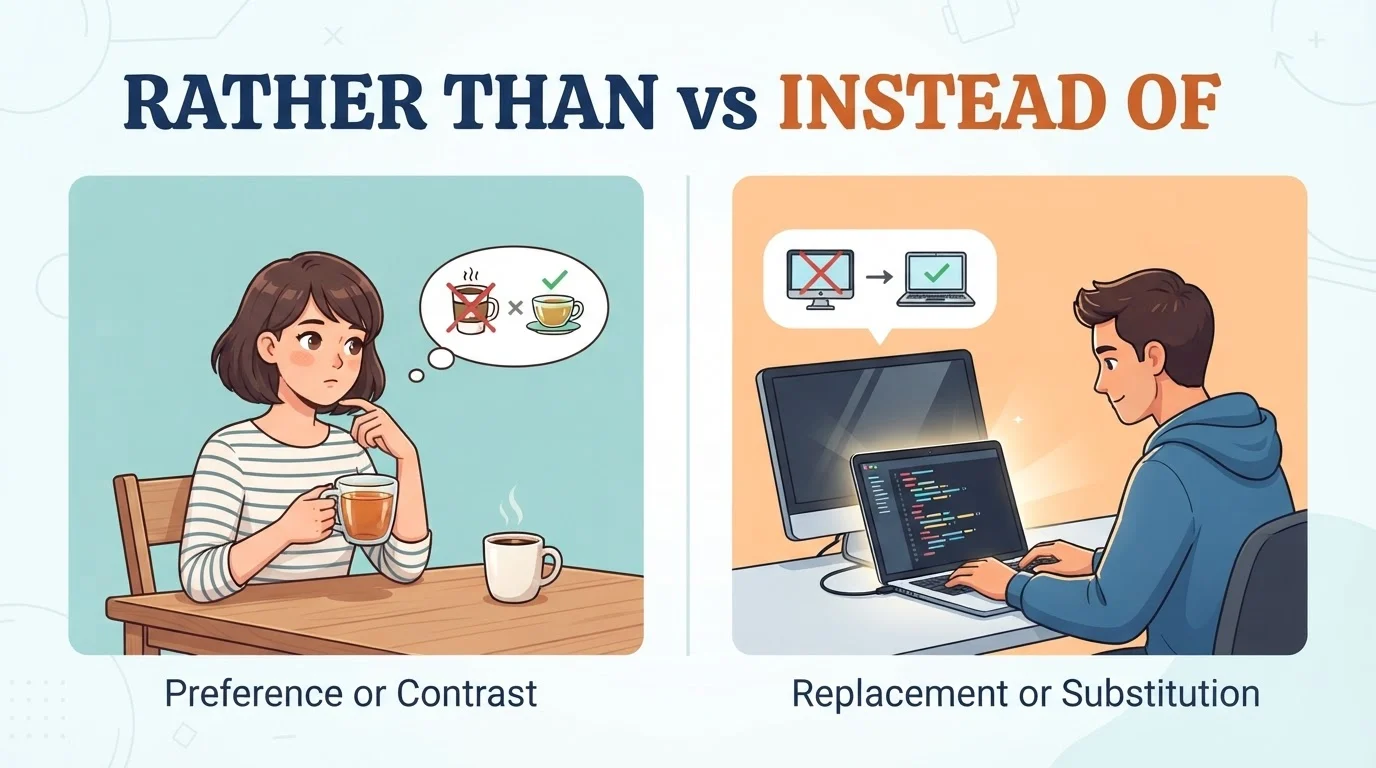
Rather than = Preference or contrast.
Instead of = Replacement or substitution.
Think about these examples:
- I chose tea rather than coffee.
- I drank tea instead of coffee.
Both sentences communicate a choice, but the first emphasizes the preference, while the second emphasizes the replacement.
Also remember this grammar rule:
Instead of + noun, pronoun, or verb ending in -ing.
For example:
- Instead of tea
- Instead of him
- Instead of studying
Frequently Asked Questions
1. What is the difference between rather than and instead of?
Rather than is commonly used to express preference or contrast between alternatives. Instead of describes something being used or done in place of another thing. Both can have similar meanings, but their grammatical structures differ.
2. Are rather than and instead of interchangeable?
They are interchangeable in some sentences, but not all. Both can introduce alternatives, but instead of is normally followed by a noun, pronoun, or gerund, whereas rather than can connect a wider range of grammatical structures.
3. Do you use a gerund after instead of?
Yes. When a verb follows instead of, it normally takes the gerund form ending in -ing. For example, “He watched television instead of studying.”
4. Can you use a verb after rather than?
Yes. Rather than can be followed by a base verb, a gerund, or a longer clause, depending on the sentence structure. For example, “She chose to walk rather than drive.”
5. Is rather than formal or informal?
Rather than is appropriate in both formal and informal English. It is commonly used in academic writing, professional communication, and everyday conversations to express preference or contrast.
6. What is another way to say instead of?
Common alternatives include in place of, rather than, as an alternative to, and in lieu of. The best choice depends on the context and grammatical structure.
7. Is it correct to say rather than instead of?
Yes, both expressions are correct, but you should choose the one that fits your intended meaning and sentence structure. Avoid using them together unnecessarily.
8. What is the difference between would rather and rather than?
Would rather expresses someone’s preference, as in “I would rather stay home.” Rather than introduces an alternative or contrast, as in “I stayed home rather than go out.” The expression would rather can also be followed by than when comparing two actions.
Conclusion
The expressions rather than and instead of are both used to introduce alternatives, preferences, and choices. However, they have different grammatical patterns and are not interchangeable in every situation.
Use rather than when expressing preference or contrasting two alternatives. Use instead of when explaining that one thing or action replaces another. Remember that instead of is followed by a noun, pronoun, or gerund when a verb is used.
The easiest rule to remember is: Rather than emphasizes preference or contrast, while instead of emphasizes replacement.