Have you ever wondered whether to write “anywhere” as one word or “any where” as two words? Although the two forms look similar, they are not interchangeable in everyday English. Choosing the correct form can make your writing clearer and help you avoid common grammar mistakes.
The good news is that the difference is simple. Anywhere is the standard one word form used to refer to any place or location. It is common in questions, negative sentences, positive sentences, and expressions about freedom or possibility. Any where, written as two separate words, is rarely correct in modern English because the words usually need to be written together when they express the idea of “any place.”
In this guide, you will learn the meaning of anywhere, when to use it, why any where is usually incorrect, and how to remember the difference. You will also find practical examples, common mistakes, synonyms, and answers to frequently asked questions.
Quick Answer: Anywhere vs Any Where
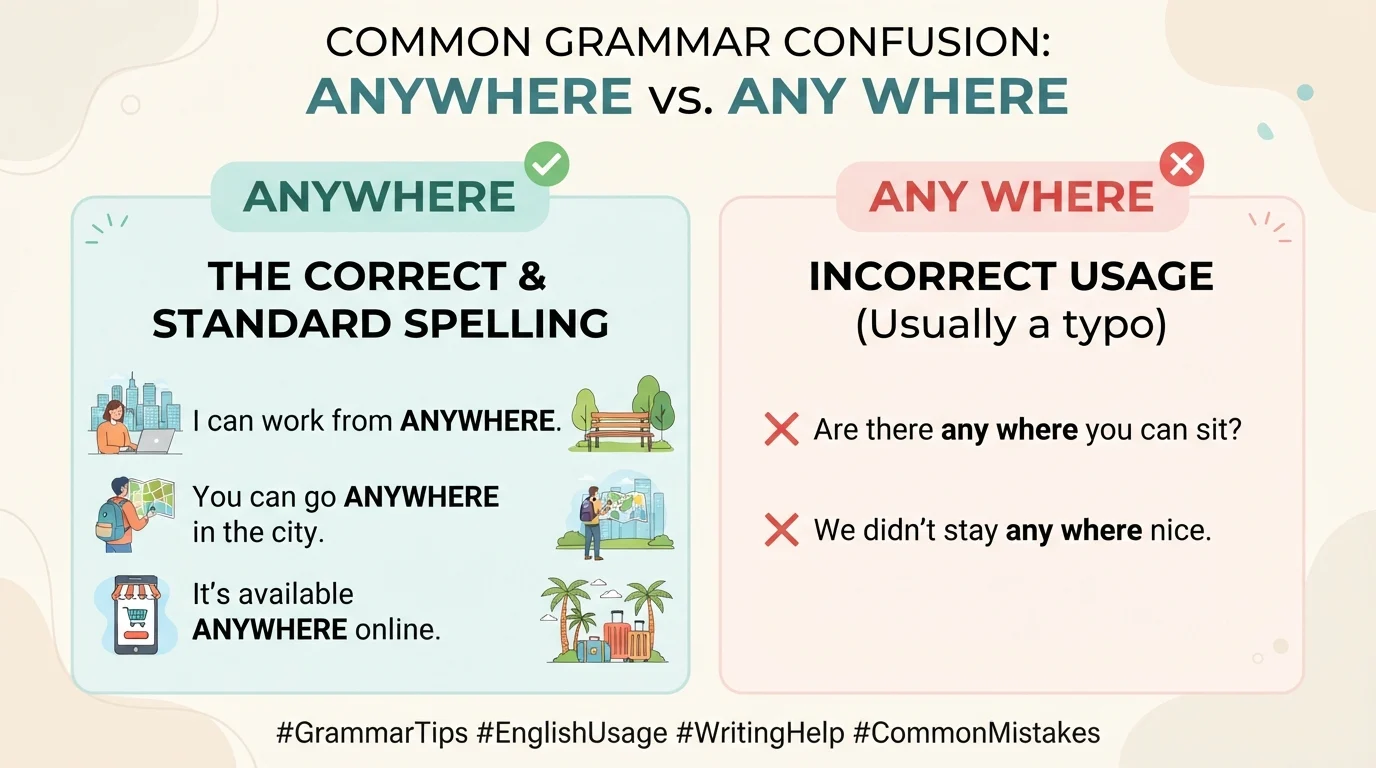
Anywhere is the correct and standard spelling when you mean any place or location.
Example: You can sit anywhere you like.
Any where is generally incorrect when you mean any place. In ordinary modern English, write the word as one word: anywhere.
1. What Does Anywhere Mean?
Anywhere is an adverb or pronoun that means any place, no matter where, or in any location.
It is commonly used when the exact place is unknown, unimportant, or unrestricted.
Examples of Anywhere
- You can find a taxi anywhere in the city.
- I cannot find my phone anywhere.
- Would you like to go anywhere this weekend?
- She can work anywhere with an internet connection.
- I looked everywhere, but I could not find it anywhere.
- You may sit anywhere in the room.
- Is there anywhere nearby where we can eat?
- He would go anywhere to help his family.
- I do not want to go anywhere tonight.
- You can put your bag anywhere you want.
In all these sentences, anywhere refers to a place or location. That is why it is written as one word.
2. What Does Any Where Mean?
Any where is not the normal spelling when you want to say “any place.” In standard modern English, the words are combined to form anywhere.
However, the separate words any and where can occasionally appear next to each other when they perform separate grammatical functions. This is uncommon and depends on the structure and meaning of the sentence.
For example, in the sentence “Choose any where you want to sit,” the wording is awkward and should usually be revised to “Choose anywhere you want to sit.”
For everyday writing, schoolwork, emails, exams, and professional communication, use anywhere whenever you mean “any place.”
3. Anywhere vs Any Where: Main Differences
| Feature | Anywhere | Any where |
|---|---|---|
| Spelling | One word | Two words |
| Standard usage | Correct for “any place” | Usually incorrect for “any place” |
| Meaning | Any place or location | No usual independent meaning as a phrase |
| Common in modern English | Yes | Rare |
| Suitable for formal writing | Yes | Generally avoid |
| Example | You can go anywhere. | Write “You can go anywhere.” |
The key point is that anywhere is the standard spelling when talking about a place without specifying which place.
4. When Should You Use Anywhere?
Use anywhere in the following situations.
A. In Questions
Use anywhere when asking whether a place exists or whether someone wants to go to a place.
Examples:
- Is there anywhere I can park?
- Are you going anywhere tomorrow?
- Can we find anywhere to sit?
- Have you seen my keys anywhere?
- Is there anywhere nearby that sells coffee?
B. In Negative Sentences
Anywhere frequently appears in negative sentences to mean “not in any place.”
Examples:
- I cannot find my wallet anywhere.
- She did not go anywhere yesterday.
- We could not find a hotel anywhere nearby.
- He does not want to live anywhere else.
- There is nowhere to park, and I cannot find anywhere nearby.
C. To Express Freedom of Choice
Anywhere can indicate that a person is free to choose a location.
Examples:
- You can sit anywhere you like.
- Put the books anywhere on the shelf.
- We can meet anywhere you prefer.
- You may travel anywhere in the country.
- Work anywhere that makes you comfortable.
D. To Express Possibility
Anywhere can also suggest that something may happen or be found in any location.
Examples:
- This information could be useful anywhere.
- You can use this app anywhere with internet access.
- A good opportunity can appear anywhere.
- These flowers grow almost anywhere in warm weather.
- You might see him anywhere around the campus.
5. Anywhere in Different Types of Sentences
Anywhere can be used in questions, affirmative sentences, negative sentences, and conditional sentences.
| Sentence type | Example |
|---|---|
| Affirmative | You can go anywhere. |
| Negative | I cannot find it anywhere. |
| Question | Are you going anywhere? |
| Conditional | If you could live anywhere, where would you live? |
| With a modal verb | You may sit anywhere. |
| With the past tense | We did not go anywhere yesterday. |
| With the future tense | I will travel anywhere for this opportunity. |
Notice that the spelling remains anywhere in every case. The form does not change with the tense.
6. Anywhere vs Everywhere vs Somewhere vs Nowhere
These words are related, but their meanings are different.
| Word | Meaning | Example |
|---|---|---|
| Anywhere | Any place | You can sit anywhere. |
| Everywhere | All places | I looked everywhere for my keys. |
| Somewhere | An unspecified place | Let’s go somewhere quiet. |
| Nowhere | No place | There is nowhere to sit. |
Easy Examples
Anywhere: You can choose any place.
Everywhere: You mean all places or many places.
Somewhere: You mean one place, but you do not identify it.
Nowhere: You mean no place at all.
Remember that all four words are normally written as single words.
7. Common Mistakes With Anywhere
Here are some frequent mistakes and their corrections.
| Incorrect | Correct |
|---|---|
| You can go any where. | You can go anywhere. |
| I cannot find it any where. | I cannot find it anywhere. |
| Is there any where to sit? | Is there anywhere to sit? |
| She did not go any where. | She did not go anywhere. |
| Put it any where you want. | Put it anywhere you want. |
| Are you going any where? | Are you going anywhere? |
The most common mistake is separating the word into two parts. In standard English, anywhere should be written as one word when it means “any place.”
8. A Simple Memory Trick
Use this easy trick to remember the spelling.
Anywhere = any + where, combined into one word.
Think of these related words:
- Somewhere
- Everywhere
- Nowhere
- Anywhere
All four are written as one word when they refer to a place.
For example:
- I want to go somewhere.
- I looked everywhere.
- There is nowhere to sit.
- You can sit anywhere.
If you are talking about a place and mean “any place,” choose anywhere.
9. Is Anywhere One Word in American and British English?
Yes. Anywhere is the standard spelling in both American English and British English.
| English variety | Standard spelling | Example |
|---|---|---|
| American English | Anywhere | You can park anywhere. |
| British English | Anywhere | You can park anywhere. |
| Australian English | Anywhere | You can park anywhere. |
| Canadian English | Anywhere | You can park anywhere. |
There is no difference in spelling between these varieties of English for this word.
10. Synonyms of Anywhere
Depending on the sentence, you may be able to replace anywhere with one of these expressions.
| Word or phrase | Meaning | Example |
|---|---|---|
| Any place | Any location | You can sit in any place you choose. |
| Wherever | At or to any place that | You can go wherever you want. |
| In any location | In any place | This service is available in any location with internet access. |
| No matter where | Regardless of the place | No matter where you go, stay safe. |
| Wherever you like | Any place you prefer | Sit wherever you like. |
These expressions are not always interchangeable. Choose the one that fits the meaning and structure of your sentence.
11. Practice: Anywhere or Any Where?
Choose the correct form for each sentence.
- You can sit ______ you like.
- I cannot find my notebook ______.
- Is there ______ nearby where we can eat?
- She can work ______ in the world.
- We did not go ______ last weekend.
Answers:
- Anywhere
- Anywhere
- Anywhere
- Anywhere
- Anywhere
In every sentence, the correct choice is anywhere, written as one word.
12. Frequently Asked Questions
Is anywhere one word or two?
Anywhere is one word. It is the standard spelling when you mean any place or location.
Is any where ever correct?
The two words can occasionally appear next to each other when they have separate grammatical functions, but this is unusual. When you mean “any place,” use anywhere.
Which is correct: “I cannot find it anywhere” or “I cannot find it any where”?
“I cannot find it anywhere” is correct. Anywhere is written as one word.
Is anywhere a noun or an adverb?
Anywhere is commonly used as an adverb, as in “You can go anywhere.” It can also function as a pronoun in sentences such as “Anywhere is better than here.”
Can I use anywhere in a question?
Yes. For example, “Are you going anywhere tonight?” and “Is there anywhere to park?”
Is anywhere correct in formal writing?
Yes. Anywhere is standard English and is suitable for essays, academic writing, emails, reports, and professional communication.
What is the difference between anywhere and everywhere?
Anywhere means any place, while everywhere means all places. For example, “You can sit anywhere” allows a choice of location, while “I looked everywhere” means you searched all possible places.
Is anywhere the same in British and American English?
Yes. Both British and American English use the spelling anywhere.
Remember This
- Anywhere is the correct spelling when you mean “any place.”
- Any where is generally incorrect when used with that meaning.
- Anywhere can appear in questions, negative sentences, and affirmative sentences.
- The spelling does not change with tense.
- American and British English use the same spelling.
Final Verdict
The difference between anywhere and any where is straightforward. Anywhere is the standard one word spelling used to refer to any place or location. The two word form is generally not appropriate when you intend this meaning.
For example, write “You can go anywhere you want,” not “You can go any where you want.” This rule applies to everyday conversation, school assignments, exams, emails, and formal writing.
Whenever you need to express the idea of “any place,” remember to write anywhere as one word. With this simple rule, you can avoid a common spelling mistake and write more confidently.