Have you ever wondered whether to say “reschedule to” or “reschedule for” when changing the date or time of a meeting, appointment, interview, or event? Both expressions are used in English, but they often serve different purposes. Choosing the right preposition helps you communicate clearly and professionally.
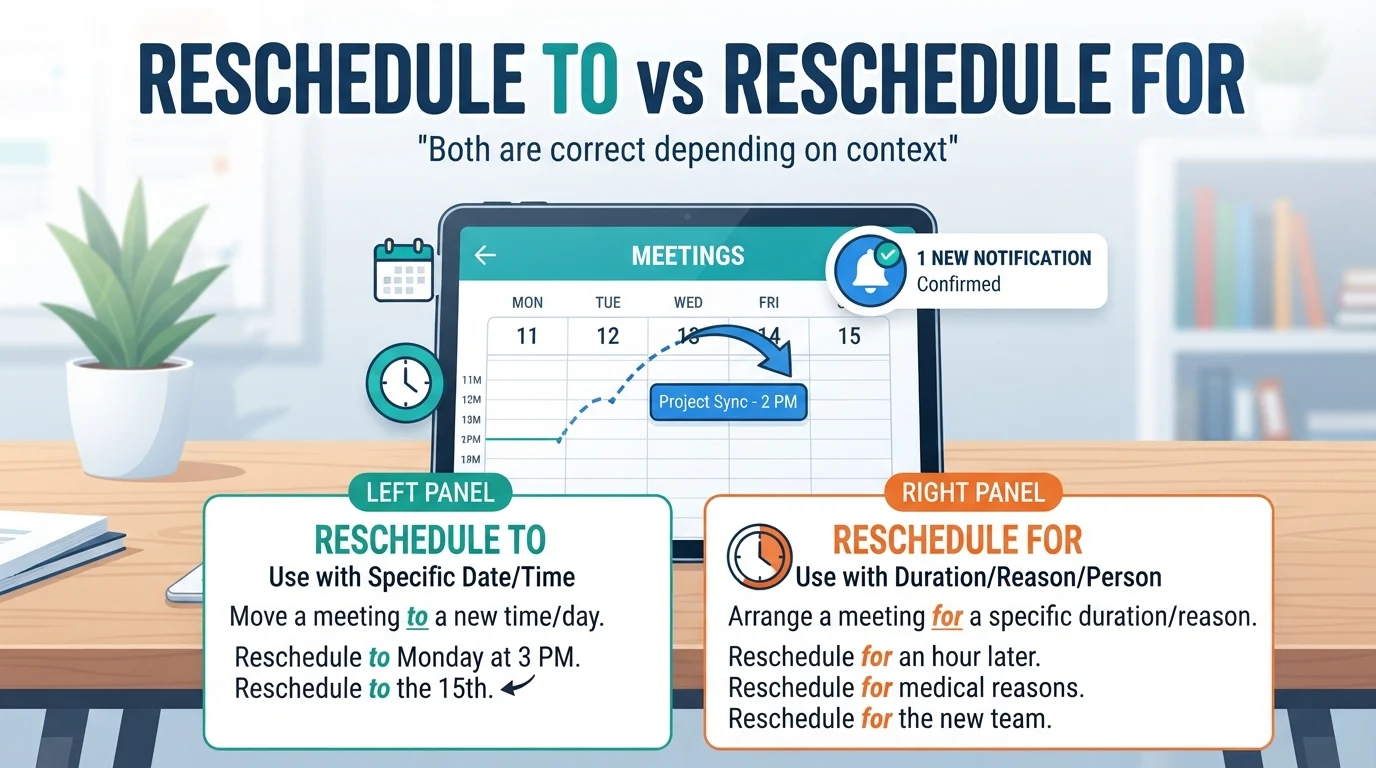
The main difference is that “reschedule for” is commonly used to identify the new date or time of an event, while “reschedule to” can emphasize the new time or destination in a revised arrangement, depending on the sentence structure. For example, “We rescheduled the meeting for Friday” is a natural way to state the new date. “We rescheduled the meeting to Friday” is also used, particularly when emphasizing the change from the original schedule.
In this guide, you will learn how to use both expressions correctly, explore practical examples, compare their meanings, and avoid common mistakes. Whether you are writing a professional email or arranging a personal appointment, these simple rules will help you choose the most natural expression.
Quick Answer: Reschedule To vs Reschedule For
“Reschedule for” is commonly used to state the new date or time of a meeting or appointment. For example, “We rescheduled the interview for Monday.” “Reschedule to” is also used, especially to emphasize moving an event to a different time or date. Both can be correct, and the most natural choice depends on the sentence and context.
1. What Does Reschedule Mean?
The verb reschedule means to change the planned date or time of an event, meeting, appointment, or activity.
People commonly reschedule events because of conflicts, emergencies, unexpected delays, or changes in availability.
Examples:
- I need to reschedule my doctor’s appointment.
- The manager rescheduled the meeting.
- We had to reschedule the interview because of a scheduling conflict.
- Can you reschedule our call for next week?
- The school rescheduled the examination due to bad weather.
- She asked to reschedule her appointment.
- They decided to reschedule the conference.
- I would like to reschedule our meeting for another day.
The word reschedule does not usually mean canceling an event permanently. It means arranging for it to happen at a different time.
2. What Does Reschedule For Mean?
Reschedule for is commonly used when specifying the new date or time at which an event is planned to take place.
The preposition for introduces the intended or newly arranged time.
Examples of Reschedule For
- We rescheduled the meeting for Friday.
- My appointment has been rescheduled for November 5.
- The interview was rescheduled for 10 a.m.
- Can we reschedule our call for next Tuesday?
- The doctor rescheduled my appointment for the following week.
- The training session has been rescheduled for the afternoon.
- They rescheduled the conference for early December.
- I would like to reschedule my exam for another date.
- The manager rescheduled our discussion for Monday morning.
- The event was rescheduled for next month.
In these examples, for identifies the date or time that has been arranged.
When Should You Use Reschedule For?
Use this expression when you want to communicate the new scheduled date or time clearly.
It is especially natural in professional emails, appointment reminders, meeting invitations, and everyday conversations.
For example:
“Could we reschedule our meeting for Thursday afternoon?”
This sentence politely asks to arrange the meeting at a new time.
3. What Does Reschedule To Mean?
Reschedule to is also used to describe changing an event to a different date or time. It often emphasizes the change from the original schedule to the new one.
Examples:
- We rescheduled the meeting to Friday.
- The interview was rescheduled to Monday morning.
- They rescheduled the appointment to a later date.
- The company rescheduled the conference to next month.
- We moved the meeting to 3 p.m. after rescheduling it.
- The class was rescheduled to the following week.
- The organizers rescheduled the event to December 10.
- The call was rescheduled to a more convenient time.
These examples are understandable and commonly encountered in English. However, when simply stating the new scheduled date or time, “rescheduled for” is often the more natural choice.
When Should You Use Reschedule To?
Use to when you want to emphasize the shift from one time or date to another, particularly when the original schedule is already understood.
For example:
“The meeting was originally scheduled for Tuesday, but we rescheduled it to Thursday.”
Here, to Thursday highlights the change from Tuesday to Thursday.
In many contexts, however, both prepositions are acceptable.
4. Reschedule To vs Reschedule For: Main Differences
| Feature | Reschedule to | Reschedule for |
|---|---|---|
| Main use | Emphasizes a change to a new time or date | States the newly arranged time or date |
| Example | We moved the meeting to Friday. | We rescheduled the meeting for Friday. |
| Focus | The change or shift | The intended scheduled time |
| Common in professional communication | Yes | Yes |
| Can refer to a date or time? | Yes | Yes |
| Always incorrect or correct? | Context dependent | Context dependent |
Important: These expressions overlap considerably. English speakers use both with dates and times, so the distinction is a useful guideline rather than an absolute grammar rule.
5. Reschedule To or Reschedule For a Meeting?
Both expressions can be correct when discussing a meeting.
Using Reschedule For
“We rescheduled the meeting for Wednesday.”
This clearly states the newly arranged date.
Using Reschedule To
“We rescheduled the meeting to Wednesday.”
This emphasizes moving the meeting to Wednesday from its original schedule.
Which Is Better?
If you simply want to tell someone the new meeting date, “rescheduled for Wednesday” is an excellent, natural choice.
If you are describing a change from an earlier date, “rescheduled to Wednesday” can also work naturally.
More examples:
- The meeting has been rescheduled for 2 p.m.
- The meeting has been rescheduled to 2 p.m.
- We rescheduled our call for next Monday.
- We moved our call to next Monday.
- The discussion was rescheduled for a later date.
The second example in each relevant pair is also used in everyday English. Choose the phrasing that best expresses your intended meaning.
6. Reschedule To or Reschedule For an Appointment?
When discussing appointments, “rescheduled for” is especially common when announcing the new appointment time.
Examples:
- Your appointment has been rescheduled for Friday at 11 a.m.
- I need to reschedule my appointment for next week.
- The dentist rescheduled my appointment for December 3.
- My consultation has been rescheduled for the afternoon.
- Could you reschedule my appointment for another day?
You can also use to:
- My appointment has been rescheduled to Friday.
- The consultation was rescheduled to a later date.
- The appointment was moved to 4 p.m.
For a clear appointment confirmation, the phrase “rescheduled for” is often the easiest choice.
7. Reschedule To vs Reschedule For in Professional Emails
Choosing a natural preposition is particularly important when writing workplace emails.
Here are some useful examples.
Example 1: Asking to Change a Meeting
“Would it be possible to reschedule our meeting for Thursday afternoon?”
This is polite and professional.
Example 2: Announcing a New Time
“Please note that tomorrow’s meeting has been rescheduled for 10 a.m.”
This clearly communicates the updated time.
Example 3: Emphasizing a Change
“Due to a scheduling conflict, we have rescheduled the presentation to Friday.”
This emphasizes that the original schedule has changed.
Example 4: Requesting a New Appointment
“Could we reschedule my appointment for next Monday?”
This is natural and courteous.
Example 5: Explaining a Change
“The interview was originally planned for Tuesday but has now been rescheduled to Thursday.”
This highlights the movement from Tuesday to Thursday.
Example 6: Sending a Short Confirmation
“Our call has been rescheduled for 3 p.m. Please let me know if you have any questions.”
This is clear and suitable for professional communication.
8. Common Mistakes With Reschedule To and Reschedule For
Here are some common issues to avoid.
| Less natural or unclear | Better alternative |
|---|---|
| We rescheduled the meeting on Friday. | We rescheduled the meeting for Friday. |
| Please reschedule my appointment at Monday. | Please reschedule my appointment for Monday. |
| We rescheduled to the meeting Friday. | We rescheduled the meeting for Friday. |
| My interview is rescheduled at 10 a.m. | My interview has been rescheduled for 10 a.m. |
| We rescheduled the call in Friday. | We rescheduled the call for Friday. |
The problem is not always the use of to or for. Sometimes the sentence has an incorrect word order or uses an unsuitable preposition such as at, on, or in.
Remember these common patterns:
- Reschedule a meeting for Friday.
- Reschedule an appointment to a later date.
- Reschedule a call for 2 p.m.
- Move a meeting to Thursday.
9. Can You Say Reschedule To Monday and Reschedule For Monday?
Yes. Both expressions can be used.
“We rescheduled the meeting for Monday” is a common way to announce the new scheduled date.
“We rescheduled the meeting to Monday” is also used to describe changing the meeting to Monday, particularly when the original date is known.
For example:
- Original: The meeting was planned for Friday.
- Revised: We rescheduled the meeting to Monday.
- Announcement: The meeting has been rescheduled for Monday.
This comparison shows how the surrounding context can affect which preposition sounds most natural.
10. Other Useful Expressions for Changing a Schedule
You can use several alternatives to reschedule to communicate a change clearly.
| Expression | Example |
|---|---|
| Move to | We moved the meeting to Thursday. |
| Push back to | We pushed the meeting back to Friday. |
| Bring forward to | We brought the meeting forward to Tuesday. |
| Postpone until | We postponed the event until next week. |
| Rearrange for | We rearranged the appointment for Monday. |
| Set for | The new meeting is set for 3 p.m. |
Be careful with push back and bring forward because their meanings can vary across regions and contexts. If clarity is essential, state the exact new date and time.
11. A Simple Memory Trick
Use this practical guideline:
For = the new scheduled time.
Example: “The meeting is rescheduled for Friday.”
To = the change toward a new time.
Example: “We moved the meeting to Friday.”
This is a helpful way to remember the difference, although it is not a strict rule. Both reschedule for and reschedule to can be correct when referring to a new date or time.
12. Frequently Asked Questions
Is it reschedule to or reschedule for?
Both can be correct. “Reschedule for” commonly introduces the new scheduled date or time, while “reschedule to” can emphasize moving an event to a different date or time.
Is “rescheduled for Monday” correct?
Yes. “The meeting has been rescheduled for Monday” is a natural and widely used sentence.
Is “rescheduled to Monday” grammatically correct?
Yes. It is used to describe moving an event to Monday. The expression can be particularly natural when the original schedule is part of the context.
Should I say “reschedule for 3 p.m.” or “reschedule to 3 p.m.”?
Both are used. “Reschedule for 3 p.m.” is a straightforward way to state the new scheduled time. “Reschedule to 3 p.m.” emphasizes the change to that time.
Which is better in a professional email?
“Reschedule for” is often a clear, natural choice when announcing a new meeting or appointment time. However, “reschedule to” is also acceptable when emphasizing the change.
Can I say “reschedule to a later date”?
Yes. For example, “We had to reschedule the event to a later date.” You can also say “reschedule the event for a later date.”
Is “reschedule on Friday” correct?
It depends on what you mean. “Reschedule the meeting on Friday” usually suggests that the act of changing the schedule happens on Friday. To identify the new meeting date, say “Reschedule the meeting for Friday.”
What is the difference between reschedule and postpone?
Reschedule means to change the planned date or time, which can be earlier or later. Postpone specifically means to delay something until a later time.
Remember This
- Reschedule for Friday commonly identifies the new scheduled date.
- Reschedule to Friday can emphasize the change to Friday.
- Both expressions are used with dates and times.
- “Rescheduled for” is often a natural choice for professional announcements.
- Use the surrounding context to decide which expression communicates your meaning best.
Final Verdict
The difference between “reschedule to” and “reschedule for” is mainly a matter of emphasis and context. Both expressions can be correct when describing a change to a meeting, appointment, interview, or event.
Use “reschedule for” when you want to state the newly arranged date or time, as in “We rescheduled the interview for Monday.” Use “reschedule to” when you want to emphasize moving an event to a different time, as in “We rescheduled the interview to Monday.”
For everyday conversation and professional emails, either form may work. When you simply want to announce a new scheduled time, “rescheduled for” is a clear and reliable choice.