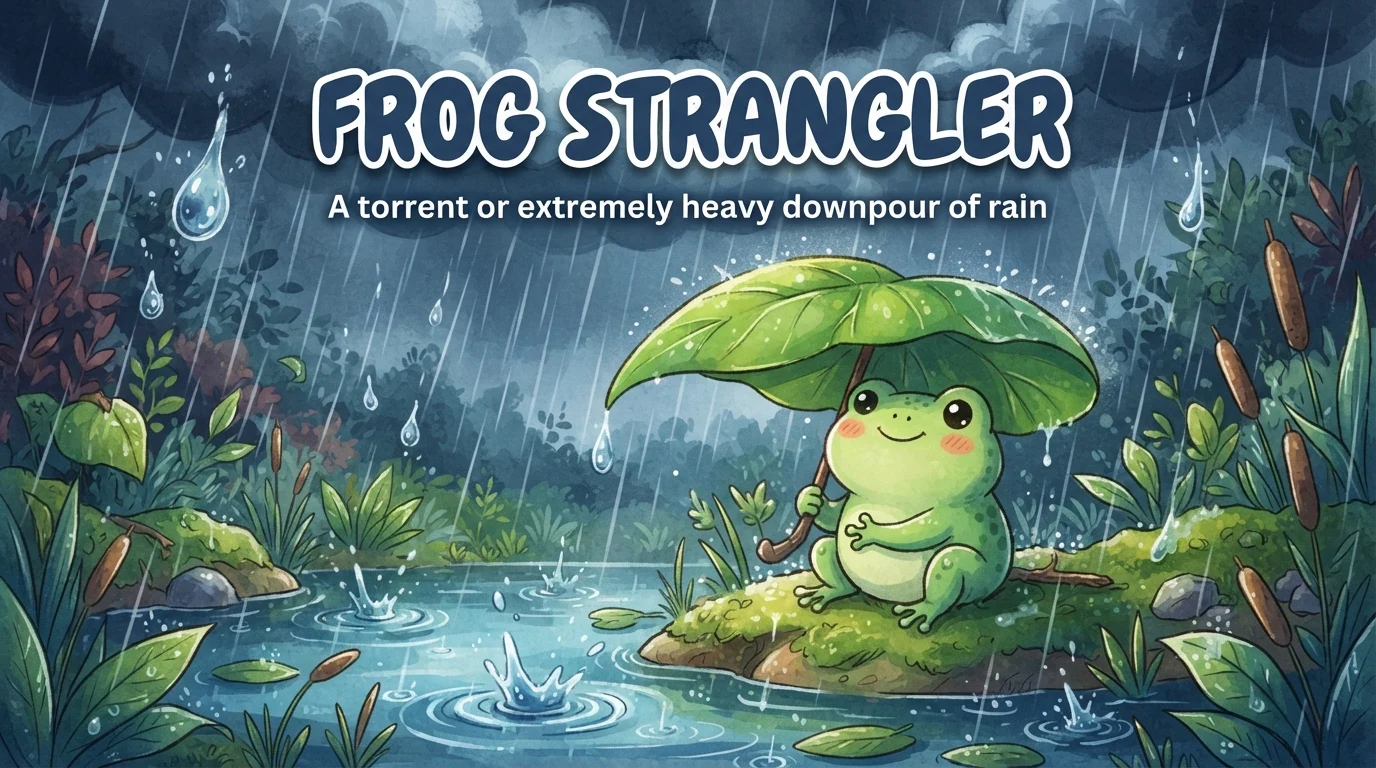
Have you ever heard someone describe a heavy rainstorm as a “frog strangler” and wondered what it means? Although the expression sounds strange or even humorous, it is a colorful English idiom used to describe extremely heavy rain. It is especially associated with informal Southern American English.
A frog strangler is a sudden or very heavy downpour, often one that makes the rain seem almost unbelievably intense. The expression creates a funny mental picture of so much water falling that even frogs, which are commonly associated with wet environments, might struggle in the storm. It is not meant to be understood literally. Instead, it exaggerates the intensity of the rainfall to make a conversation more vivid and entertaining.
In this guide, you will learn the meaning of frog strangler, where the expression comes from, how to use it in sentences, and how it compares with similar weather expressions. You will also discover when it is appropriate to use this informal idiom in everyday conversation.
Quick Answer: What Does Frog Strangler Mean?
Frog strangler is an informal expression, especially associated with Southern American English, that means an extremely heavy rainstorm or downpour. It is a humorous exaggeration used to describe rain falling in very large amounts. For example, “Take an umbrella. It’s a real frog strangler out there!”
1. What Does Frog Strangler Mean?
A frog strangler is a very heavy downpour of rain. It describes rainfall that is unusually intense, often making it difficult to drive, walk outside, or continue outdoor activities comfortably.
The expression is informal and colorful rather than scientific. People use it to emphasize just how much rain is falling.
Examples of Frog Strangler in Sentences
- We were planning a picnic, but a frog strangler ruined our plans.
- You should stay inside until this frog strangler passes.
- It started as a light shower and quickly turned into a frog strangler.
- The roads flooded after that terrible frog strangler.
- I have never seen a frog strangler like this one before.
- We had to cancel the outdoor wedding because of a frog strangler.
- Grab your raincoat because there is a frog strangler coming our way.
- The farmers welcomed the rain, but that frog strangler was too much for the roads.
- We waited in the shop until the frog strangler slowed down.
- By the time we reached home, the frog strangler had soaked us completely.
In each sentence, frog strangler refers to exceptionally heavy rain, not to an animal or a literal act of strangling.
2. Where Does the Expression Frog Strangler Come From?
The expression is associated particularly with the Southern United States, where colorful and humorous expressions about weather are common in regional speech.
Its exact historical origin is uncertain. The phrase likely developed as a form of exaggeration, using the image of a frog struggling in an overwhelming amount of rainwater to emphasize the storm’s intensity.
Frogs are closely associated with wet environments, ponds, and rain. Describing a downpour as a frog strangler turns that association into a humorous image: the rain is so intense that even a frog might have trouble coping with it.
The expression belongs to a broader tradition of regional English idioms that describe weather in memorable, exaggerated ways.
3. Is Frog Strangler an American Expression?
Yes. Frog strangler is especially associated with informal Southern American English. It may be understood elsewhere, but it is not equally common in every English-speaking region.
The expression is more likely to appear in casual conversation, regional storytelling, humor, and informal writing than in formal reports or academic texts.
For example:
“Goodness, what a frog strangler! We’d better wait until the rain lets up.”
This sentence sounds conversational and expresses surprise at the intensity of the rainfall.
In a formal weather report, a more neutral phrase such as “heavy rainfall” or “a severe downpour” would usually be preferable.
4. How to Use Frog Strangler in Everyday English
You can use frog strangler when talking about unusually heavy rain, especially in an informal or humorous conversation.
A. Talking About Current Weather
“The rain outside is a real frog strangler.”
This means that the rainfall is extremely heavy.
B. Describing a Past Storm
“We got caught in a frog strangler on our way home.”
This means that you experienced a very heavy downpour while traveling.
C. Warning Someone About Rain
“Take an umbrella. There’s a frog strangler coming.”
This is an informal way to warn someone that heavy rain is expected.
D. Explaining a Cancelled Activity
“The football match was cancelled because of a frog strangler.”
This indicates that the rain was heavy enough to interfere with the event.
E. Telling a Funny Story
“We thought we’d only be out for five minutes, but a frog strangler soaked us before we reached the car.”
Here, the idiom makes the story more colorful and entertaining.
5. Frog Strangler vs. Downpour vs. Deluge
These expressions all relate to heavy rain, but they differ in tone and usage.
| Expression | Meaning | Tone | Example |
|---|---|---|---|
| Frog strangler | Extremely heavy rain | Informal, humorous, regional | That was some frog strangler! |
| Downpour | A sudden or heavy fall of rain | Neutral | A heavy downpour flooded the street. |
| Deluge | A very large amount of water or rain | Formal or dramatic | The town experienced a deluge overnight. |
| Torrential rain | Extremely heavy rainfall | Neutral to formal | Torrential rain disrupted traffic. |
| Cloudburst | A sudden, very heavy burst of rain | Weather-related | A cloudburst struck the valley. |
| Shower | A short period of rain | Neutral | A brief shower passed through. |
The main difference: Frog strangler is a humorous regional idiom, while downpour, torrential rain, and deluge are more widely understood expressions.
6. Similar Expressions for Heavy Rain
English has many colorful expressions for heavy rainfall.
It’s Raining Cats and Dogs
This familiar idiom means that it is raining very heavily.
Example: “We cannot leave yet. It’s raining cats and dogs.”
Pouring Rain
This is a common expression for rain falling heavily.
Example: “It was pouring rain when we left the office.”
Bucketing Down
This informal expression, especially common in British English, means that rain is falling very heavily.
Example: “It’s bucketing down outside, so let’s wait here.”
Coming Down in Sheets
This expression describes rain falling so heavily that it resembles continuous sheets of water.
Example: “The rain was coming down in sheets, and visibility was poor.”
A Gully Washer
This is another colorful regional American expression for an extremely heavy rainstorm, particularly one that produces enough water to run through gullies.
Example: “That storm was a real gully washer.”
These expressions can make descriptions of the weather more vivid, but their regional associations and levels of formality vary.
7. Is Frog Strangler a Literal Expression?
No. In ordinary usage, frog strangler is figurative language, not a literal description of something happening to frogs.
It uses exaggeration to emphasize how intense the rain is. This makes it an example of colorful, humorous expression.
For instance:
“The storm last night was a frog strangler.”
The speaker is not suggesting that frogs were actually harmed. The speaker simply means that the rain was extremely heavy.
Understanding this figurative meaning is important for English learners because idioms often cannot be interpreted accurately by examining each word separately.
8. Common Mistakes When Using Frog Strangler
Here are some mistakes to avoid.
| Mistake | Better usage |
|---|---|
| Using it to describe light rain | Use it for extremely heavy rain. |
| Treating it as a scientific weather term | Understand it as an informal idiom. |
| Using it in every formal report | Prefer “heavy rainfall” or “downpour” in formal contexts. |
| Assuming it is equally common everywhere | Recognize its association with Southern American English. |
| Interpreting it literally | Understand it as humorous exaggeration. |
The expression works best when you want to sound conversational, expressive, or playful.
9. A Simple Memory Trick
Think of a frog sitting near a pond during an enormous rainstorm.
The rain is so intense that the frog seems overwhelmed by the amount of water. This exaggerated image helps you remember the meaning.
Frog strangler = extremely heavy rain.
You can connect it with other expressions:
- Frog strangler: humorous and regional.
- Downpour: a heavy fall of rain.
- Deluge: a very large amount of water or rain.
- Torrential rain: extremely heavy rainfall.
This simple association can help you remember the idiom and recognize it when you hear it in conversation.
10. Frequently Asked Questions
What does frog strangler mean in slang?
Frog strangler is an informal expression for extremely heavy rain. It is especially associated with Southern American English and is often used humorously.
Is frog strangler a real idiom?
Yes. It is a recognized regional English expression, although it is much less common than phrases such as “downpour” and “raining cats and dogs.”
Why do people call heavy rain a frog strangler?
The phrase uses humorous exaggeration to suggest that the rainfall is extraordinarily intense. Its exact historical origin is uncertain.
Is frog strangler offensive?
No, it is generally a harmless, humorous expression about the weather. It is not normally intended as an insult.
Is frog strangler used in British English?
It may be understood in British English, but it is particularly associated with Southern American English. British speakers are more likely to use expressions such as “bucketing down.”
What is another word for frog strangler?
Depending on the context, alternatives include downpour, deluge, torrential rain, cloudburst, and gully washer.
Can I use frog strangler in formal writing?
It is generally better to use a neutral expression such as “heavy rainfall” or “a severe downpour” in formal writing. Frog strangler is most suitable for casual conversation and informal storytelling.
Does frog strangler mean a flood?
Not necessarily. It refers to extremely heavy rain. A flood may occur as a result of heavy rainfall, but the two expressions do not have the same meaning.
Remember This
- Meaning: An extremely heavy downpour of rain.
- Type: Informal, humorous idiom.
- Regional association: Southern American English.
- Typical context: Casual conversation and storytelling.
- Formal alternative: Heavy rainfall, downpour, or torrential rain.
- Literal meaning: It does not ordinarily refer to actual harm to frogs.
Final Verdict
The expression frog strangler means an exceptionally heavy rainstorm or downpour. It is a colorful, humorous idiom particularly associated with the Southern United States.
You might hear someone say, “That was a real frog strangler,” after experiencing a storm with intense rainfall. The expression makes the description more vivid than simply saying that it rained heavily.
Although frog strangler is useful for understanding regional English and informal conversation, it is not the best choice for every situation. In formal writing, if reports, or professional communication, phrases such as “heavy rainfall,” “downpour,” and “torrential rain” are generally more appropriate.