Are you confused about whether to use maximum or maximal? Both words are related to the idea of being as great, large, high, or extensive as possible. However, they do not always fit into the same sentences. Although they share a similar meaning, their grammatical functions and common usage are different.
Maximum can function as a noun, an adjective, and, less commonly, an adverb. It usually refers to the greatest amount, number, level, or limit that is possible or permitted. Maximal is an adjective that describes something that is as great, extensive, or high as possible within particular conditions.
Understanding the difference between maximum and maximal will help you choose the right word in academic writing, mathematics, science, business, and everyday conversations. This guide explains their meanings, grammatical differences, examples, synonyms, and common mistakes.
Quick Answer: Maximum vs Maximal
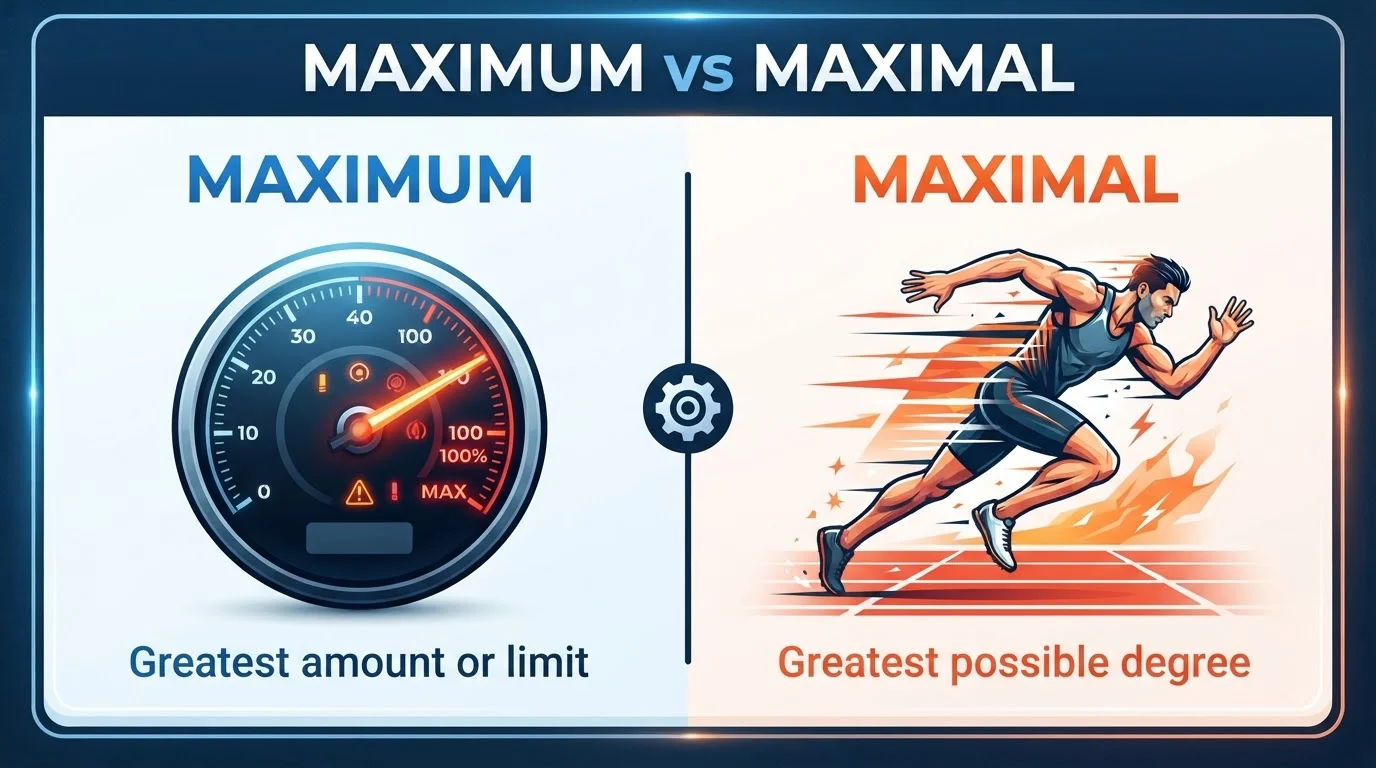
Maximum refers to the greatest possible amount, number, degree, or limit. It can be used as a noun or adjective. Maximal is an adjective that describes something that reaches the greatest possible extent under particular conditions. For example, “The maximum speed is 100 km/h” identifies a limit, while “The machine operates at maximal efficiency” describes the highest possible level of efficiency. Both words express the idea of reaching a high point, but their grammatical roles and usage differ.
What Does Maximum Mean?
Maximum refers to the greatest amount, number, degree, or level that is possible, allowed, or recorded.
It can function as a noun or an adjective. It is commonly used in everyday English, mathematics, science, business, and official instructions.
1. Maximum as a Noun
As a noun, maximum means the highest possible amount, level, or limit.
Examples:
- The maximum for this examination is 100 marks.
- The hotel has a maximum of 200 guests.
- You have reached the maximum.
- The speed limit represents the legal maximum.
- The company recorded a maximum in monthly sales.
In these examples, maximum refers to the greatest amount or limit.
2. Maximum as an Adjective
As an adjective, maximum describes the greatest amount, level, or number that is possible or permitted.
Examples:
- The maximum speed of this car is 220 km/h.
- Students have a maximum time of three hours to complete the test.
- The maximum capacity of the hall is 500 people.
- You can withdraw a maximum amount of $1,000 per day.
- The company offers a maximum discount of 30 percent.
Here, maximum describes a limit or the highest permitted amount.
3. Maximum as an Adverb
Maximum can also be used informally as an adverb, especially in expressions such as at maximum or maximum possible. However, in standard writing, at most or to the maximum extent may be more natural, depending on the sentence.
For example:
“The journey will take two hours maximum.”
A more formal alternative is:
“The journey will take two hours at most.”
What Does Maximal Mean?
Maximal is an adjective that means as great, extensive, high, or complete as possible within particular conditions or limitations.
It describes something that has reached the greatest possible extent or level.
Unlike maximum, maximal does not normally function as a noun.
Examples of Maximal in Sentences
- The team made a maximal effort to complete the project.
- The treatment aims to achieve maximal effectiveness.
- The researchers worked to obtain maximal accuracy.
- The machine operates at maximal efficiency.
- The organization seeks maximal participation from its members.
- The athlete trained with maximal intensity.
In these examples, maximal describes the greatest possible degree of effort, effectiveness, accuracy, efficiency, participation, or intensity.
Maximum vs Maximal: Key Differences
The main difference between maximum and maximal is their grammatical function and how they are commonly used.
| Feature | Maximum | Maximal |
|---|---|---|
| Part of speech | Noun and adjective; occasionally adverb | Adjective |
| Meaning | The greatest possible amount, number, degree, or limit | Reaching the greatest possible extent or degree |
| Common usage | Everyday English, measurements, limits, and mathematics | Technical, scientific, academic, and formal contexts |
| Refers to a limit | Yes | Not usually by itself |
| Example | The maximum speed is 100 km/h. | The engine operates at maximal efficiency. |
Remember: Maximum often identifies the highest limit or amount, while maximal describes something that reaches the greatest possible degree.
When Should You Use Maximum?
Use maximum when you are talking about a specific upper limit, quantity, number, measurement, or permitted amount.
It is especially common when describing restrictions, capacities, measurements, and mathematical values.
Examples:
- The maximum age for applicants is 35.
- The maximum weight allowed is 20 kilograms.
- The classroom has a maximum capacity of 40 students.
- The maximum temperature reached 45 degrees Celsius.
- You can spend a maximum of $500 on the equipment.
In these examples, maximum identifies the highest permitted or recorded value.
When Should You Use Maximal?
Use maximal when you want to describe the greatest possible degree, extent, intensity, or level of something.
It is particularly useful in scientific, technical, academic, and formal writing.
Examples:
- The researchers aimed for maximal accuracy.
- The athlete demonstrated maximal physical effort.
- The treatment produced maximal improvement in the measured outcome.
- The company wants to achieve maximal productivity.
- The system is designed for maximal performance.
In these sentences, maximal describes the extent or intensity of something rather than simply identifying a numerical limit.
Maximum vs Maximal in Different Contexts
1. In Everyday English
Maximum is much more common in ordinary conversations.
For example:
- The maximum speed is 80 km/h.
- You can bring a maximum of two bags.
- The maximum number of participants is 50.
Maximal is less common in everyday conversation. People often use maximum or phrases such as as much as possible instead.
2. In Academic Writing
Both words can be used in academic writing, but their meanings differ.
Examples:
- The maximum temperature recorded during the experiment was 40°C.
- The researchers aimed to achieve maximal accuracy.
- The maximum number of observations was 500.
Use maximum for numerical limits and maximal when describing the greatest possible degree of a quality or outcome.
3. In Science and Research
Maximal is often used to describe the greatest degree of an effect, response, activity, or intensity.
Examples:
- The experiment produced a maximal response.
- The researchers measured maximal oxygen consumption.
- The treatment was designed to achieve maximal effectiveness.
Maximum is also common when reporting numerical values or upper limits.
Example:
“The maximum temperature recorded was 75°C.”
4. In Mathematics
Maximum has a specific mathematical meaning. It refers to the greatest value in a set or the greatest value reached by a function over a specified domain.
For example:
“The maximum value of the function is 10.”
Maximal can have a more specialized meaning in mathematics and related fields. It often describes something that cannot be extended or enlarged while preserving a particular property.
For example:
“A maximal set is one that cannot be enlarged while retaining the specified property.”
This does not necessarily mean that it is the largest set of all possible sets. The distinction is important in advanced mathematics.
Maximum vs Maximal: Sentence Comparison
The following examples show how the two words can be used in related contexts.
| With Maximum | With Maximal |
|---|---|
| The machine has a maximum capacity of 100 units. | The machine operates at maximal efficiency. |
| The maximum speed is 150 km/h. | The vehicle is designed for maximal performance. |
| The company allows a maximum of five attempts. | The team made a maximal effort to succeed. |
| The maximum temperature was 40°C. | The experiment produced a maximal response. |
| The maximum score is 100. | The students demonstrated maximal concentration. |
Notice that maximum usually identifies a value or limit, while maximal describes the highest possible degree of a characteristic or activity.
Maximum vs Maximal vs Minimum
It is also helpful to understand how these words relate to minimum.
| Word | Meaning | Example |
|---|---|---|
| Maximum | The greatest possible amount or limit | The maximum capacity is 100 people. |
| Maximal | Reaching the greatest possible degree | The athlete made a maximal effort. |
| Minimum | The smallest possible amount or limit | The minimum age is 18. |
The words maximum and minimum are commonly used to identify upper and lower limits. Maximal describes something that reaches the greatest possible extent.
Synonyms of Maximum and Maximal
Although these words are related, their synonyms depend on how they are used.
Synonyms of Maximum
| Synonym | Meaning |
|---|---|
| Highest | At the greatest level |
| Greatest | Larger or more extensive than all others |
| Uppermost | At the highest position or level |
| Limit | The greatest or smallest permitted point |
| Peak | The highest point or level |
| Optimum | The most favorable or desirable level |
Synonyms of Maximal
| Synonym | Meaning |
|---|---|
| Greatest | As large or extensive as possible |
| Highest | At the highest possible level |
| Utmost | To the greatest possible degree |
| Full | Complete or at the greatest extent |
| Optimal | Best or most favorable under particular conditions |
| Extreme | At the greatest or most intense end of a scale |
Note: These words are not always interchangeable. For example, optimal means best or most favorable, while maximal means greatest in extent or degree. The greatest amount is not necessarily the best amount.
Common Mistakes to Avoid
Mistake 1: Using Maximal as a Noun
Incorrect: The maximal of the room is 100 people.
Correct: The maximum capacity of the room is 100 people.
Maximal is an adjective and cannot normally be used as a noun in this way.
Mistake 2: Using Maximal When You Mean a Numerical Limit
Awkward: The maximal number of students is 40.
Better: The maximum number of students is 40.
Maximum is the more natural choice when identifying an upper numerical limit.
Mistake 3: Assuming Maximum and Maximal Are Always Interchangeable
Incorrect assumption: Both words can be used in every sentence without changing anything.
Correct understanding: They share a general idea, but their grammatical roles and common uses are different.
For example:
“The maximum weight is 50 kilograms.”
“The athlete lifted a maximal weight.”
Both sentences are correct, but they communicate different ideas.
Mistake 4: Confusing Maximal With Optimal
Maximal means the greatest possible degree or extent. Optimal means the most suitable or favorable level.
For example:
“The company wants maximal production.”
This means the company wants the greatest possible amount of production.
“The company wants optimal production.”
This means the company wants the most efficient or suitable level of production.
The two expressions do not necessarily mean the same thing.
Easy Trick to Remember the Difference
Use this simple memory trick:
Maximum = The greatest amount or limit.
Maximal = Reaching the greatest possible degree.
Think about these examples:
- Maximum capacity: The greatest number of people a room can hold.
- Maximal effort: The greatest possible effort someone can make.
If you are identifying a number, quantity, or upper limit, maximum is usually the right choice.
If you are describing the greatest possible degree of an action, quality, or condition, maximal may be more appropriate.
Frequently Asked Questions
1. What is the difference between maximum and maximal?
Maximum usually refers to the greatest possible amount, number, value, or limit. Maximal is an adjective that describes something reaching the greatest possible degree or extent.
2. Is maximal a correct English word?
Yes. Maximal is a correct English adjective. It is commonly used in academic, scientific, mathematical, and technical contexts to describe the greatest possible degree or extent of something.
3. Is maximum a noun or an adjective?
Maximum can function as both a noun and an adjective. For example, in “The maximum is 100,” it is a noun. In “The maximum speed is 100 km/h,” it is an adjective.
4. Can I use maximal instead of maximum?
Not in every situation. Maximal is an adjective and usually describes the greatest possible degree of something. Maximum is more suitable when referring to a specific quantity, numerical value, or upper limit.
5. What is an example of maximal?
“The researchers made a maximal effort to improve the accuracy of the experiment.” In this sentence, maximal describes the greatest possible level of effort.
6. Is maximal the same as optimal?
No. Maximal means the greatest possible in amount or degree, while optimal means the best or most favorable under particular conditions. The highest possible level is not always the most suitable one.
7. What is the opposite of maximum and maximal?
The opposite of maximum is generally minimum, which refers to the smallest possible amount or limit. The opposite of maximal may be minimal, which describes the smallest possible degree or extent.
8. Is maximum more common than maximal?
Yes. Maximum is much more common in everyday English because people frequently use it to discuss limits, quantities, capacities, and measurements. Maximal is more specialized and often appears in academic, scientific, and technical writing.
Conclusion
The difference between maximum and maximal mainly involves their grammatical functions and common usage. Maximum can be a noun or adjective and usually refers to the greatest possible amount, value, number, or limit. Maximal is an adjective that describes something reaching the greatest possible degree or extent.
Use maximum when talking about limits, quantities, measurements, or numerical values. Use maximal when describing the greatest possible level of effort, intensity, effectiveness, or another quality.
Remember this simple rule: Maximum identifies the greatest amount, while maximal describes the greatest possible degree.