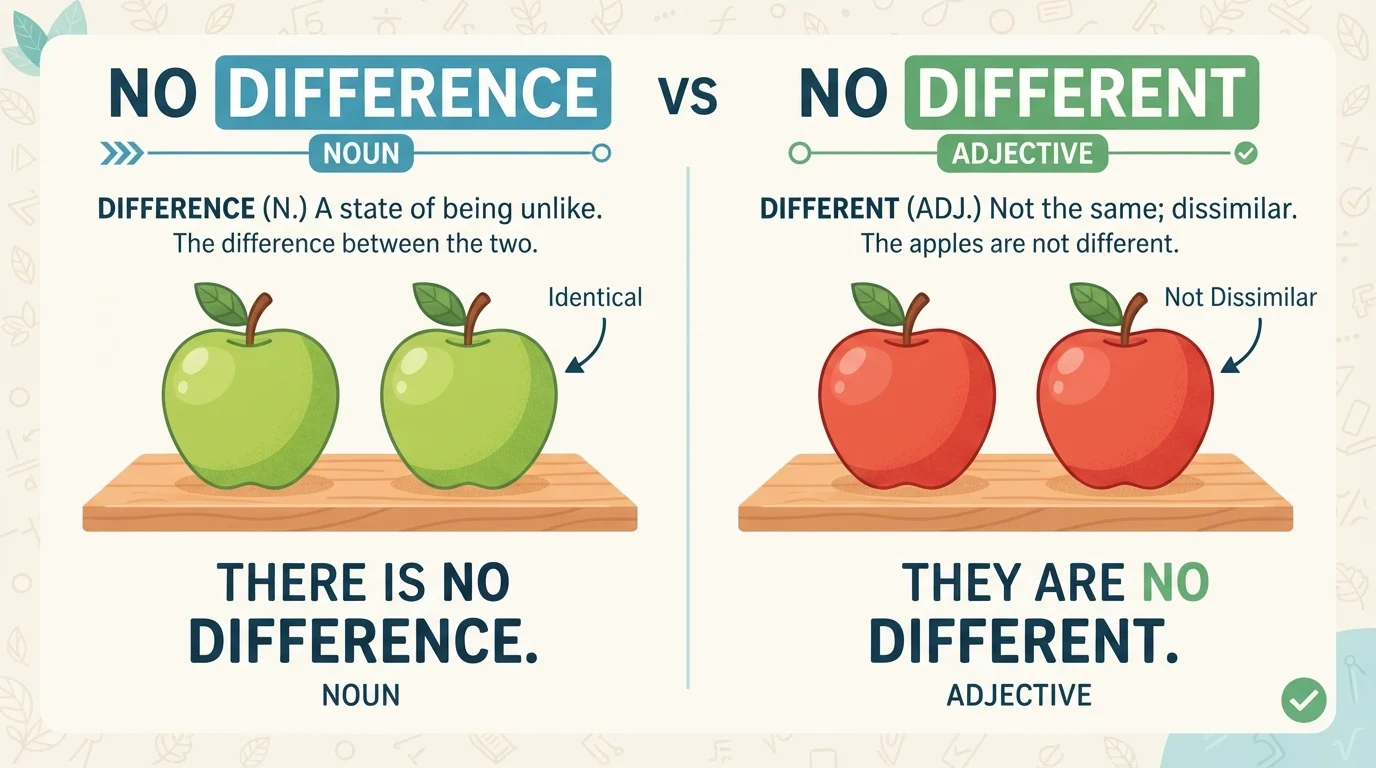
Is it correct to say “There is no difference” or “There is no different”? Many English learners find these expressions confusing because the words difference and different look similar and are closely related in meaning. However, they have different grammatical functions, so they cannot be used interchangeably.
The correct expression is usually “no difference” when you want to say that two or more things are the same or do not vary. On the other hand, “no different” can also be correct, but it must be used in a suitable sentence, such as “This situation is no different from the previous one.”
In this article, you will learn the difference between “no difference” and “no different,” understand their grammatical rules, and discover how to use both expressions correctly in everyday English.
Quick Answer: No Difference vs. No Different
“No difference” is a correct expression used when two or more things are the same or have no noticeable distinction. “No different” is also grammatically correct when it follows a linking verb and describes something as not being different from another thing.
Examples:
- Correct: There is no difference between these two products.
- Incorrect: There is no different between these two products.
- Correct: This product is no different from the other one.
The main distinction is grammatical: difference is a noun, while different is an adjective.
What Does No Difference Mean?
“No difference” means that two or more things are the same or have no noticeable distinction between them.
The word difference is a noun. It refers to a way in which people, objects, situations, or ideas are not the same.
We commonly use “no difference” with expressions such as:
- There is no difference.
- There is no difference between them.
- It makes no difference.
- I can see no difference.
Examples of No Difference in Sentences
- There is no difference between these two shirts.
The shirts look the same or have no noticeable distinction. - It makes no difference whether we leave now or later.
The timing does not matter. - I can see no difference between the original and the copy.
Both appear identical. - There is no difference in their opinions.
Their opinions are the same. - For me, there is no difference between the two options.
Both options are equally acceptable. - The new version makes no difference to the overall result.
The new version does not change the outcome.
What Does No Different Mean?
“No different” means not different or essentially the same as something else.
The word different is an adjective. It describes a person, object, situation, or idea that is not the same as another.
However, “no different” usually needs a linking verb, such as is, was, or seems, to form a complete sentence.
Common structures include:
- Is no different from
- Was no different from
- Seems no different from
- Is no different than
Examples of No Different in Sentences
- This situation is no different from the previous one.
This situation is essentially the same as the earlier situation. - Her opinion is no different from mine.
Her opinion is the same as mine. - The new model is no different from the old one.
The new model has no meaningful distinction from the old model. - His reaction was no different than I expected.
His reaction was not different from what I expected. - This problem is no different from the one we faced last year.
The problem is essentially the same as the earlier one. - Their experience is no different from ours.
They experienced something similar to what we experienced.
No Difference vs. No Different: Key Differences
Although both expressions communicate the idea of similarity, they have different grammatical roles.
| Point | No Difference | No Different |
|---|---|---|
| Main word | Difference | Different |
| Part of speech | Noun | Adjective |
| Basic meaning | No distinction or variation | Not different from something |
| Common structure | There is no difference | Something is no different |
| Example | There is no difference between them. | They are no different from each other. |
Remember: Use “no difference” when you need a noun. Use “no different” when you need an adjective to describe something.
Difference Between Difference and Different
Understanding the two individual words makes the distinction much easier.
1. Difference Is a Noun
A noun names a person, place, thing, or idea. The word difference refers to the quality or condition of being unlike something else.
Examples:
- There is a big difference between the two designs.
- I noticed a difference in his behavior.
- Their salaries have a considerable difference.
2. Different Is an Adjective
An adjective describes a noun or pronoun. The word different describes something that is not the same as another thing.
Examples:
- These two designs are different.
- She has a different opinion.
- We chose a different approach.
Compare:
- There is no difference between the bags.
- The bags are not different.
Both sentences express a similar idea, but their grammatical structures are different.
No Difference vs. Not Different
These expressions are also closely related.
“No difference” uses a noun, while “not different” uses an adjective with the negative word not.
Examples:
- There is no difference between the two answers.
- The two answers are not different.
Both sentences suggest that the answers are the same.
However, “no difference” is often more natural when discussing the absence of a distinction, while “not different” describes the things themselves.
Common Mistakes to Avoid
Mistake 1: Using Different Instead of Difference
Incorrect: There is no different between these two phones.
Correct: There is no difference between these two phones.
Explanation: The verb is needs a noun in this structure. Therefore, use difference, not different.
Mistake 2: Using Difference Instead of Different
Incorrect: This phone is no difference from mine.
Correct: This phone is no different from mine.
Explanation: The linking verb is is followed by an adjective in this construction. Therefore, use different.
Mistake 3: Forgetting the Linking Verb
Incorrect: This situation no different from the last one.
Correct: This situation is no different from the last one.
Explanation: The adjective phrase needs a linking verb to complete the sentence.
Mistake 4: Confusing No Difference with No Different
Remember that these expressions cannot simply replace each other.
- There is no difference between them.
- They are no different from each other.
Both are correct, but their sentence structures are different.
Easy Ways to Remember the Difference
Use this simple memory trick:
- Difference = Noun: There is no difference.
- Different = Adjective: They are no different.
Think of these two questions:
Are you talking about a distinction? Use difference.
Example: There is no difference between the two pictures.
Are you describing something? Use different.
Example: The two pictures are no different from each other.
This simple rule will help you choose the correct expression in everyday writing and conversation.
Frequently Asked Questions
1. Is it correct to say no difference?
Yes. “No difference” is grammatically correct and means that two or more things have no noticeable distinction. For example: “There is no difference between these two answers.”
2. Is no different grammatically correct?
Yes. “No different” is correct when used in a suitable sentence, usually after a linking verb. For example: “This situation is no different from the previous one.”
3. Is it no difference or no different?
Both expressions are correct, but they are used differently. Use “no difference” as a noun phrase and “no different” as an adjective phrase. For example, “There is no difference” and “They are no different.”
4. Can I say there is no different?
No. In standard English, “There is no different” is incorrect when you mean that two things are the same. The correct expression is “There is no difference.”
5. What is the difference between no difference and not different?
“No difference” is a noun phrase that refers to the absence of a distinction. “Not different” is an adjective phrase describing things that are not unlike each other.
6. Is it no different from or no different than?
Both expressions are used in English. “No different from” is traditionally preferred in formal writing, while “no different than” is also common, particularly in American English. The best choice can depend on the sentence and the style you are following.
7. What is another way to say no difference?
Depending on the context, you can use “the same,” “identical,” “alike,” “no distinction,” or “equivalent.” For example, “There is no difference between them” can be rewritten as “They are identical.”
Conclusion
“No difference” and “no different” are both correct English expressions, but they serve different grammatical purposes.
Use “no difference” when referring to the absence of a distinction between two or more things. Use “no different” when describing something as not being different from another thing.
For example:
- There is no difference between the two options.
- The two options are no different from each other.
The easiest way to remember the rule is that difference is a noun, while different is an adjective. Once you understand this distinction, you can use both expressions confidently and avoid common grammatical mistakes.