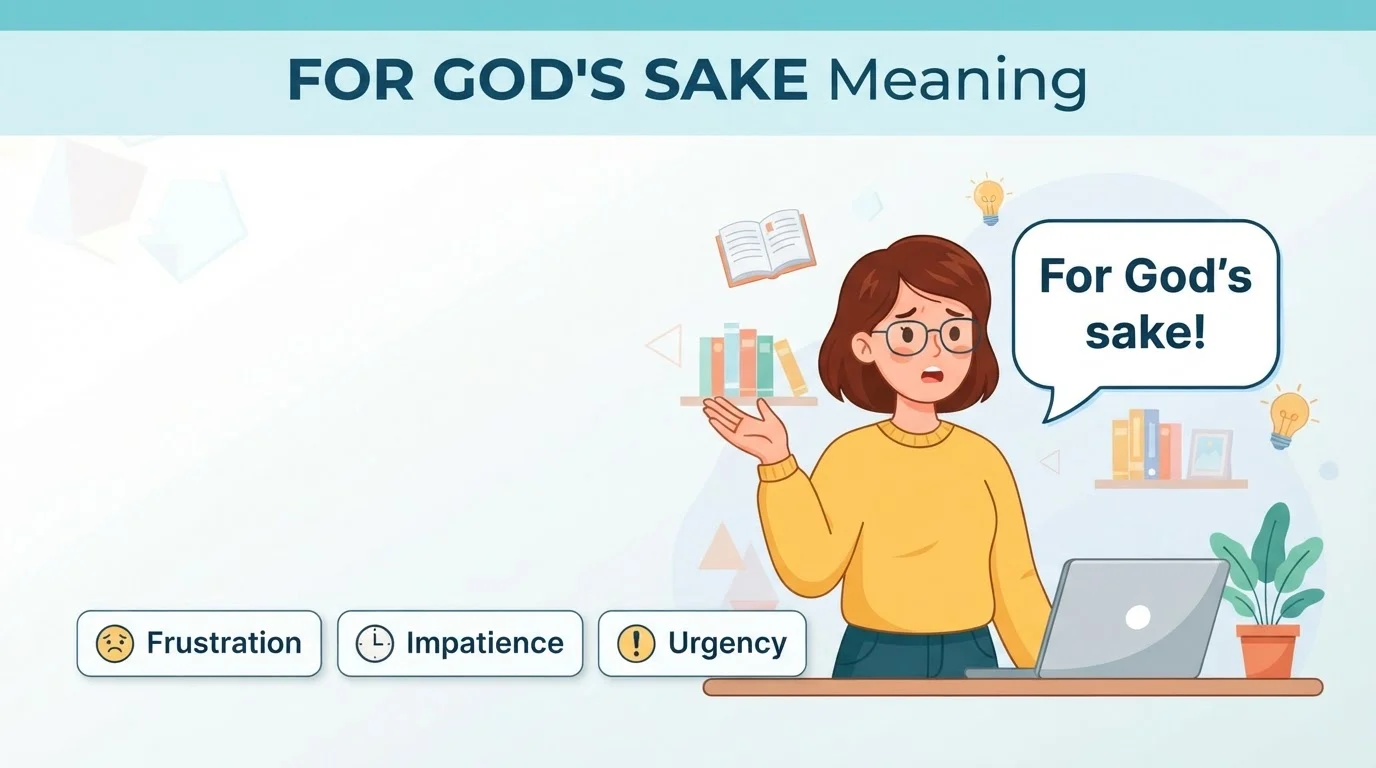
Have you ever heard someone say “for God’s sake” when they are frustrated, annoyed, surprised, or desperately asking someone to do something? This common English expression is used to show strong emotions, especially irritation, impatience, anger, or urgency. For example, someone might say, “For God’s sake, stop making that noise!” to express frustration with another person’s behavior.
Although the phrase contains the word God, people often use it as an everyday expression rather than as a religious statement. It can also be used to make a request sound more emotional or urgent.
Understanding the meaning and correct usage of for God’s sake will help you recognize it in movies, conversations, books, and everyday English. In this guide, you will learn its definition, different uses, sentence examples, alternatives, and common mistakes.
Quick Answer: What Does “For God’s Sake” Mean?
For God’s sake is an English expression used to show strong feelings such as frustration, annoyance, impatience, desperation, or urgency. It can also be used when making an emotional request or emphasizing the importance of something. For example, “For God’s sake, be careful!” means that the speaker is urgently asking someone to be careful. Depending on the context and tone, the expression can sound angry, pleading, or emphatic.
What Does “For God’s Sake” Mean?
For God’s sake is an idiomatic expression that people use to emphasize their feelings or make a statement more forceful.
It does not usually have a literal religious meaning in everyday conversations. Instead, it functions as an emotional expression that communicates the speaker’s attitude toward a situation.
The phrase has several common uses.
1. To Express Frustration or Annoyance
The most common use of for God’s sake is to express irritation when something is annoying, repeated, or difficult to tolerate.
Examples:
- For God’s sake, stop talking while I am working!
- Can you turn down the music, for God’s sake?
- For God’s sake, why are you always late?
- I have explained this three times, for God’s sake!
- For God’s sake, leave me alone!
In these examples, the speaker is frustrated or irritated.
2. To Show Impatience
You can use the expression when you want someone to act quickly or stop wasting time.
Examples:
- For God’s sake, hurry up! We are already late.
- Make a decision, for God’s sake.
- For God’s sake, just tell me what happened.
- We need to leave now, for God’s sake!
- Please finish your work, for God’s sake.
Here, the phrase communicates impatience and urgency.
3. To Make an Urgent Request
Sometimes, for God’s sake is used when someone desperately wants another person to do something important.
Examples:
- For God’s sake, be careful while driving.
- Please listen to me, for God’s sake.
- For God’s sake, don’t touch that wire!
- Get some rest, for God’s sake.
- For God’s sake, call the doctor immediately.
In these sentences, the speaker is emphasizing the importance of the request.
4. To Express Surprise or Disbelief
The expression can also show that someone is shocked, confused, or unable to believe something.
Examples:
- For God’s sake, you actually bought that expensive car?
- For God’s sake, how did you manage to lose your phone again?
- You forgot your passport? For God’s sake!
- For God’s sake, I can’t believe what I am hearing.
- He did that again, for God’s sake?
The speaker uses the phrase to emphasize a strong reaction.
How to Use “For God’s Sake” in a Sentence
The expression can appear at the beginning, middle, or end of a sentence. Its position depends on the structure and emphasis.
1. At the Beginning of a Sentence
When placed at the beginning, for God’s sake often introduces an emotional request, warning, or complaint.
Examples:
- For God’s sake, be quiet!
- For God’s sake, don’t make the same mistake again.
- For God’s sake, give me a minute to think.
- For God’s sake, stop arguing with each other.
2. In the Middle of a Sentence
The expression can also appear in the middle to emphasize frustration or impatience.
Examples:
- Why are you doing this, for God’s sake?
- Can you please listen, for God’s sake?
- What happened to the money, for God’s sake?
- I need some peace and quiet, for God’s sake.
3. At the End of a Sentence
At the end of a sentence, the phrase often adds emotional emphasis.
Examples:
- Stop complaining, for God’s sake!
- Tell me the truth, for God’s sake!
- Don’t waste my time, for God’s sake!
- Just be honest with me, for God’s sake!
Is “For God’s Sake” Rude or Offensive?
It can be. The expression is not necessarily rude in every situation, but it often sounds emotional, forceful, or irritated.
Its effect depends on the speaker’s tone, the situation, and the relationship between the people involved.
| Situation | Possible Meaning or Effect |
|---|---|
| During an argument | Shows anger or frustration |
| When someone is repeatedly late | Expresses impatience |
| During a warning | Emphasizes urgency |
| In a casual conversation | May sound like an emotional reaction |
| In a professional meeting | Can sound unprofessional or disrespectful |
| In a religious context | May be understood more literally |
For example:
Angry: “For God’s sake, stop interrupting me!”
Concerned: “For God’s sake, be careful on that road!”
Impatient: “For God’s sake, how long will this take?”
If you are speaking to someone you do not know well, or communicating in a professional setting, it is usually better to choose a more polite alternative.
For God’s Sake vs For Heaven’s Sake
Both expressions are used to show frustration, impatience, urgency, or strong feelings. However, for heaven’s sake is often considered a softer alternative.
| Expression | Meaning | Example |
|---|---|---|
| For God’s sake | Expresses strong frustration, urgency, or annoyance | For God’s sake, stop shouting! |
| For heaven’s sake | Expresses frustration or impatience, often more mildly | For heaven’s sake, be reasonable! |
Both expressions are common in English, but their emotional strength depends on the speaker and context.
Examples of For Heaven’s Sake
- For heaven’s sake, give me a chance to explain.
- For heaven’s sake, don’t forget your keys.
- For heaven’s sake, why is everyone shouting?
- Please be patient, for heaven’s sake.
Alternatives to “For God’s Sake”
If you want to express frustration or urgency without using for God’s sake, several alternatives are available.
| Alternative | Meaning | Example |
|---|---|---|
| For heaven’s sake | Expresses frustration or impatience | For heaven’s sake, calm down! |
| Please | Makes a request more polite | Please stop making noise. |
| Seriously | Expresses disbelief or annoyance | Seriously, why are you doing that? |
| Come on | Shows impatience or encouragement | Come on, hurry up! |
| Honestly | Emphasizes frustration or sincerity | Honestly, I can’t believe this. |
| For goodness’ sake | A milder expression of frustration | For goodness’ sake, be careful! |
| I beg you | Makes an emotional or desperate request | I beg you, please listen to me. |
Polite Alternatives
If you want to sound respectful, particularly in professional or formal situations, try these expressions:
- Please pay attention.
- Could you hurry up, please?
- I would really appreciate your cooperation.
- Please be careful.
- Could you explain what happened?
- Let’s try to resolve this calmly.
These alternatives communicate your message without sounding overly frustrated or aggressive.
Is “For God’s Sake” a Swear Word?
For God’s sake is not generally classified as a traditional swear word or an obscenity. However, it can be considered a mild religious exclamation or an offensive expression by people who dislike using God’s name casually.
Some speakers may find it disrespectful because it uses the name of God in an emotional expression.
A milder alternative is for goodness’ sake, which communicates similar feelings without directly referring to God.
Common Mistakes to Avoid
Mistake 1: Writing “For Gods Sake”
Incorrect: For Gods Sake, stop shouting!
Correct: For God’s sake, stop shouting!
The correct expression uses an apostrophe in God’s because it is a possessive form.
Mistake 2: Confusing “For God’s Sake” With a Literal Religious Statement
The phrase is commonly used as an idiom to express emotions. It does not necessarily mean that someone is making a religious request or speaking directly to God.
Mistake 3: Using It in Every Situation
Although the expression is common, it can sound rude or aggressive when used with strangers, colleagues, customers, or people in positions of authority.
Choose a polite alternative when the situation requires respectful communication.
Mistake 4: Confusing It With “For Goodness’ Sake”
Both expressions communicate frustration, impatience, or urgency. However, for goodness’ sake is generally a milder alternative and may be more suitable when you want to avoid religious wording.
Easy Trick to Remember the Meaning
Remember this simple rule:
For God’s sake = Strong emotion, frustration, urgency, or impatience.
Think of someone saying:
“For God’s sake, be careful!”
The person is not necessarily making a religious statement. They are emphasizing how important it is for someone to be careful.
You can also remember these differences:
- For God’s sake: Often stronger and more emotional.
- For heaven’s sake: Often a softer expression.
- For goodness’ sake: A milder alternative.
Frequently Asked Questions
1. What does for God’s sake mean?
For God’s sake is an English expression used to show frustration, annoyance, impatience, desperation, or urgency. It can also emphasize an emotional request or warning.
2. Is for God’s sake a bad word?
It is not generally considered a traditional swear word, but some people may find it offensive or disrespectful because it uses God’s name casually. Its appropriateness depends on the audience and context.
3. Is for God’s sake rude?
It can sound rude, especially when spoken angrily or used to criticize someone. However, it can also express urgency, concern, or disbelief. Tone and context make a difference.
4. What is another way to say for God’s sake?
Common alternatives include for heaven’s sake, for goodness’ sake, come on, seriously, and honestly. More polite alternatives include please, could you hurry up, and please be careful.
5. What is the difference between for God’s sake and for heaven’s sake?
Both expressions communicate frustration, impatience, or urgency. For God’s sake can sound stronger, while for heaven’s sake is often a milder alternative. Their meanings are very similar.
6. Can I use for God’s sake in formal writing?
It is generally better to avoid this expression in formal or professional writing because it can sound emotional, informal, or disrespectful. Use alternatives such as please, urgently, or for this reason, depending on the intended meaning.
7. What does for God’s sake mean in a conversation?
In everyday conversations, it usually means that the speaker is frustrated, annoyed, impatient, or making an urgent request. For example, “For God’s sake, listen to me!” expresses strong frustration.
8. Is for goodness’ sake more polite than for God’s sake?
Generally, yes. For goodness’ sake is often considered a milder alternative because it avoids directly using God’s name. It can still express irritation or impatience.
Conclusion
The expression for God’s sake is commonly used in English to express frustration, annoyance, impatience, urgency, or strong emotions. It can appear at the beginning, middle, or end of a sentence, depending on what the speaker wants to emphasize.
Although it is not generally classified as a traditional swear word, it can sound rude or disrespectful in certain situations. For more polite communication, you can use alternatives such as for heaven’s sake, for goodness’ sake, or simply please.
Remember this simple rule: For God’s sake is an emotional expression, not necessarily a religious statement.