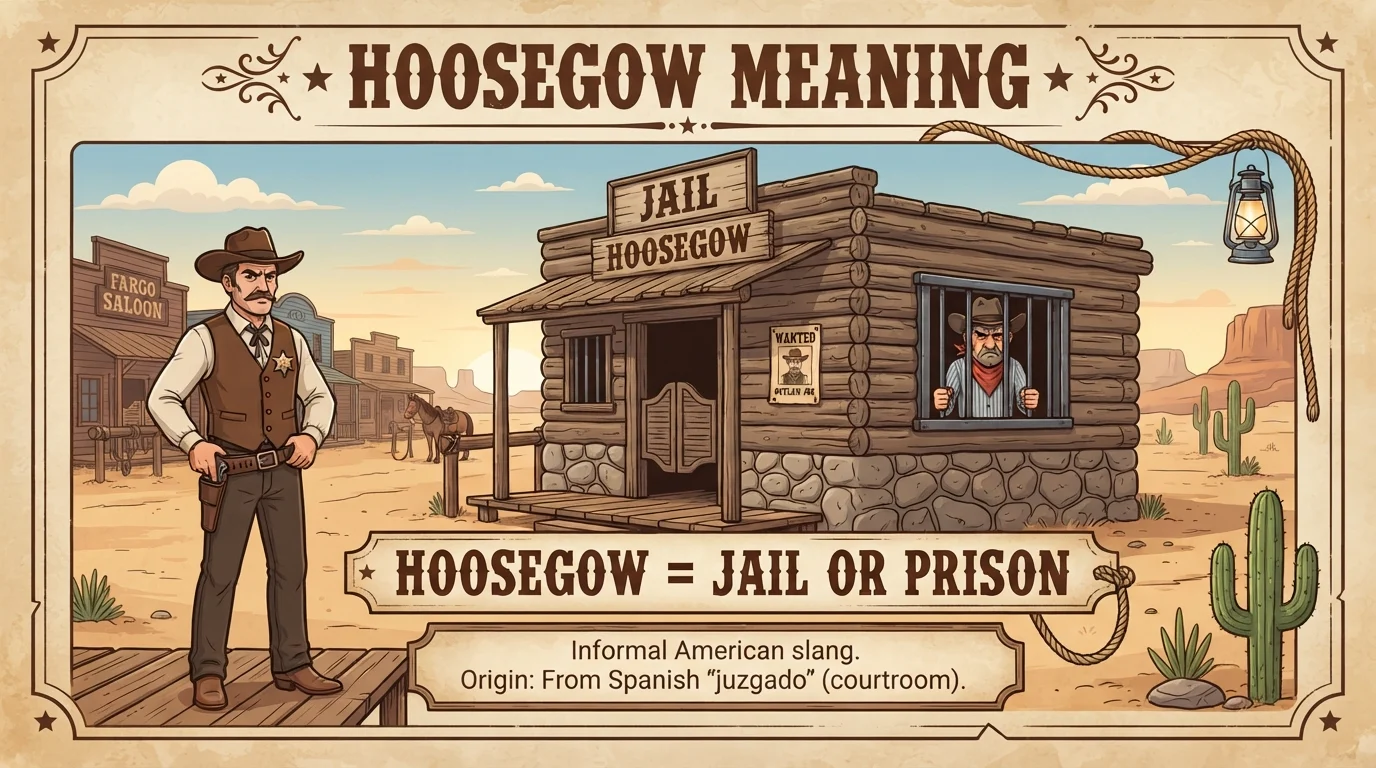
Have you ever heard someone use the unusual word hoosegow and wondered what it means? Although it may sound unfamiliar, hoosegow is an informal American English slang term for a jail or prison. It is commonly associated with old Western movies, cowboy stories, and humorous conversations about getting arrested.
For example, someone might say, The sheriff threw the troublemaker in the hoosegow. This means the sheriff put the troublemaker in jail.
The word has an interesting history and is believed to have developed from a Spanish word used for a judicial authority or court. Over time, its meaning shifted toward jail or prison in American slang.
In this guide, you will learn the meaning of hoosegow, its origin, pronunciation, synonyms, common expressions, and practical examples so you can understand and use this unusual English word correctly.
Quick Answer: What Does Hoosegow Mean?
Hoosegow is an informal American slang word meaning jail, prison, or a place where people are held after being arrested.
It is often used humorously or in a playful way, particularly in cowboy and Western settings.
Examples:
- The sheriff locked the outlaw in the hoosegow.
- He spent the night in the hoosegow after the fight.
- The police took the troublemaker straight to the hoosegow.
In simple terms, hoosegow means jail, but it has a more humorous and old fashioned tone than the ordinary word.
What Does Hoosegow Mean?
The word hoosegow is a noun that refers to a jail or prison. It is especially associated with informal American English.
Unlike neutral words such as jail and prison, hoosegow often sounds humorous, playful, or old fashioned.
It is commonly used when talking about someone being arrested, detained, or sent to jail.
Examples of Hoosegow in Sentences
- The sheriff sent the robber to the hoosegow.
- The cowboy spent two nights in the hoosegow.
- If you keep breaking the law, you might end up in the hoosegow.
- The troublemaker was taken to the local hoosegow.
- The outlaw escaped from the hoosegow before sunrise.
- The movie features a funny scene inside the hoosegow.
- He joked that his mischievous dog belonged in the hoosegow.
In each example, hoosegow refers to a jail or prison.
What Is the Origin of Hoosegow?
The word hoosegow has an interesting Spanish origin.
It is generally traced to the Spanish word juzgado, which means a court or judicial authority. The word entered American English through contact with Spanish speakers, particularly in the American Southwest.
Over time, its pronunciation and spelling changed in informal speech. It eventually developed the meaning of a jail or prison.
The word became especially associated with American Western culture, including cowboy stories, frontier communities, and old Western films.
Today, hoosegow is still understood, but it is relatively uncommon in ordinary conversation.
How Do You Pronounce Hoosegow?
The word hoosegow is commonly pronounced:
HOOZ-gow
Phonetic pronunciation: /ˈhuːzɡaʊ/
It has two syllables:
- Hooze: Sounds like the word whose.
- Gow: Rhymes with now.
The stress falls on the first syllable.
Is Hoosegow Formal or Informal?
Hoosegow is an informal slang word. It is not generally appropriate for formal documents, legal writing, or professional communication.
It is more suitable for:
- Casual conversations
- Humorous stories
- Informal writing
- Cowboy and Western fiction
- Movies and television dialogue
- Playful descriptions of jail
For example:
Informal: The sheriff threw him in the hoosegow.
Formal: The suspect was taken into police custody.
If you are writing a legal report or discussing an actual criminal case, use jail, prison, or detention facility instead.
Hoosegow vs Jail vs Prison
Although these words are related, they do not always have exactly the same meaning or tone.
| Word | Meaning | Usage |
|---|---|---|
| Hoosegow | Jail or prison | Informal, humorous, and old fashioned |
| Jail | A place where people are detained, often before trial or for shorter sentences | Common and neutral |
| Prison | An institution where people serve sentences after conviction | Common and neutral |
| Lockup | A place where arrested people are temporarily held | Informal or neutral |
| Penitentiary | A prison for people convicted of crimes | Formal |
| Detention center | A facility where people are held in custody | Formal or administrative |
Examples
- Hoosegow: The outlaw ended up in the hoosegow.
- Jail: The police took the suspect to jail.
- Prison: He was sentenced to five years in prison.
- Lockup: The suspect was kept in the local lockup.
- Penitentiary: The convicted criminal was transferred to a penitentiary.
The main difference is that hoosegow is slang, while the other words are more widely used in ordinary and formal English.
Common Synonyms of Hoosegow
If you want to replace hoosegow with a more familiar word, you can use one of the following expressions.
- Jail: A place where people are held in custody.
- Prison: An institution where convicted people serve sentences.
- Lockup: A place where arrested people are temporarily detained.
- Clink: An informal slang word for jail.
- Brig: A jail, especially one aboard a ship or within a military setting.
- Penitentiary: A formal term for a prison.
- Slammer: An informal slang term for jail or prison.
- Correctional facility: A formal term for an institution where people are held under the criminal justice system.
Example: Instead of saying, The sheriff put him in the hoosegow, you can say, The sheriff put him in jail.
Common Expressions and Related Phrases
The word hoosegow is often used in sentences involving arrest, punishment, or imprisonment.
Here are some related expressions:
1. End Up in the Hoosegow
This means to be arrested and sent to jail.
Example: If he continues stealing, he will end up in the hoosegow.
2. Throw Someone in the Hoosegow
This means to put someone in jail.
Example: The sheriff threatened to throw the outlaw in the hoosegow.
3. Spend a Night in the Hoosegow
This means to spend a night in jail.
Example: The man spent a night in the hoosegow after causing trouble at the bar.
4. Escape from the Hoosegow
This means to break out of jail or prison.
Example: The prisoner managed to escape from the hoosegow before anyone noticed.
Common Mistakes When Using Hoosegow
Although the word is easy to understand once you know its meaning, learners may make a few mistakes when using it.
Mistake 1: Treating Hoosegow as a Formal Word
Incorrect approach: Using hoosegow in a formal legal report.
Better choice: Use jail, prison, or detention facility in formal writing.
Mistake 2: Confusing Hoosegow with a Police Station
A hoosegow means jail or prison, not simply a police station.
Example:
- Correct: The suspect was taken to the hoosegow.
- Incorrect meaning: The suspect visited the hoosegow to report a crime.
A police station is where police work and receive reports. A jail is where people are held in custody.
Mistake 3: Using Hoosegow in Every Situation Involving Imprisonment
The word is informal and often humorous. It may sound inappropriate when discussing serious crimes, tragic events, or actual imprisonment.
Choose your vocabulary according to the tone and context.
How to Remember the Meaning of Hoosegow
Here is a simple way to remember the word:
Hoosegow = Jail or Prison.
Think of an old cowboy movie in which a sheriff catches an outlaw and sends him to the local jail. The sheriff might jokingly call that jail the hoosegow.
This association can help you remember both the meaning and the word’s connection with American Western culture.
Frequently Asked Questions (FAQs)
1. What does hoosegow mean in slang?
In American slang, hoosegow means jail or prison. It is an informal and often humorous term used to describe a place where arrested people are held. For example, The sheriff put the outlaw in the hoosegow.
2. Is hoosegow a real English word?
Yes. Hoosegow is a recognized English word, although it is informal and relatively uncommon. It is mainly used in American English, especially in humorous or old fashioned contexts.
3. Where did the word hoosegow come from?
Hoosegow is generally traced to the Spanish word juzgado, meaning a court or judicial authority. It entered American English through Spanish language contact in the American Southwest and eventually developed the slang meaning of jail.
4. Is hoosegow a synonym for jail?
Yes. Hoosegow is an informal synonym for jail or prison. However, it has a more humorous and old fashioned tone than the standard word jail.
5. Is hoosegow offensive?
No, hoosegow is not generally considered an offensive word. It is slang and can sound humorous or outdated. However, it may be unsuitable when discussing serious legal or personal situations.
6. What is the pronunciation of hoosegow?
Hoosegow is pronounced HOOZ-gow, with the stress on the first syllable. Its phonetic pronunciation is /ˈhuːzɡaʊ/.
7. What is another word for hoosegow?
Common alternatives include jail, prison, lockup, clink, slammer, and penitentiary. The best alternative depends on the context and level of formality.
Conclusion
The word hoosegow is an informal American slang term meaning jail or prison. It is commonly associated with cowboy stories, Western movies, and humorous conversations about arrest and imprisonment.
The word has Spanish origins and is generally traced to juzgado, meaning a court or judicial authority. Over time, it developed its present slang meaning in American English.
Remember this simple definition: Hoosegow means jail or prison. Use it in casual or humorous contexts, but choose standard words such as jail or prison in formal and serious situations.