The words root and route are often confused because they have similar spellings and can sound alike in some English accents. However, they have different meanings and are used in different contexts. Knowing the difference between them will help you avoid spelling mistakes and communicate more clearly.
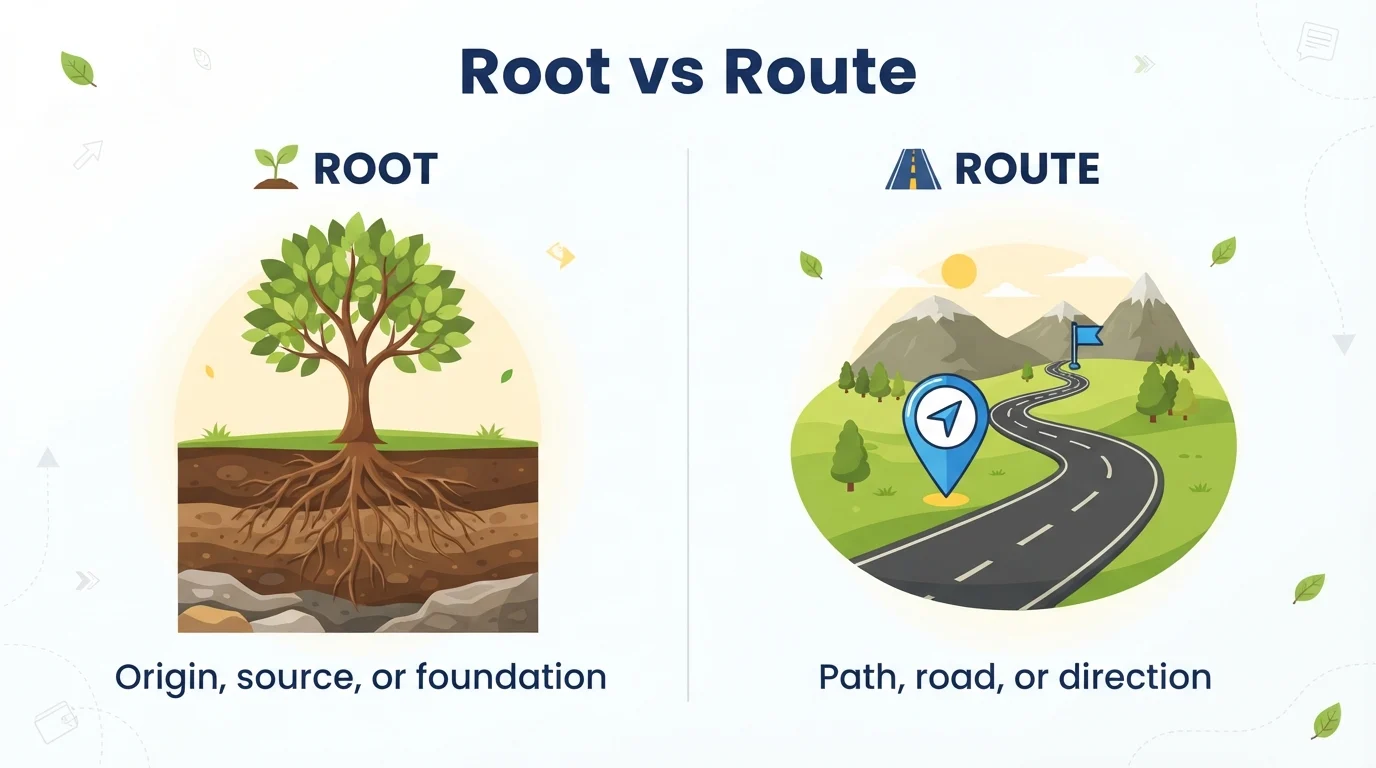
Root usually refers to the underground part of a plant, the origin or source of something, or the basic part of a word. Route refers to a way, path, or direction taken to reach a destination.
For example, you might say, The tree has deep roots when talking about a plant. However, you would say, We took a different route to the airport when describing a journey.
In this guide, you will learn the meanings of root and route, their grammatical uses, pronunciation differences, common expressions, and practical examples.
Quick Answer: What Is the Difference Between Root and Route?
Root means the origin, source, foundation, or underground part of a plant. Route means a path, road, or direction used to travel from one place to another.
Examples:
- Root: The roots of the tree are growing deep into the soil.
- Route: We chose a shorter route to reach the city.
In simple terms, root is about origins or foundations, while route is about paths or directions.
What Does Root Mean?
The word root can be used as both a noun and a verb. As a noun, it has several meanings, including the underground part of a plant, the source of something, or the basic element from which something develops.
1. Root as the Underground Part of a Plant
A root is the part of a plant that usually grows below the ground. It absorbs water and nutrients and helps hold the plant firmly in the soil.
Examples:
- The tree has strong roots.
- The roots of this plant need more water.
- The gardener removed the damaged roots.
- The roots spread deep into the ground.
- This plant grows well in loose soil.
2. Root as the Origin or Source of Something
Root can also mean the original cause, source, or beginning of something.
Examples:
- We need to find the root of the problem.
- Poverty is one of the root causes of social inequality.
- Her fear has its roots in childhood experiences.
- The conflict has deep historical roots.
- Education is at the root of many social changes.
In these examples, root refers to the origin or underlying cause of something.
3. Root in Grammar and Language
In linguistics, a root is the basic part of a word that carries its central meaning. Other parts can be added to it to create related words.
Examples:
- Help is the root of helpful and helpless.
- Act is the root of action and active.
- Care is the root of careful and careless.
- Play is the root of playful and player.
4. Root as a Verb
The verb root has several meanings depending on the context.
It can mean to establish roots or grow firmly in a place.
Example: The tree has rooted deeply in the soil.
In informal American English, root for someone means to support or encourage them, especially in a competition.
Examples:
- I always root for my favorite football team.
- We are rooting for you.
- Everyone was rooting for the home team.
What Does Route Mean?
The word route is a noun and a verb. As a noun, it means a path, road, course, or way used to travel between places.
It can refer to a physical road, a public transportation path, a delivery path, or a planned journey.
1. Route as a Path or Direction
Examples:
- We took the shortest route to the airport.
- This route is safer during the winter.
- The driver followed the wrong route.
- Which route should we take to reach the hotel?
- The mountain route offers beautiful views.
2. Route in Transportation
The word route is commonly used for buses, trains, airplanes, and other forms of transportation.
Examples:
- This bus route connects two major cities.
- The airline has introduced a new international route.
- The train follows a scenic route.
- My daily route to work takes thirty minutes.
3. Route in Technology and Business
Route is also used in technology and business to describe how information, requests, products, or services move from one point to another.
Examples:
- The system routes messages to the correct department.
- The company changed its delivery route.
- The network routes data through several servers.
- Please route this request to the customer service team.
4. Route as a Verb
As a verb, route means to send or direct someone or something along a particular path.
Examples:
- The manager routed the complaint to the relevant department.
- The package was routed through another city.
- The system routes incoming calls automatically.
Root vs Route: Key Differences
Although these words look similar, their meanings and uses are different.
| Root | Route |
|---|---|
| Refers to the origin, source, or foundation of something. | Refers to a path, road, or direction. |
| Can describe the underground part of a plant. | Can describe a journey between places. |
| Commonly used in gardening, grammar, and discussions about causes. | Commonly used in travel, transportation, technology, and delivery. |
| Can be used as a noun and a verb. | Can be used as a noun and a verb. |
| Example: We need to identify the root cause. | Example: We need to choose the best route. |
Root vs Route: Examples in Sentences
The following examples will help you understand the difference more clearly.
Examples of Root
- The roots of the tree are visible above the ground.
- We must address the root cause of the problem.
- Music has deep roots in her family.
- The word has a Latin root.
- His traditions are rooted in his culture.
- I am rooting for our team.
- The plant has started to root in the garden.
Examples of Route
- We followed a different route home.
- The bus route passes through the city center.
- The driver selected the fastest route.
- This route is closed because of construction.
- The airline operates a direct route to London.
- The delivery company changed its usual route.
- Please route the document to the finance department.
Root vs Route: Pronunciation Differences
Although root and route have different meanings, their pronunciation can cause confusion.
How to Pronounce Root
The word root is commonly pronounced in two ways:
- /ruːt/, rhyming with boot.
- /rʊt/, rhyming with foot.
Both pronunciations are accepted in English, although preferences vary by region and speaker.
How to Pronounce Route
The word route also has two common pronunciations:
- /ruːt/, rhyming with boot.
- /raʊt/, rhyming with out.
Both are accepted pronunciations. The /raʊt/ pronunciation is particularly common in American English, while /ruːt/ is widely used in British English and elsewhere.
Because root and route can both be pronounced /ruːt/, context is often necessary to understand which word someone means.
Common Expressions with Root and Route
Both words appear in several common English expressions.
Common Expressions with Root
- Root cause: The original or main reason something happens.
- Root of the problem: The underlying source of an issue.
- Take root: To become established or firmly settled.
- Deep roots: Strong historical, cultural, or personal connections.
- Root word: The basic part of a word.
- Root for someone: To support someone in a competition.
Examples:
- We need to identify the root cause of the accident.
- The new business has taken root in the community.
- I am rooting for my favorite team.
Common Expressions with Route
- Direct route: The shortest or most straightforward path.
- Alternative route: A different way to reach a destination.
- Scenic route: A path chosen for its attractive views.
- Bus route: The path followed by a bus.
- Delivery route: The path used to deliver goods.
- On route: Sometimes used informally to mean traveling toward a destination, although en route is the established expression.
Examples:
- We decided to take the scenic route.
- The driver selected an alternative route.
- The bus follows the same route every morning.
Root vs Route: Common Mistakes to Avoid
English learners sometimes use these words incorrectly because of their similar spelling and pronunciation.
Mistake 1: Using Route Instead of Root
Incorrect: We need to find the route cause of the problem.
Correct: We need to find the root cause of the problem.
The expression root cause refers to the original reason behind an issue.
Mistake 2: Using Root Instead of Route
Incorrect: We took a different root to the airport.
Correct: We took a different route to the airport.
A route is a path or direction used to reach a destination.
Mistake 3: Confusing Root For with Route For
Incorrect: I route for my favorite team.
Correct: I root for my favorite team.
The expression root for means to support or encourage someone.
Mistake 4: Confusing Rooted and Routed
These words have different meanings:
- Rooted: Established firmly or connected to an origin.
- Routed: Directed or sent along a particular path.
Examples:
- Her beliefs are deeply rooted in her culture.
- The package was routed through another city.
How to Remember the Difference Between Root and Route
Here is a simple trick:
- Root = Origin or foundation.
- Route = Road or path.
Think of a tree when you see the word root. Its roots grow into the soil and support the plant.
Think of a map when you see the word route. It shows the path you need to follow to reach a destination.
Examples:
- The root of the problem is poor communication.
- The route to the airport is closed.
This simple association can help you remember which word to use.
Frequently Asked Questions (FAQs)
1. What is the main difference between root and route?
Root refers to the origin, source, foundation, or underground part of a plant. Route refers to a path, road, or direction used to travel between places. For example, root cause means the original reason for a problem, while travel route means the path taken on a journey.
2. Are root and route pronounced the same?
Sometimes. Both words can be pronounced /ruːt/, rhyming with boot. However, route can also be pronounced /raʊt/, rhyming with out, and root can also be pronounced /rʊt/, rhyming with foot.
3. Is it root cause or route cause?
The correct expression is root cause. It means the original or underlying reason for a problem. For example, The investigation revealed the root cause of the accident.
4. Is it root for or route for?
The correct expression is root for when you mean to support or encourage someone, especially in a competition. For example, I am rooting for my favorite football team.
5. What does take root mean?
Take root means to become established, settled, or firmly connected to a place, idea, or community. For example, The new tradition quickly took root in the community.
6. Can root and route be used as verbs?
Yes. Root can mean to grow roots or support someone, as in I am rooting for you. Route means to direct or send something along a particular path, as in The system routes calls automatically.
7. What is the difference between rooted and routed?
Rooted means firmly established, connected, or based on something. Routed means directed or sent along a particular path. For example, Her beliefs are rooted in tradition, while The package was routed through another city.
Conclusion
The difference between root and route is mainly related to their meanings and contexts.
Use root when referring to the origin, source, foundation, or underground part of a plant. Use route when referring to a road, path, direction, or way of reaching a destination.
Remember this simple rule: Root means origin, while route means path.
Although the two words can sound alike, their meanings are quite different. Learning their common expressions, pronunciation, and sentence examples will help you use them correctly in everyday English.