Have you ever confused dual and duel because they sound almost identical? These two English words differ by just one letter, but their meanings are completely different. Using the wrong word can change the meaning of your sentence, especially in writing.
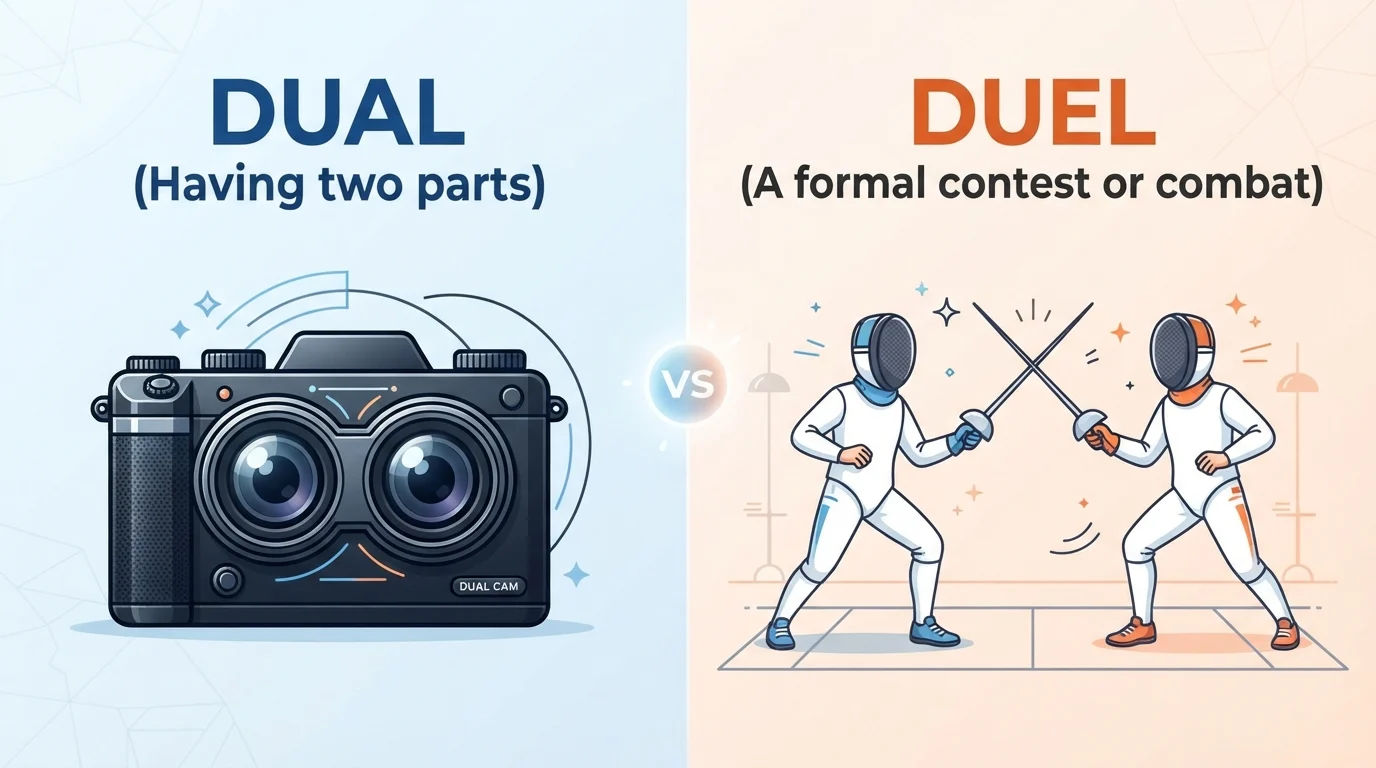
The word dual means having two parts, functions, purposes, or aspects. For example, a dual-purpose device serves two purposes, and a dual citizenship arrangement involves citizenship in two countries. In contrast, duel refers to a formal fight or contest between two people, traditionally involving weapons or, more broadly, a direct competition between opponents.
Although dual and duel are pronounced similarly in many English accents, they belong to different categories of meaning. Understanding the difference is easy once you connect each word with its main idea: two things for dual and a fight between opponents for duel.
In this guide, you will learn their definitions, grammatical uses, examples, common mistakes, pronunciation, and practical memory tricks to help you use both words confidently.
Quick Answer: Dual vs Duel
Dual means having two parts, purposes, roles, or functions. Example: “She has dual responsibilities at work.”
Duel means a fight or contest between two opponents. Example: “The two rivals agreed to a duel.”
Remember that dual is associated with two aspects or functions, while duel is associated with a confrontation between opponents.
1. What Does Dual Mean?
Dual is an adjective that means having two parts, two purposes, two roles, or two related aspects.
It is commonly used in technology, education, employment, law, citizenship, and everyday descriptions.
Examples of Dual in Sentences
- My phone has a dual camera system.
- She has dual responsibilities as a teacher and a department head.
- The building serves a dual purpose as a library and a community center.
- He holds dual citizenship in two countries.
- The company introduced a dual payment system.
- This machine has dual functions.
- She plays a dual role in the organization.
- The car comes with dual airbags.
- The project has dual objectives: reducing costs and improving quality.
- He has a dual interest in science and business.
In each example, dual describes something involving two parts, roles, purposes, or features.
Common Expressions With Dual
- Dual citizenship: Citizenship in two countries.
- Dual purpose: Serving two purposes.
- Dual role: Having two roles or responsibilities.
- Dual function: Performing two functions.
- Dual control: A system in which control is shared or provided in two ways, depending on the context.
- Dual identity: Having two identities or aspects of identity.
- Dual degree: A degree arrangement involving two academic qualifications or fields, depending on the program.
The central meaning remains the same: dual refers to two parts or aspects.
2. What Does Duel Mean?
Duel is a noun or a verb associated with a fight or contest between two opponents.
Traditionally, a duel was a formal fight between two people, often involving weapons, to settle a dispute or defend personal honor. Today, the word can also describe a direct competition between two people, teams, or rivals.
Examples of Duel as a Noun
- The two rivals challenged each other to a duel.
- The movie features a dramatic sword duel.
- The duel ended before anyone was seriously injured.
- The historical novel describes a duel between two noblemen.
- The championship became a duel between two talented players.
- The two chess masters engaged in an intense duel of strategy.
- The final match was a duel between the tournament’s best competitors.
- The story ends with a duel between the hero and the villain.
Examples of Duel as a Verb
- The two champions dueled for the title.
- The rivals dueled on the field.
- The characters duel with swords in the final scene.
- The competitors dueled for the audience’s attention.
- The two teams dueled throughout the championship.
As a verb, duel means to fight or compete directly against an opponent.
3. Dual vs Duel: Main Differences
| Feature | Dual | Duel |
|---|---|---|
| Part of speech | Adjective | Noun and verb |
| Main meaning | Having two parts or purposes | A fight or contest between opponents |
| Common context | Technology, roles, functions, citizenship | Fighting, rivalry, competition |
| Example | The car has dual airbags. | The rivals fought a duel. |
| Related idea | Two aspects | Two opponents |
| Memory clue | Dual features | Duel involves a contest |
The simplest distinction is that dual describes something with two parts, while duel refers to a confrontation or competition.
4. Dual vs Duel: Examples in Everyday English
These examples show how the two words work in different contexts.
Example 1: Technology
Correct: “My laptop supports dual monitors.”
Incorrect: “My laptop supports duel monitors.”
Why? Dual describes a setup involving two monitors. Duel would suggest a fight or contest.
Example 2: Employment
Correct: “She has a dual role in the company.”
Incorrect: “She has a duel role in the company.”
Why? The sentence refers to two roles, not a confrontation.
Example 3: History
Correct: “The two gentlemen fought a duel.”
Incorrect: “The two gentlemen fought a dual.”
Why? A duel is a fight between opponents.
Example 4: Sports
Correct: “The final was a duel between two outstanding athletes.”
Incorrect: “The final was a dual between two outstanding athletes.”
Why? Duel describes their direct competition.
Example 5: Citizenship
Correct: “He has dual citizenship.”
Incorrect: “He has duel citizenship.”
Why? Dual citizenship refers to citizenship in two countries.
Example 6: Fiction
Correct: “The hero challenged the villain to a duel.”
Incorrect: “The hero challenged the villain to a dual.”
Why? The hero is challenging the villain to a fight or contest.
5. Dual vs Duel Pronunciation
Dual and duel are pronounced identically or very similarly by many English speakers. In many accents, both are pronounced like “DOO-uhl,” although pronunciation can vary by region and speaker.
This similarity is why people often confuse the two words in writing.
| Word | Typical pronunciation | Meaning |
|---|---|---|
| Dual | DOO-uhl | Having two parts |
| Duel | DOO-uhl | A fight or contest |
Because their pronunciation overlaps, the best way to distinguish them is by remembering their meanings rather than relying on how they sound.
6. Is Dual a Noun or an Adjective?
Dual is primarily an adjective in everyday English. It describes a noun that has two parts, functions, or purposes.
Examples:
- Dual cameras
- Dual citizenship
- Dual responsibilities
- Dual purpose
- Dual control
For instance, in “The device has dual cameras,” dual describes the cameras.
The related noun dual appears in specialized contexts, but most English learners will encounter it as an adjective.
7. Is Duel a Noun or a Verb?
Duel can be both a noun and a verb.
As a noun, it refers to a fight or contest.
Example: “The duel attracted a large crowd.”
As a verb, it means to fight or compete against an opponent.
Example: “The two rivals dueled for the championship.”
The verb forms include:
- Base form: duel
- Third-person singular: duels
- Present participle: dueling or duelling
- Simple past: dueled or duelled
The spellings dueling and dueled are common in American English, while duelling and duelled are common in British English.
8. Common Mistakes With Dual and Duel
Here are some common spelling mistakes and their corrections.
| Incorrect | Correct | Explanation |
|---|---|---|
| He has duel citizenship. | He has dual citizenship. | Two citizenships |
| The movie features a sword dual. | The movie features a sword duel. | A fight with swords |
| The device has duel functions. | The device has dual functions. | Two functions |
| They agreed to a dual. | They agreed to a duel. | A fight or contest |
| She has duel responsibilities. | She has dual responsibilities. | Two responsibilities |
| The rivals dueled for the title. | The rivals dueled for the title. | Correct use of the verb |
The key is to identify the meaning before choosing the spelling.
9. Dual vs Duel in American and British English
The meanings of dual and duel are the same in American and British English. However, the spelling of the verb duel changes slightly in some forms.
| Form | American English | British English |
|---|---|---|
| Present tense | Duel | Duel |
| Simple past | Dueled | D ue lled, usually written as “duelled” |
| Present participle | Dueling | Duelling |
| Adjective meaning two parts | Dual | Dual |
The British forms are duelled and duelling. The American forms are dueled and dueling.
This spelling difference does not change the meaning of the word.
10. Synonyms of Dual and Duel
The two words have different meanings, so they also have different synonyms.
Synonyms of Dual
Depending on the context, alternatives for dual include:
- Twofold
- Double
- Two-part
- Paired
- Bipartite
Examples:
“The project has a twofold purpose.”
“The system has a double function.”
These alternatives are not always interchangeable, so choose one that fits the sentence.
Synonyms of Duel
Depending on the context, alternatives for duel include:
- Fight
- Contest
- Showdown
- Face-off
- Combat
- Battle
Examples:
“The rivals had a showdown.”
“The two teams faced off in the final.”
Some alternatives, such as battle, can describe conflicts involving more than two people, while duel traditionally focuses on two opponents.
11. A Simple Memory Trick for Dual vs Duel
Use this easy trick to remember the difference.
Dual = two parts.
Think of dual cameras, dual citizenship, or dual responsibilities.
Duel = two opponents.
Think of two rivals facing each other in a fight or contest.
You can also connect the word duel with the idea of a challenge between opponents. When you see duel, imagine a dramatic sword fight or a competition between two rivals.
Remember:
- Dual describes two aspects.
- Duel describes a confrontation.
This simple association can help you avoid confusing the two spellings.
12. Practice: Dual or Duel?
Choose the correct word to complete each sentence.
- The smartphone has a ______ camera.
- The two knights fought a ______.
- She has ______ responsibilities at work.
- The final match was a ______ between two champions.
- He holds ______ citizenship.
- The rivals decided to ______ for the title.
- The machine has a ______ purpose.
- The film ends with a sword ______.
Answers
- Dual
- Duel
- Dual
- Duel
- Dual
- Duel
- Dual
- Duel
If the sentence describes two functions or aspects, use dual. If it describes a fight or contest, use duel.
13. Frequently Asked Questions
What is the difference between dual and duel?
Dual means having two parts, purposes, or roles. Duel means a fight or contest between two opponents. For example, a phone can have dual cameras, while two rivals can fight a duel.
Are dual and duel pronounced the same?
They are pronounced identically or very similarly in many English accents. Because their pronunciation overlaps, it is important to learn their different meanings and spellings.
Is dual an adjective?
Yes. Dual is primarily an adjective meaning having two parts, functions, roles, or aspects. For example, “The device has dual controls.”
Can duel be used as a verb?
Yes. Duel can mean to fight or compete directly against someone. For example, “The two players dueled for the championship.”
Is it dual citizenship or duel citizenship?
The correct expression is dual citizenship because it refers to citizenship in two countries.
Is it a sword dual or a sword duel?
The correct phrase is sword duel because a duel is a fight between opponents, traditionally involving weapons.
What is the plural of duel?
The plural noun is duels. For example, “The history book describes several famous duels.”
What is the difference between dual and double?
Both can relate to two, but they are not always interchangeable. Dual often describes two functions, roles, or aspects, while double can mean twice as much or consisting of two parts. For example, “dual citizenship” is the standard expression, while “double the amount” means twice as much.
Remember This
- Dual means having two parts, purposes, roles, or functions.
- Duel means a fight or contest between two opponents.
- Dual is mainly an adjective.
- Duel can be a noun or a verb.
- Both words sound alike in many English accents.
- Use dual citizenship, dual cameras, and dual responsibilities.
- Use sword duel, historic duel, and duel for the championship.
Final Verdict: Dual vs Duel
Although dual and duel sound alike, their meanings are very different. Dual describes something with two parts, roles, or functions, while duel refers to a fight or contest between two opponents.
Use dual in expressions such as dual citizenship, dual cameras, and dual responsibilities. Use duel when discussing a sword fight, a historical confrontation, or a direct contest between rivals.
The easiest way to remember the difference is this: dual means two aspects, while duel means a contest between opponents. Once you connect each spelling with its meaning, you can use both words correctly in everyday conversation and writing.