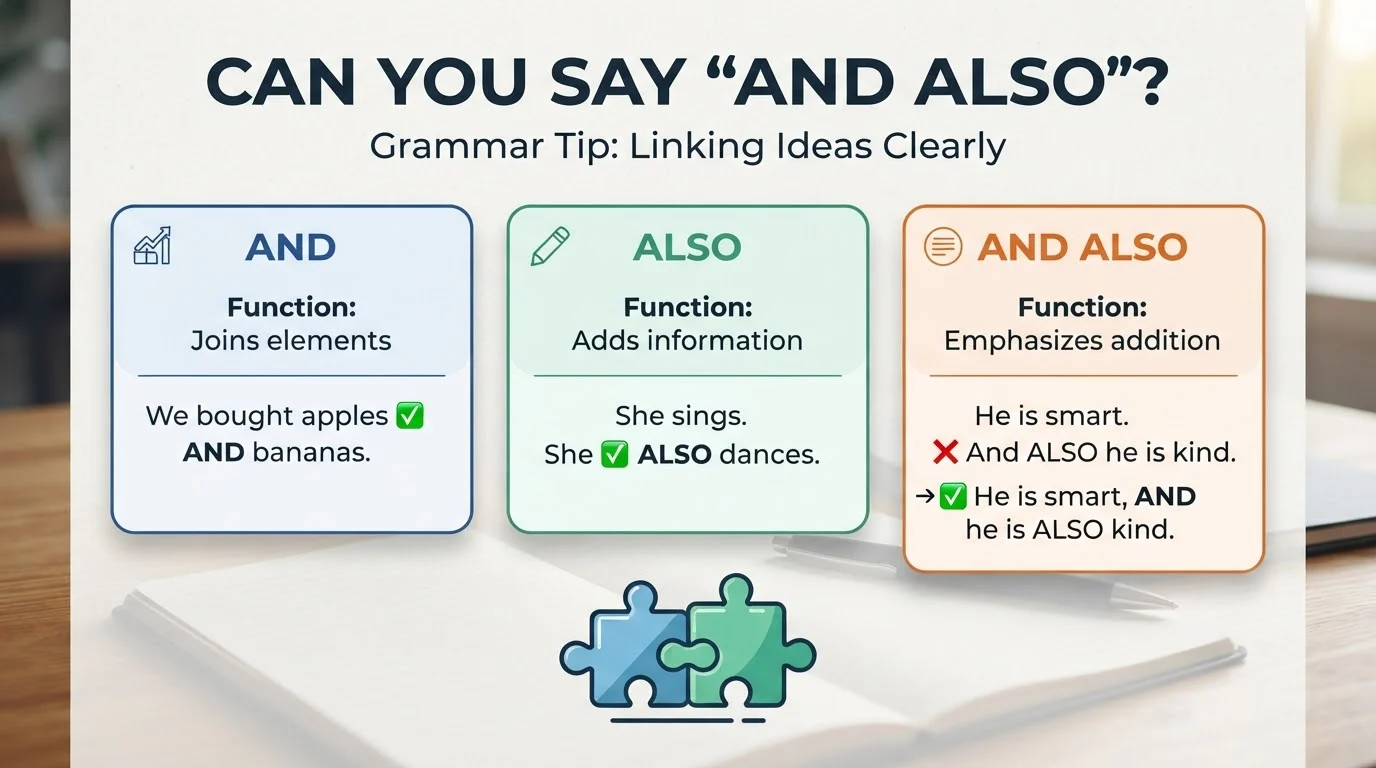
Is it correct to say “and also” in English? Yes! The phrase and also is grammatically correct and commonly used in everyday conversations and writing. It combines two ideas while adding extra information, emphasizing an additional point, or mentioning another action or item.
However, many English learners wonder if using both and and also together is necessary. They may also be unsure whether the phrase sounds natural in formal writing, everyday speech, or professional communication.
The good news is that you can use “and also” correctly in many situations. The key is understanding how it works in a sentence and avoiding unnecessary repetition. In this guide, you will learn the meaning of and also, its correct usage, sentence examples, common mistakes, and the difference between and, also, and and also.
Quick Answer: Can You Say “And Also”?
Yes, “and also” is correct English. It is used to add another piece of information, action, or idea to something already mentioned. For example, “She is intelligent and also hardworking.” The phrase is common in both spoken and written English. However, because and and also both express addition, using them together can sometimes be unnecessary. Choose the wording that makes your sentence clear and natural.
What Does “And Also” Mean?
And also means in addition, as well as, or too. It connects information and introduces something extra.
The word and joins words, phrases, or clauses, while also adds the idea that something else is included.
When combined, they emphasize that another thing is true or relevant.
Examples of And Also in Sentences
- She speaks English and also understands French.
- He is a talented writer and also a skilled editor.
- We visited the museum and also explored the nearby park.
- The course teaches grammar and also improves speaking skills.
- My brother works full time and also studies at university.
In each example, and also introduces additional information.
How to Use “And Also” Correctly
You can use and also in several ways, depending on the structure and meaning of your sentence.
1. To Add Another Quality or Characteristic
Use and also when describing two or more qualities of a person, place, or thing.
Examples:
- She is friendly and also very helpful.
- The restaurant is affordable and also offers excellent food.
- This book is informative and also entertaining.
- He is confident and also hardworking.
- The application is simple to use and also highly effective.
2. To Add Another Action
You can use and also to mention an additional action performed by someone.
Examples:
- She teaches English and also writes educational articles.
- He cleaned the kitchen and also washed the dishes.
- They visited Lahore and also traveled to Islamabad.
- I completed my assignment and also prepared for the examination.
- The company manufactures furniture and also sells home accessories.
3. To Add Another Piece of Information
Use the phrase when you want to provide an additional fact or detail.
Examples:
- The school provides free books and also offers transportation.
- The hotel has a swimming pool and also provides free breakfast.
- The product is affordable and also comes with a warranty.
- The report includes financial information and also discusses future plans.
4. In Everyday Conversations
And also is natural in casual conversations when you want to add another thought.
Examples:
- “I need to buy groceries and also pick up my package.”
- “She is my colleague and also a close friend.”
- “We should invite Ali and also ask Sara to join us.”
It helps connect ideas without requiring a complicated sentence structure.
And vs Also vs And Also
Although these expressions are related, they do not work in exactly the same way.
| Expression | Meaning | Example |
|---|---|---|
| And | Connects words or ideas | She sings and dances. |
| Also | Adds extra information | She also dances. |
| And also | Connects and emphasizes an additional point | She sings and also dances. |
What Is the Difference Between And and Also?
And connects two or more words, phrases, or clauses.
Example: She bought apples and oranges.
Also adds information and can appear in different positions in a sentence.
Example: She also bought oranges.
And also combines both functions to introduce additional information.
Example: She bought apples and also purchased oranges.
All three forms are correct when used appropriately.
Is “And Also” Redundant?
Sometimes, yes. Although and also is grammatically correct, it can sound repetitive when the additional meaning is already clear from the word and.
Consider these examples:
Wordy: She bought a notebook and also a pen.
More concise: She bought a notebook and a pen.
Both sentences are correct, but the second is shorter and more natural in many contexts.
However, and also is not always redundant.
For example:
“She is a doctor and also runs a charity organization.”
Here, and also emphasizes an additional responsibility or activity. The sentence sounds natural.
Remember: Do not avoid and also completely. Use it when it improves clarity or emphasis, and remove also when it adds no meaningful information.
Can You Start a Sentence With “And Also”?
Yes, you can start a sentence with and also, especially in informal writing or conversations. However, it should connect naturally to the previous sentence.
Examples:
- The course covers basic grammar. And also, it includes practical speaking exercises.
- We need to prepare the presentation. And also, we should review the budget.
- The hotel offers comfortable rooms. And also, it provides free airport transportation.
Although these examples are understandable, starting a sentence with and also can sometimes sound awkward or unnecessarily repetitive.
For more polished writing, consider these alternatives:
- Additionally, the course includes practical speaking exercises.
- We should also review the budget.
- Furthermore, the hotel provides free airport transportation.
In formal writing, these alternatives may create a smoother connection between ideas.
Is “And Also” Formal or Informal?
And also is acceptable in both formal and informal English. However, its suitability depends on the sentence and context.
| Context | Is It Appropriate? | Example |
|---|---|---|
| Everyday conversation | Yes | I need milk and also some bread. |
| Emails | Yes | Please review the document and also confirm the details. |
| Academic writing | Yes, when appropriate | The study examines costs and also evaluates long term outcomes. |
| Professional reports | Yes, but avoid unnecessary repetition | The policy improves efficiency and also reduces costs. |
| Formal presentations | Yes | The proposal saves time and also improves productivity. |
In formal writing, words such as additionally, furthermore, and moreover can sometimes be better choices.
Alternatives to “And Also”
If you want to avoid repeating and also, you can use several other expressions.
| Alternative | Meaning | Example |
|---|---|---|
| Additionally | Adds another point | Additionally, the course includes practical exercises. |
| Furthermore | Introduces another supporting point | Furthermore, the results support our findings. |
| Moreover | Adds information or emphasis | Moreover, the service is affordable. |
| As well as | Adds another item or feature | She teaches English as well as French. |
| In addition | Introduces extra information | In addition, the company offers free delivery. |
| Too | Adds something to an earlier statement | She speaks Spanish too. |
| Also | Adds another fact or action | He also works on weekends. |
Examples Using Alternatives
- Additionally, the school offers free transportation.
- Furthermore, students receive practical training.
- The restaurant serves breakfast as well as lunch.
- In addition, the company provides customer support.
- She enjoys reading and writing too.
Common Mistakes to Avoid
Mistake 1: Assuming “And Also” Is Grammatically Incorrect
Incorrect assumption: You should never use and also because it is repetitive.
Correct understanding: And also is grammatically correct. It is only unnecessary when and already communicates the intended addition clearly.
Mistake 2: Using “And Also” Too Frequently
Incorrect or awkward: She is smart and also kind and also friendly and also helpful.
Better: She is smart, kind, friendly, and helpful.
Use and also when it adds emphasis, not in every part of a sentence.
Mistake 3: Using It Without a Clear Connection
Awkward: I like coffee. And also the weather is nice.
Better: I like coffee, and I also enjoy the pleasant weather.
The ideas should connect logically.
Mistake 4: Confusing “And Also” With “But Also”
These expressions have different purposes.
- And also adds another related point.
- But also introduces an additional point, often as part of a contrast or emphasis.
Example of and also:
“She is intelligent and also hardworking.”
Example of but also:
“She is not only intelligent but also hardworking.”
The second example uses the paired structure not only … but also.
Easy Trick to Remember the Usage
Remember this simple rule:
And = connects ideas.
Also = adds information.
And also = connects ideas while emphasizing an additional point.
For example:
- She sings and dances.
- She also dances.
- She sings and also dances.
All three sentences are correct, but the best choice depends on the emphasis you want to create.
Frequently Asked Questions
1. Can you say and also in English?
Yes. And also is grammatically correct and commonly used to introduce additional information, actions, or qualities.
2. Is and also grammatically correct?
Yes. The phrase is correct when it connects related ideas or emphasizes an additional point. However, it may be unnecessary when and alone is sufficient.
3. Is and also redundant?
It can be redundant in some sentences because both words express addition. However, it is not always repetitive or incorrect. It can be useful when you want to emphasize an extra point.
4. Can I use and also in formal writing?
Yes. You can use and also in formal writing, academic work, and professional communication. However, alternatives such as additionally, furthermore, and moreover may sometimes sound more polished.
5. Can you start a sentence with and also?
Yes, particularly in informal writing and conversation. However, starting a sentence this way can sound awkward if the connection to the previous sentence is unclear. Additionally or furthermore may be better in formal writing.
6. What is another way to say and also?
Common alternatives include additionally, furthermore, moreover, in addition, as well as, and too. The best alternative depends on the sentence structure.
7. What is the difference between and and also?
And connects words, phrases, or clauses, while also adds extra information. And also combines these functions to introduce another related point.
8. Is and also used in spoken English?
Yes. It is common in everyday spoken English. People use it to add another thought, action, or detail during conversations.
Conclusion
The phrase and also is grammatically correct and widely used in English. It helps connect ideas and introduce additional information, actions, or qualities.
Although the phrase can sometimes sound repetitive, it is not automatically incorrect. Use it when you want to emphasize an additional point, and choose and alone when a shorter sentence communicates the same meaning.
Remember the simple rule: And connects ideas, also adds information, and and also can do both.