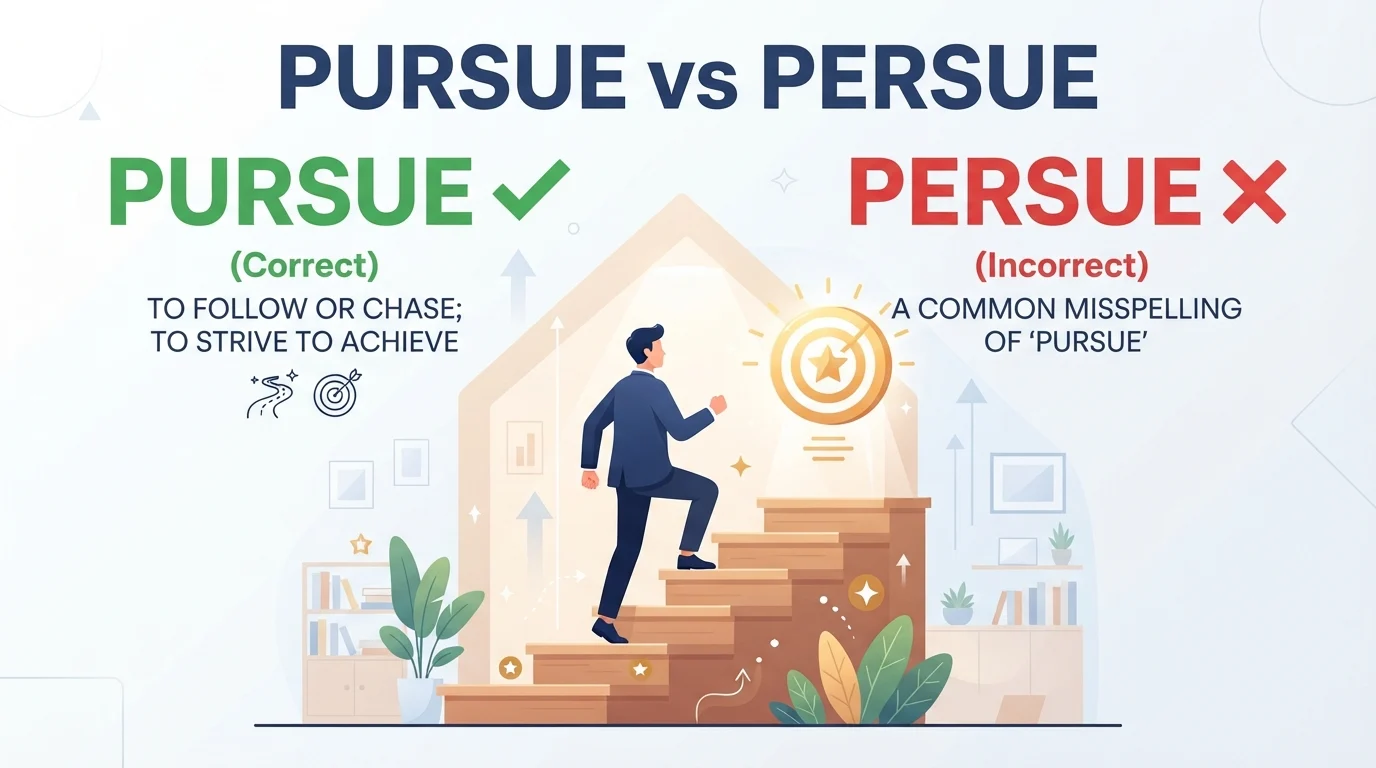
Are you confused about if to write pursue or persue? You are not alone. These two spellings look similar, and the difference is easy to overlook when writing quickly. However, only one of them is correct in standard English.
Pursue is the correct spelling. It means to follow someone or something, work toward a goal, continue an activity, or try to achieve something. For example, you might pursue a career, pursue your dreams, or pursue a business opportunity. The word is widely used in professional communication, education, personal development, and everyday conversation.
On the other hand, persue is a common spelling mistake. It is not an accepted alternative spelling of pursue in standard modern English. If you want to improve your spelling, expand your vocabulary, or write more confidently in English, learning this difference is important.
In this guide, you will discover the meaning of pursue, how to use it in sentences, common spelling mistakes, synonyms, pronunciation, and simple memory tricks to help you remember the correct spelling.
Quick Answer: Pursue vs Persue
Pursue is the correct spelling and means to follow, seek, or work toward something. For example, “She wants to pursue a career in medicine.” Persue is an incorrect spelling and should be avoided in standard English writing. Remember to spell the word with pur at the beginning, not per.
1. What Does Pursue Mean?
Pursue is a verb that means to follow, seek, continue, or make an effort to achieve something.
It can describe physically following someone, working toward a personal ambition, continuing an activity, or trying to obtain information.
Examples of Pursue in Sentences
- She wants to pursue a career in medicine.
- He decided to pursue his dream of becoming a writer.
- The police pursued the suspect through the streets.
- You should pursue opportunities that help you grow.
- They plan to pursue further education after graduation.
- The company is pursuing new business opportunities.
- She continued to pursue her goals despite several setbacks.
- The journalist pursued the story until the facts became clear.
- He wants to pursue a degree in computer science.
- We should pursue a peaceful solution to the problem.
In each sentence, pursue expresses the idea of following something, seeking an outcome, or continuing an effort.
2. What Does Persue Mean?
Persue is a misspelling of pursue. It does not have a separate standard meaning in modern English.
People often make this mistake because the pronunciation of pursue may sound unfamiliar, and the letters can be difficult to remember. However, the correct spelling always begins with pur.
Incorrect: She wants to persue her dreams.
Correct: She wants to pursue her dreams.
Incorrect: He decided to persue a university degree.
Correct: He decided to pursue a university degree.
Incorrect: The police continued to persue the suspect.
Correct: The police continued to pursue the suspect.
If you are writing an essay, email, application, report, or social media post, always use pursue.
3. Pursue vs Persue: Main Differences
| Feature | Pursue | Persue |
|---|---|---|
| Spelling | Correct | Incorrect |
| Meaning | To follow, seek, or work toward something | No standard meaning |
| Part of speech | Verb | Misspelling of a verb |
| Suitable for formal writing | Yes | No |
| Example | I want to pursue my goals. | I want to persue my goals. |
| Correct choice | Yes | No |
The important point is simple. Pursue is always the correct spelling when you mean to follow or work toward something.
4. How to Use Pursue Correctly
Pursue is a versatile verb. You can use it in several different situations.
A. Pursue a Career
Use pursue when talking about a profession or career path that someone wants to follow.
Examples:
- She plans to pursue a career in law.
- He decided to pursue teaching after graduation.
- I want to pursue a career in digital marketing.
- They encouraged their daughter to pursue a career in science.
B. Pursue a Dream or Goal
Pursue is frequently used when discussing ambitions and personal achievements.
Examples:
- Never stop pursuing your dreams.
- He worked hard to pursue his lifelong ambition.
- She is pursuing her goal of becoming financially independent.
- You should pursue goals that are meaningful to you.
C. Pursue an Opportunity
Use pursue when trying to obtain an opportunity, business deal, or possible advantage.
Examples:
- The company plans to pursue new markets.
- She decided to pursue the job opportunity.
- We are pursuing several promising business partnerships.
- The organization continues to pursue funding for its project.
D. Pursue Someone or Something
Pursue can also mean to follow or chase a person or object.
Examples:
- The police pursued the escaping driver.
- The dog pursued the ball across the garden.
- The detectives pursued every possible lead.
- The athlete pursued the runner ahead of him.
E. Pursue Knowledge or Education
Pursue is also common in academic contexts.
Examples:
- She wants to pursue higher education abroad.
- He pursued a degree in engineering.
- Many students pursue additional qualifications to improve their careers.
- They are pursuing research into renewable energy.
5. Pursue in Different Tenses
Pursue follows regular verb patterns. Its spelling changes slightly in some forms, but the base form remains pursue.
| Tense or form | Correct form | Example |
|---|---|---|
| Base form | Pursue | I want to pursue my goals. |
| Present simple | Pursues | She pursues new opportunities. |
| Present participle | Pursuing | He is pursuing a degree. |
| Simple past | Pursued | They pursued the case. |
| Past participle | Pursued | She has pursued her ambition for years. |
Notice that the past tense and past participle are both pursued, not persued or pursueded.
Examples:
Present: She pursues her dreams.
Past: She pursued her dreams.
Present continuous: She is pursuing her dreams.
Present perfect: She has pursued her dreams for years.
6. Common Expressions With Pursue
The verb pursue appears in many common English expressions.
| Expression | Meaning | Example |
|---|---|---|
| Pursue a dream | Work toward an ambition | He wants to pursue his dream of becoming a pilot. |
| Pursue a career | Follow a professional path | She plans to pursue a career in medicine. |
| Pursue a goal | Make an effort to achieve something | They continue to pursue their goals. |
| Pursue an opportunity | Try to obtain an opportunity | We should pursue this opportunity. |
| Pursue a case | Continue investigating or dealing with a case | The lawyer decided to pursue the case. |
| Pursue a relationship | Seek or continue a romantic relationship | He decided to pursue a relationship with her. |
| Pursue knowledge | Seek to learn more | She enjoys pursuing knowledge. |
| Pursue legal action | Take steps through the legal system | The company may pursue legal action. |
These expressions are useful in everyday English, academic writing, professional communication, and formal discussions.
7. Common Spelling Mistakes With Pursue
Because pursue contains an unusual letter combination, some learners accidentally change its spelling.
Here are mistakes to avoid.
| Incorrect spelling | Correct spelling |
|---|---|
| Persue | Pursue |
| Persuing | Pursuing |
| Persued | Pursued |
| Persues | Pursues |
Remember that the correct spelling starts with p u r, followed by s u e.
Correct examples:
- I want to pursue my education.
- She is pursuing a new opportunity.
- They pursued the matter further.
- He pursues excellence in his work.
- We have pursued several possible solutions.
A spell checker can help identify the mistake, but learning the correct letter sequence will make your writing more accurate.
8. Pursue vs Follow vs Chase
Pursue has meanings similar to follow and chase, but the words are not always interchangeable.
| Word | Meaning | Example |
|---|---|---|
| Pursue | Follow, seek, or work toward something | She wants to pursue a career in medicine. |
| Follow | Go after someone or keep up with something | Follow the instructions carefully. |
| Chase | Run after someone or something to catch it | The dog chased the cat. |
| Seek | Try to find or obtain something | They seek better opportunities. |
| Aim for | Try to achieve a particular result | He aims for a promotion. |
Pursue is especially useful when describing long term goals, ambitions, investigations, and sustained efforts.
For example, you can pursue a dream or pursue a career. You would not normally use chase in these expressions unless you deliberately wanted a more informal or figurative tone.
9. Why Do People Confuse Pursue and Persue?
There are several reasons why people misspell pursue.
First, the word may be unfamiliar to beginners. Second, its pronunciation can make the vowel sequence difficult to remember. Third, people may accidentally replace the letter u with e because they are typing quickly.
The easiest solution is to remember the word in meaningful phrases rather than memorizing the letters alone.
For example:
- Pursue your dreams.
- Pursue a career.
- Pursue your goals.
- Pursue an opportunity.
Repeatedly reading and using these phrases helps reinforce the correct spelling.
10. A Simple Memory Trick for Pursue vs Persue
Use this simple trick:
Pursue begins with PUR, not PER.
Think of the phrase:
Pursue your purpose.
Both words begin with the letters pur and can be connected with working toward something meaningful.
Another helpful reminder is to memorize this sentence:
“I will pursue my dreams.”
Whenever you need the word, recall the sentence and copy its spelling pattern.
Remember that persue is not the correct spelling in standard English.
11. Practice: Pursue or Persue?
Choose the correct spelling to complete each sentence.
- She wants to ______ a career in medicine.
- The police continued to ______ the suspect.
- He is ______ a degree in engineering.
- They decided to ______ new business opportunities.
- I have always wanted to ______ my dreams.
- The company ______ several possible solutions last year.
- She plans to ______ higher education.
- He is ______ a promotion at work.
Answers
- Pursue
- Pursue
- Pursuing
- Pursue
- Pursue
- Pursued
- Pursue
- Pursuing
In every answer, the correct spelling begins with pur.
12. Frequently Asked Questions
Is pursue or persue correct?
Pursue is correct. Persue is a common spelling mistake and is not an accepted alternative spelling in standard English.
What does pursue mean?
Pursue means to follow, seek, or work toward something. For example, “She wants to pursue a career in medicine.”
How do you spell pursue?
The correct spelling is p u r s u e, or pursue. It begins with pur, not per.
What is the past tense of pursue?
The past tense is pursued. For example, “He pursued his dream of becoming a musician.”
Is pursuing spelled with an e or an i?
The correct spelling is pursuing. It is formed by removing the final e from pursue and adding ing.
Can pursue mean chase?
Yes. Pursue can mean to chase or follow someone or something. It can also mean to work toward a goal or seek an opportunity.
What is a synonym for pursue?
Depending on the context, synonyms include follow, seek, chase, aim for, and work toward.
Is pursue formal or informal?
Pursue is appropriate in both formal and informal English. It is common in professional writing, academic contexts, everyday conversation, and discussions about personal goals.
Remember This
- Pursue is the correct spelling.
- Persue is incorrect in standard English.
- Pursue means to follow, seek, chase, or work toward something.
- The past tense is pursued.
- The present participle is pursuing.
- Remember the phrase “pursue your purpose” to recall the spelling.
Final Verdict
The difference between pursue and persue is straightforward. Pursue is the only correct spelling when you want to express the idea of following, seeking, or working toward something. Persue is a spelling error that should be avoided in standard English.
You can pursue a career, pursue a dream, pursue an opportunity, or pursue a solution to a problem. The word works naturally in both professional and everyday communication.
To remember the correct spelling, focus on the first three letters: PUR. Whenever you need this verb, write pursue rather than persue. With regular practice, you will find it easier to spell and use the word confidently.