Have you ever heard someone say that a payment was made “under the table” and wondered what it means? The expression under the table is an English idiom that usually refers to something done secretly, especially a payment, transaction, or agreement that is not officially reported or recorded. It is often associated with illegal, dishonest, or unofficial activities, such as paying someone in cash to avoid taxes or hiding income from authorities.
However, the phrase can also have a literal meaning when something is physically located beneath a table. Its intended meaning depends on the context in which it is used.
Understanding the expression under the table will help you recognize it in conversations, news reports, workplace discussions, and everyday English. In this guide, you will learn its meaning, origins, common uses, sentence examples, related expressions, and mistakes to avoid.
Quick Answer: What Does Under the Table Mean?
Under the table is an idiom that usually describes a secret or unofficial payment, transaction, or arrangement that is not properly recorded or reported. It is commonly associated with avoiding taxes, hiding income, or bypassing official rules. For example, if an employer pays a worker in cash without reporting the wages, the payment may be described as being made under the table. Literally, the expression can also mean that something is physically beneath a table.
What Does Under the Table Mean?
The expression under the table has two main meanings.
1. Secret or Unofficial Payment
The most common figurative meaning of under the table refers to money paid secretly without being officially recorded or reported.
Such payments may be made to avoid taxes, hide income, bypass regulations, or gain an unfair advantage. Depending on the circumstances and applicable laws, these transactions may be illegal.
For example, an employer might pay a worker in cash without reporting the wages to the relevant authorities. This is commonly called paying someone under the table.
Examples:
- The restaurant owner paid some workers under the table.
- He accepted money under the table to approve the deal.
- The company was accused of making under the table payments.
- She earned extra money by working under the table.
- The investigation revealed several under the table transactions.
In these examples, the expression refers to secret or unofficial financial activities.
2. Physically Beneath a Table
Under the table can also have a literal meaning. It describes something that is physically located beneath a table.
In this sense, it is not an idiom and does not suggest anything illegal or secret.
Examples:
- The cat is sleeping under the table.
- I found my missing keys under the table.
- The children hid their toys under the table.
- Please put your schoolbag under the table.
- There is a small box under the table.
Here, the expression simply describes the physical position of an object or person.
Under the Table Meaning in Different Contexts
The expression can appear in several situations. Its meaning depends on the subject being discussed.
1. In Employment
When an employer pays someone under the table, it usually means the worker receives wages unofficially, often without the employer properly reporting the payment.
For example:
“He worked at the construction site under the table for several months.”
This suggests that his employment or earnings were not officially reported.
2. In Business
In business, under the table often refers to secret payments or unofficial financial arrangements.
For example:
“The contractor was accused of accepting money under the table.”
This means the contractor allegedly received an unofficial payment, possibly to influence a business decision.
3. In Politics
The expression can describe secret payments or improper financial arrangements involving politicians or public officials.
For example:
“The investigation focused on allegations of under the table payments to public officials.”
Here, the phrase suggests hidden financial dealings that may involve corruption.
4. In Everyday Conversations
People also use the expression when discussing unofficial work, cash payments, or arrangements that are deliberately kept hidden.
For example:
“My neighbour does some under the table work on weekends.”
This suggests that the neighbour performs work without officially reporting the earnings.
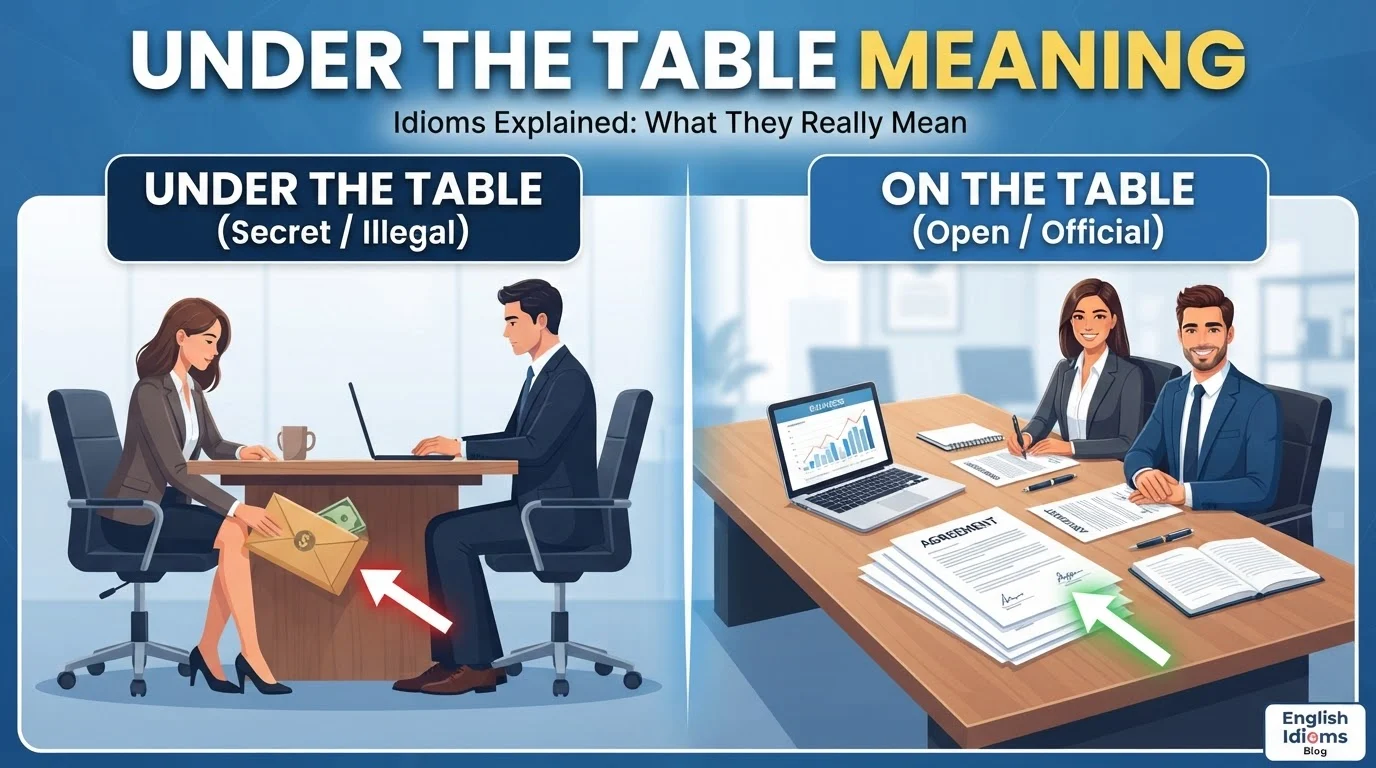
Under the Table vs On the Table
Under the table and on the table have different meanings, especially when discussing money and business.
| Expression | Meaning | Example |
|---|---|---|
| Under the table | Secret or unofficial, often involving hidden payments | He received money under the table. |
| On the table | Open, available for discussion, or officially presented | The proposal is on the table. |
The two expressions can communicate opposite ideas in business and financial contexts.
Under the table suggests secrecy or concealment, while on the table usually suggests openness, visibility, or something available for consideration.
Examples of On the Table
- The new proposal is on the table for discussion.
- Several options are still on the table.
- The company placed its financial records on the table for review.
- Her suggestion remains on the table.
Notice that on the table does not necessarily refer to physical objects. It can also describe ideas, proposals, and opportunities that are available for discussion.
Synonyms of Under the Table
Depending on the context, several expressions can have meanings similar to under the table.
| Synonym or Related Expression | Meaning |
|---|---|
| Off the books | Not officially recorded in financial or business records |
| Unofficially | Without following an official process |
| Secretly | Without other people knowing |
| Illegally | In violation of the law |
| Covertly | In a hidden or secret manner |
| In cash without reporting | Receiving money without officially declaring the payment or income |
These expressions are not always interchangeable. For example, something done secretly is not necessarily illegal, and an unofficial payment is not automatically unlawful in every situation.
Examples Using Similar Expressions
- The company paid some workers off the books.
- They reached an unofficial agreement.
- The transaction was handled secretly.
- The organization was accused of making illegal payments.
- He received additional income without reporting it.
Antonyms of Under the Table
When under the table refers to secret or unofficial activities, its opposite can be expressed through words and phrases that suggest openness, transparency, and proper reporting.
| Antonym or Opposite Expression | Meaning |
|---|---|
| Officially | Through an authorized or recognized process |
| Transparently | Openly and honestly |
| Legally | In accordance with the law |
| On the record | Officially documented or reported |
| Above board | Honest, open, and legitimate |
| Properly documented | Recorded in the required documents or accounts |
Examples
- The company officially reported all employee salaries.
- The organization handled the transaction transparently.
- All payments were made legally.
- The agreement was placed on the record.
- The business operates in an aboveboard manner.
Common Mistakes to Avoid
Although under the table is a common English expression, learners sometimes misunderstand its meaning or use it incorrectly.
Mistake 1: Assuming It Always Means Something Illegal
Under the table often suggests secret or unofficial activity, but the exact legal status depends on the circumstances.
For example, a cash payment is not automatically illegal. It becomes problematic when it involves tax evasion, fraud, bribery, or other unlawful conduct.
Mistake 2: Confusing Its Literal and Figurative Meanings
The phrase can describe something physically beneath a table or a secret financial arrangement.
Compare these examples:
“The dog is hiding under the table.”
This is the literal meaning.
“The employer paid the workers under the table.”
This is the figurative meaning.
Mistake 3: Using Under the Table When You Mean On the Table
These expressions have different meanings.
Incorrect: The proposal is under the table for discussion.
Correct: The proposal is on the table for discussion.
Use under the table when referring to something hidden or unofficial. Use on the table when referring to something presented for consideration.
Mistake 4: Assuming Every Cash Payment Is Under the Table
A cash payment can be completely legal when it is properly recorded and reported.
For example:
“The customer paid the shopkeeper in cash and received a receipt.”
This is an ordinary cash transaction, not an under the table payment.
Easy Trick to Remember the Meaning
Use this simple memory trick:
Under the table = Hidden or unofficial
On the table = Open or available for discussion
Imagine money being passed secretly beneath a table while other people are unaware of the transaction. This image can help you remember the figurative meaning.
You can also remember this sentence:
“If money is hidden from official records, it may be described as being paid under the table.”
This simple trick will help you understand the expression in everyday conversations and business discussions.
Frequently Asked Questions
1. What does under the table mean?
Under the table is an idiom that usually refers to a secret or unofficial payment or transaction that is not properly recorded or reported. It can also literally mean something located beneath a table.
2. What does paid under the table mean?
Paid under the table means receiving money secretly or unofficially, often without reporting the payment to the relevant authorities. It is commonly associated with unreported wages, tax avoidance, and improper financial arrangements.
3. Is working under the table illegal?
Working under the table may be illegal when wages or income are deliberately hidden to avoid taxes or other legal obligations. However, the legal consequences depend on the applicable laws and circumstances.
4. What is an example of under the table?
An example is an employer paying a worker cash without recording or reporting the wages. This type of unofficial payment is commonly described as paying someone under the table.
5. What is another word for under the table?
Depending on the context, similar expressions include off the books, unofficially, secretly, and covertly. Above board is an opposite expression that means honest and open.
6. What is the opposite of under the table?
The opposite of under the table can be above board, officially, transparently, or on the record. These expressions suggest that an activity is open, honest, or properly documented.
7. What is the difference between under the table and on the table?
Under the table usually refers to secret or unofficial activities, especially hidden payments. On the table means something is openly presented or available for discussion or consideration.
8. Can under the table have a literal meaning?
Yes. It can describe something physically located beneath a table. For example, “My shoes are under the table.” In financial or business discussions, however, it usually has a figurative meaning.
Conclusion
The expression under the table usually refers to secret or unofficial payments, transactions, or arrangements that are not properly recorded or reported. It is commonly used when discussing unreported wages, hidden income, tax avoidance, and other questionable financial activities.
However, the phrase can also have a literal meaning when something is physically beneath a table. The context determines which meaning is intended.
Remember this simple rule: Under the table means hidden or unofficial, while on the table means open or available for discussion. Understanding this distinction will help you use the expression correctly in everyday conversations, workplace discussions, and written English.