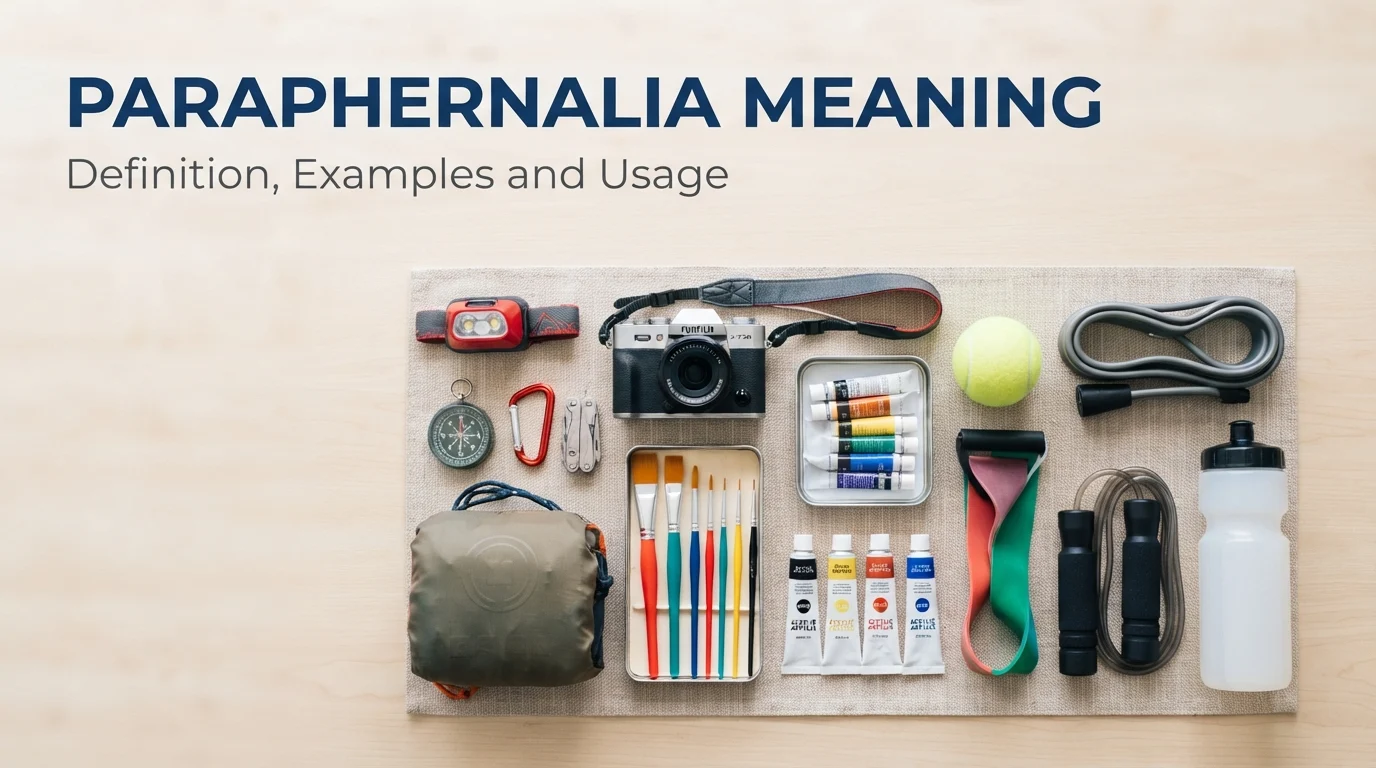
Have you ever heard someone talk about camping paraphernalia, fishing paraphernalia, or drug paraphernalia? The word paraphernalia refers to the equipment, tools, objects, or accessories connected with a particular activity, hobby, job, or purpose. Although it may look like a difficult word, its meaning is quite simple when you see it in everyday sentences.
People use “paraphernalia” when talking about collections of items needed for something. For example, a student may have school paraphernalia, a photographer may carry camera paraphernalia, and a traveler may pack travel paraphernalia.
The word can also appear in news reports and legal discussions, especially in the phrase “drug paraphernalia.” In this guide, you will learn the meaning of paraphernalia, how to pronounce it, how to use it correctly, and how it differs from similar words.
Quick Answer: What Does Paraphernalia Mean?
Paraphernalia means the collection of equipment, tools, or other items associated with a particular activity or purpose. For example, “She packed her camping paraphernalia” means she packed the items she needed for camping. The word is often used when referring to several related objects rather than one specific item. Depending on the context, it can refer to ordinary equipment or objects associated with illegal activities.
What Does Paraphernalia Mean?
Paraphernalia is a noun used to describe objects or equipment connected with a particular activity, interest, or situation.
In simple English, it means the things you need or use for something.
For example:
- The fisherman packed his fishing paraphernalia.
- The artist carried her painting paraphernalia.
- The police found drug paraphernalia in the room.
In the first example, “fishing paraphernalia” means fishing equipment and related items. In the second, it means supplies used for painting. In the third, the phrase refers to objects associated with drug use.
The exact meaning depends on the context in which the word appears.
How to Pronounce Paraphernalia
The word is pronounced approximately as:
par uh fer NAY lee uh
The main stress falls on “NAY.”
Breaking the word into smaller sound groups can make it easier to pronounce: par + uh + fer + NAY + lee + uh.
Examples of Paraphernalia in Sentences
Here are ten examples showing how “paraphernalia” is used in everyday English.
- She packed all her camping paraphernalia.
She packed the equipment and supplies she needed for camping. - The fisherman kept his paraphernalia in a large box.
He stored his fishing tools and related items in a box. - The artist carried her painting paraphernalia to the studio.
She brought her painting supplies with her. - His desk was covered with computer paraphernalia.
His desk had various computer accessories and related items on it. - The magician arranged his performance paraphernalia before the show.
He prepared the objects and equipment used in his performance. - We bought some travel paraphernalia before our holiday.
We purchased accessories and useful items for our trip. - The room was filled with sports paraphernalia.
The room contained objects connected with sports, such as team merchandise or equipment. - She collected vintage beauty paraphernalia.
She collected old beauty products, tools, and accessories. - The police reported finding drug paraphernalia during the investigation.
They reported finding objects associated with drug use. - He put away his gardening paraphernalia after finishing the work.
He stored his gardening tools and supplies.
Different Types of Paraphernalia
The word can describe items associated with many different activities.
| Type | Meaning | Example |
|---|---|---|
| Camping paraphernalia | Camping equipment and supplies | We packed our camping paraphernalia. |
| Fishing paraphernalia | Fishing tools and accessories | His fishing paraphernalia filled a bag. |
| Sports paraphernalia | Sports equipment or related merchandise | The shop sells football paraphernalia. |
| School paraphernalia | Items associated with school | She bought school paraphernalia before classes began. |
| Computer paraphernalia | Computer accessories and related equipment | His desk was full of computer paraphernalia. |
| Drug paraphernalia | Objects associated with using, preparing, or consuming drugs | The report mentioned drug paraphernalia. |
| Travel paraphernalia | Travel accessories and useful items | She organized her travel paraphernalia. |
Notice that the word does not always have a negative meaning. In many situations, it simply describes useful or familiar equipment.
Paraphernalia vs. Equipment
“Paraphernalia” and “equipment” have similar meanings, but they are not always interchangeable.
| Paraphernalia | Equipment |
|---|---|
| Refers to items associated with a particular activity or purpose. | Refers to the tools or apparatus needed for a task. |
| Often suggests a collection of different objects or accessories. | Often emphasizes the tools or machinery used to do something. |
| Can sound informal or slightly unusual in everyday contexts. | Is a common, general word. |
| Example: She packed her hiking paraphernalia. | Example: She checked her hiking equipment. |
Simple rule: Use “equipment” for tools or apparatus needed to perform a task. Use “paraphernalia” when referring to the collection of objects and accessories associated with an activity.
Paraphernalia vs. Accessories
These words overlap, but they have different uses.
Paraphernalia refers to a group of objects connected with an activity or purpose.
Accessories are additional items that are useful, decorative, or designed to accompany something else.
Examples:
- The photographer packed all her camera paraphernalia.
- She bought new accessories for her camera.
The first sentence refers broadly to the collection of items associated with photography. The second refers to additional items used with the camera.
Is Paraphernalia a Singular or Plural Word?
This is one of the most important things to understand about the word.
Paraphernalia is generally treated as an uncountable noun in modern English. Even though it refers to a collection of objects, it usually takes a singular verb.
Correct: The paraphernalia is stored in the cupboard.
Incorrect: The paraphernalia are stored in the cupboard.
To talk about individual items, you can say:
- A piece of paraphernalia
- Several items of paraphernalia
- A collection of paraphernalia
Avoid saying “a paraphernalia” when you mean one object. Use “an item of paraphernalia” instead.
Common Mistakes to Avoid
Mistake 1: Thinking paraphernalia always means drug equipment
Incorrect idea: Paraphernalia only refers to illegal drug related objects.
Correct understanding: The word can describe equipment and accessories for many activities, including camping, sports, photography, and gardening.
Mistake 2: Using the word as a countable noun
Incorrect: She bought three paraphernalias.
Correct: She bought three items of paraphernalia.
Mistake 3: Confusing paraphernalia with personal belongings
“Personal belongings” refers broadly to things owned by a person. “Paraphernalia” usually refers to objects associated with a particular activity or purpose.
For example, a person’s bag may contain personal belongings, while a photographer’s camera paraphernalia refers to items related to photography.
Mistake 4: Assuming the word is always formal
Although it is a relatively long word, “paraphernalia” can be used in ordinary conversation. However, simpler words such as “stuff,” “gear,” or “equipment” may sound more natural in some situations.
Easy Memory Trick
Remember paraphernalia as “all the stuff associated with an activity.”
Imagine a camper getting ready for a trip. They gather a tent, a flashlight, cooking supplies, a sleeping bag, and other useful objects. Together, these items can be called camping paraphernalia.
Think of it this way:
- Equipment: Tools needed for a task.
- Accessories: Extra or accompanying items.
- Paraphernalia: The collection of objects associated with an activity.
This simple connection can help you remember the meaning.
American English vs. British English
“Paraphernalia” is used in both American and British English, and its basic meaning is the same.
| American English | British English |
|---|---|
| He packed his camping paraphernalia. | He packed his camping paraphernalia. |
| The shop sells sports paraphernalia. | The shop sells sports paraphernalia. |
| The report mentioned drug paraphernalia. | The report mentioned drug paraphernalia. |
There is no major difference in meaning or spelling between the two varieties. The pronunciation may vary slightly by speaker and accent.
Synonyms and Similar Words
Several words can be used instead of “paraphernalia,” depending on the situation.
| Word | Meaning |
|---|---|
| Equipment | Tools or apparatus needed for a task |
| Gear | Equipment used for a particular activity |
| Accessories | Additional items used with something |
| Supplies | Materials needed for a task or activity |
| Tools | Objects used to carry out work |
| Belongings | Things owned by a person |
| Materials | Items used to make or do something |
| Kit | A set of items designed for a particular purpose |
For example, “camping gear” is a natural alternative to “camping paraphernalia.” “Painting supplies” may sound more straightforward than “painting paraphernalia.”
Final Verdict: What Does Paraphernalia Mean?
Paraphernalia means the collection of equipment, tools, accessories, or other objects associated with an activity or purpose. It can describe ordinary things, such as camping gear, sports merchandise, or photography supplies. It can also refer to objects associated with drug use in legal or news related contexts.
The easiest way to remember the word is to think of it as “all the things connected with something.” Remember that “paraphernalia” is generally an uncountable noun, so you should say “some paraphernalia” or “several items of paraphernalia,” rather than “paraphernalias.”
Frequently Asked Questions
1. What does paraphernalia mean in simple words?
It means the equipment, tools, or other objects associated with a particular activity. For example, camping paraphernalia means the things used for camping.
2. Is paraphernalia a negative word?
No. The word is neutral in general. It can refer to ordinary items, such as sports or camping equipment, although “drug paraphernalia” often appears in negative or legal contexts.
3. What is an example of paraphernalia?
“His fishing paraphernalia was packed in a bag.” This means he had packed the tools and accessories he used for fishing.
4. Is paraphernalia singular or plural?
It is generally treated as an uncountable noun and takes a singular verb. For example, “The paraphernalia is in the box.”
5. What is another word for paraphernalia?
Depending on the context, similar words include equipment, gear, accessories, supplies, tools, and kit.
6. What does drug paraphernalia mean?
Drug paraphernalia refers to objects used or intended for activities involving drugs, such as preparing, consuming, or administering them. The precise legal meaning can vary by jurisdiction.
7. How do you use paraphernalia in a sentence?
You can say, “She put all her gardening paraphernalia in the shed.” This means she stored the tools and items she used for gardening.
8. Is paraphernalia a formal word?
It can be used in both casual and formal English. In everyday conversation, people may prefer simpler words such as “stuff,” “gear,” or “equipment.”
Remember This
- Paraphernalia means objects or equipment associated with an activity.
- It can refer to ordinary items or objects associated with drug use.
- The word is used in both American and British English.
- It is generally an uncountable noun.
- “Equipment,” “gear,” and “supplies” can be simpler alternatives.
- The meaning depends on the context.
Conclusion
The word “paraphernalia” may look complicated, but its meaning is easy to understand once you connect it with everyday activities. It describes the collection of objects, tools, and accessories associated with something, whether that is camping, photography, sports, gardening, or another interest.
To use the word correctly, pay attention to the context and remember that it usually functions as an uncountable noun. Instead of saying “three paraphernalias,” say “three items of paraphernalia.” With a little practice, you can recognize this word in conversations, news reports, and written English and use it confidently when describing related collections of objects.