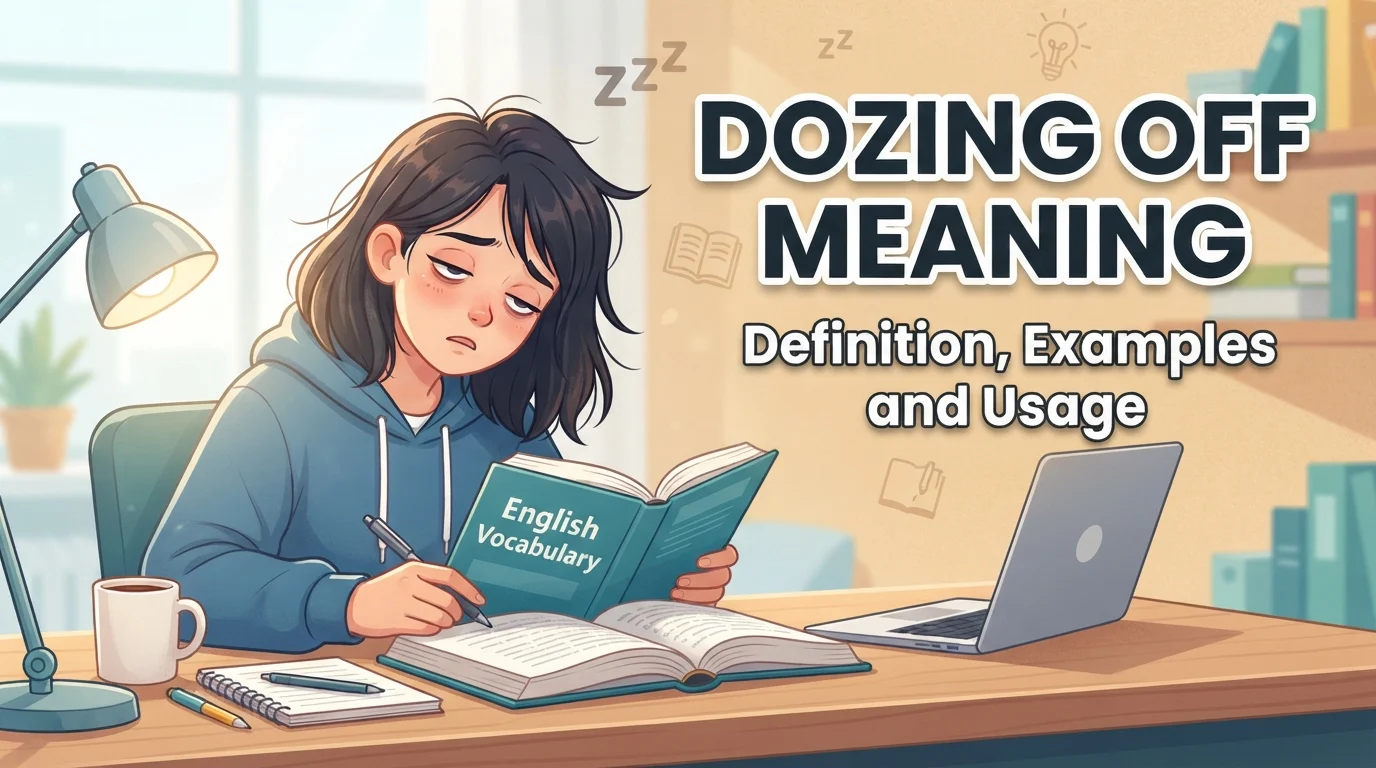
Have you ever felt so sleepy that your eyes started closing while you were reading, studying, or watching television? You may have been dozing off. This common English expression describes the moment when someone begins to fall asleep, often without planning to do so. It is frequently used in everyday conversations, books, movies, and informal writing.
Understanding the meaning of “dozing off” can help you describe tiredness and sleep more naturally in English. Although it may sound similar to taking a nap or sleeping deeply, it has a slightly different meaning.
In this guide, you will learn what “dozing off” means, how to use it in sentences, which expressions are similar, and which mistakes to avoid. If you are an English learner, a student, or someone who wants to improve everyday vocabulary, this simple explanation will help you use the phrase confidently.
Quick Answer: What Does Dozing Off Mean?
Dozing off means gradually falling asleep, usually for a short time and often without intending to. It commonly happens when someone is tired, comfortable, bored, or sitting quietly. For example, “I was dozing off during the movie” means that I was beginning to fall asleep while watching it. The phrase is informal and widely used in everyday American and British English.
What Does Dozing Off Mean?
“Dozing off” describes the process of beginning to fall asleep. A person may close their eyes, nod their head, or briefly lose track of what is happening around them.
The expression often suggests that the person did not deliberately decide to go to sleep. Instead, sleepiness gradually takes over.
For example:
- I started dozing off during the lecture.
- She was dozing off on the sofa.
- He dozed off while reading a book.
In each example, the person was becoming sleepy and beginning to sleep.
What Does “Doze” Mean?
The verb “doze” means to sleep lightly or for a short period. The phrase “doze off” emphasizes the moment when someone starts falling asleep.
Doze: To sleep lightly.
Doze off: To begin falling asleep.
Dozing off: The ongoing process of beginning to fall asleep.
Dozing Off vs. Dosing Off
These expressions look and sound similar, but they have different meanings.
| Expression | Meaning | Example |
|---|---|---|
| Dozing off | Beginning to fall asleep | I was dozing off during the film. |
| Dosing off | Usually an incorrect form when you mean falling asleep | I was dosing off during the film. |
| Dosing | Giving or taking a measured amount of medicine or another substance | The nurse is dosing the medicine carefully. |
If you want to describe someone becoming sleepy, the correct expression is dozing off, not “dosing off.”
Remember that “dosing” is a real English word, but it usually relates to amounts of medicine or other substances.
10 Examples of Dozing Off in Sentences
Here are ten natural examples to help you understand how to use the phrase.
- I was dozing off during the movie.
I was beginning to fall asleep while watching the movie. - She kept dozing off in class.
She repeatedly started falling asleep during the lesson. - My father dozed off in his favorite chair.
He fell asleep lightly while sitting in his chair. - I almost dozed off while reading the book.
I nearly fell asleep while reading. - He was so tired that he started dozing off at work.
His tiredness made it difficult to stay awake. - The baby was dozing off in her mother’s arms.
The baby was gradually falling asleep while being held. - Please wake me up if I start dozing off.
The speaker wants someone to wake them if they begin falling asleep. - I dozed off on the bus and missed my stop.
I fell asleep briefly while traveling and went past my destination. - After lunch, everyone seemed to be dozing off.
Everyone appeared sleepy and close to falling asleep. - He caught himself dozing off during the meeting.
He noticed that he was beginning to fall asleep.
Dozing Off vs. Falling Asleep
These expressions are closely related, but there is a small difference in how they are commonly used.
| Dozing off | Falling asleep |
|---|---|
| Often suggests light or unintended sleep. | Describes the general process of going from awake to asleep. |
| Commonly happens when someone is tired or relaxed. | Can happen intentionally or unintentionally. |
| Often suggests that the person may wake easily. | Does not necessarily describe how deeply someone sleeps. |
| Example: I dozed off on the sofa. | Example: I fell asleep at 10 p.m. |
Simple rule: “Dozing off” often suggests that sleep is gradually taking over, while “falling asleep” is a more general expression.
Dozing Off vs. Taking a Nap
Although both expressions involve sleep, they are not exactly the same.
Dozing off usually means beginning to sleep, often unintentionally.
Taking a nap means deliberately sleeping for a short period, usually to rest.
Examples:
- I dozed off while watching television.
- I took a nap after lunch.
In the first example, falling asleep may not have been planned. In the second, the person intentionally chose to rest.
Common Situations Where People Doze Off
People may doze off in many everyday situations, especially when they are tired or comfortable.
1. While Watching Television
“I was dozing off while watching the news.”
The person was becoming sleepy while sitting and watching television.
2. During a Class or Meeting
“He started dozing off during the long presentation.”
The person was struggling to stay awake.
3. While Traveling
“She dozed off on the train.”
The movement and quiet surroundings may have made her sleepy.
4. While Reading
“I often doze off when I read late at night.”
The person tends to become sleepy while reading at night.
5. After Eating
“I nearly dozed off after a heavy lunch.”
The person felt sleepy after eating.
Common Mistakes to Avoid
English learners sometimes confuse “dozing off” with similar sounding expressions. Here are a few mistakes to watch for.
Mistake 1: Writing “dosing off” when you mean falling asleep
Incorrect: I was dosing off in class.
Correct: I was dozing off in class.
Mistake 2: Using “dozing off” to mean sleeping deeply
“Dozing off” usually refers to beginning to fall asleep or sleeping lightly. If someone is sleeping deeply, simply say “sleeping deeply” or “sound asleep.”
Mistake 3: Confusing “doze off” and “take a nap”
“Doze off” often suggests unintended sleep, while “take a nap” usually suggests a planned short rest.
Mistake 4: Forgetting the tense
- Present: I sometimes doze off.
- Past: I dozed off.
- Continuous: I am dozing off.
- Past continuous: I was dozing off.
Choose the verb form that matches the time and structure of your sentence.
Easy Memory Trick
Think of “dozing off” as slowly drifting into sleep.
Imagine sitting on a comfortable sofa while watching television. Your eyes become heavy, your head starts to nod, and before you realize it, you have begun to fall asleep.
That is dozing off.
You can remember the difference this way:
- Doze off: Start falling asleep.
- Wake up: Stop sleeping and become conscious.
- Take a nap: Choose to sleep for a short time.
American English vs. British English
“Dozing off” is common in both American and British English. The meaning and usage are essentially the same.
| American English | British English |
|---|---|
| I was dozing off during the movie. | I was dozing off during the film. |
| He dozed off on the couch. | He dozed off on the sofa. |
| She nearly fell asleep in class. | She nearly fell asleep in class. |
The main differences in these examples are words such as “movie” and “film” or “couch” and “sofa.” The expression “dozing off” itself is natural in both varieties of English.
Similar Words and Expressions
These words and phrases can help you describe different stages or types of sleep.
| Word or phrase | Meaning |
|---|---|
| Falling asleep | Beginning to sleep |
| Nodding off | Beginning to fall asleep, often with your head nodding |
| Drifting off | Gradually becoming asleep |
| Snoozing | Sleeping lightly or for a short time |
| Taking a nap | Sleeping briefly, usually intentionally |
| Sleeping soundly | Sleeping deeply |
| Feeling drowsy | Feeling sleepy |
| Being half asleep | Being partly awake and partly asleep |
“Nodding off” is especially close in meaning to “dozing off.” For example, “I nodded off during the lecture” means that I started falling asleep during the lecture.
Final Verdict: What Does Dozing Off Mean?
“Dozing off” means gradually beginning to fall asleep, usually for a short time and often without intending to. It is a common, informal expression used in everyday English.
For example, if you are watching a movie late at night and your eyes begin to close, you can say, “I am dozing off.”
The key distinction is that dozing off describes the beginning of sleep, while taking a nap usually means deliberately sleeping for a short period. Also, remember to spell it “dozing,” not “dosing,” when talking about sleep.
Frequently Asked Questions
1. Is dozing off the same as falling asleep?
They are very similar. “Dozing off” often suggests that someone is gradually or unintentionally falling asleep, while “falling asleep” is a broader expression.
2. Is dozing off a formal or informal expression?
It is mainly an everyday expression. It is natural in casual conversations and also appears in general writing.
3. What is another word for dozing off?
“Nodding off” and “drifting off” are common alternatives. Both can describe beginning to fall asleep.
4. Is “dosing off” correct?
Not when you mean beginning to fall asleep. The correct phrase is “dozing off.” “Dosing” usually refers to giving or taking a measured amount of a substance.
5. What does “I dozed off” mean?
It means “I fell asleep,” usually briefly or unintentionally. For example, “I dozed off on the bus” means you fell asleep while traveling.
6. Can you use dozing off in the present tense?
Yes. You can say, “I am dozing off,” when you are beginning to fall asleep at that moment. You can also say, “I sometimes doze off while reading.”
7. What is the difference between dozing off and nodding off?
Both mean beginning to fall asleep. “Nodding off” often brings to mind someone’s head dropping as they become sleepy, while “dozing off” is a more general expression.
8. Why do people doze off?
People may doze off because they are tired, sleep deprived, relaxed, or sitting in a quiet environment. Frequent unintended sleepiness, especially during activities that require attention, may be a reason to review sleep habits or seek medical advice.
Remember This
- Dozing off means beginning to fall asleep.
- It often happens unintentionally.
- “Dozing off” is correct when talking about sleep.
- “Dosing off” is generally incorrect for this meaning.
- “Nodding off” and “drifting off” have similar meanings.
- The expression is used in both American and British English.
Conclusion
“Dozing off” is a useful English expression for describing the moment when someone begins to fall asleep. You might doze off while watching television, reading a book, sitting on a bus, or listening to a long presentation. The phrase often suggests that sleepiness is taking over without the person planning to sleep.
To use it correctly, remember the spelling and the difference between “dozing off” and “dosing off.” Practice with simple sentences such as “I dozed off during the movie” or “I am dozing off because I am tired.” With regular practice, you will be able to recognize and use this everyday expression naturally.