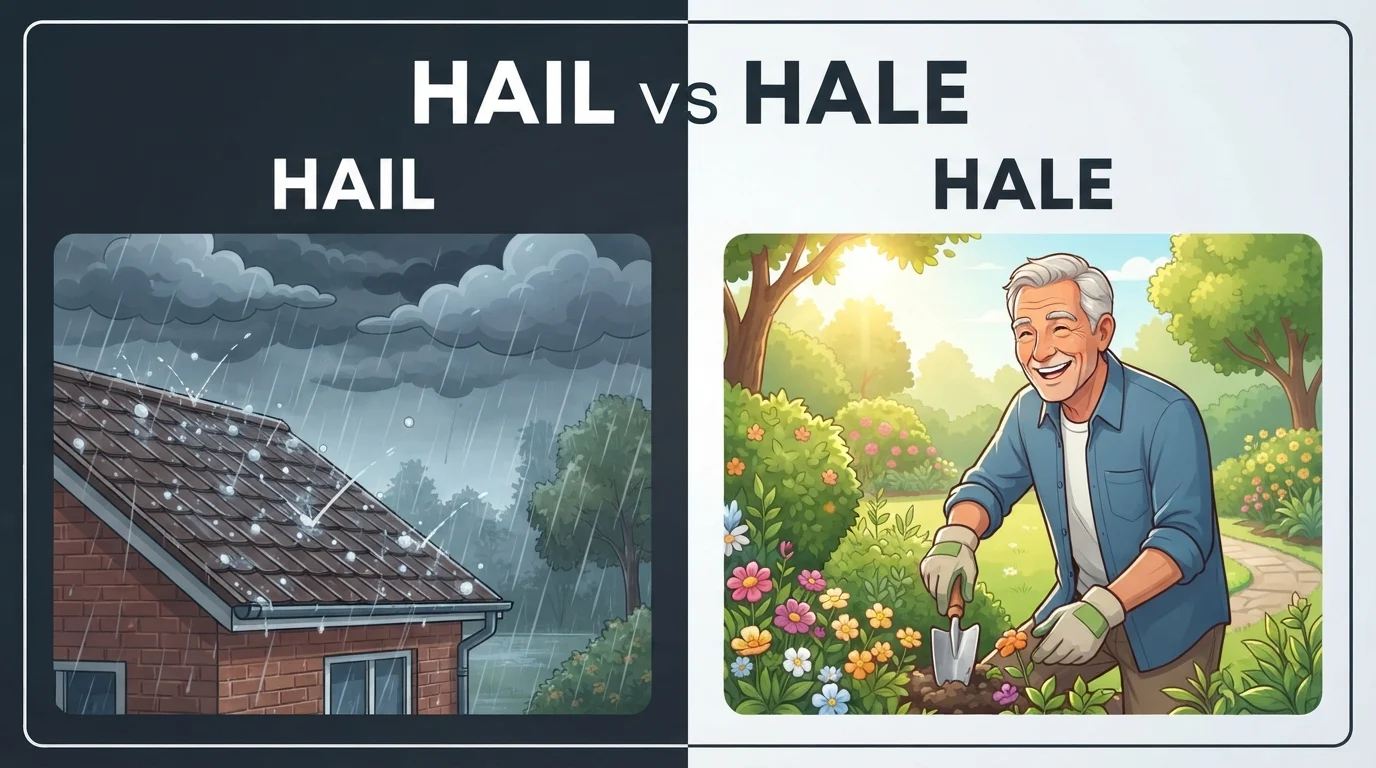
Have you ever confused the words hail and hale while reading or writing in English? These two words sound exactly the same, but they have different meanings and uses. Understanding the difference between hail vs hale will help you avoid spelling mistakes and choose the correct word in your sentences.
The word hail has several meanings. It can refer to small balls of ice that fall from the sky during a storm, the act of calling out to someone, or the act of recognizing a person or thing in a particular way. In contrast, hale is an adjective that means healthy and strong, especially when describing an older person.
For example, you might say, “The hail damaged my car,” or “My grandfather is still hale and hearty.” In this guide, you will learn the definitions, differences, examples, common mistakes, and memory tricks that make these two words easy to understand.
Quick Answer
Hail can mean frozen rain, calling out to someone, or praising or describing someone in a particular way. Hale means healthy and strong, especially in older age. Both words are pronounced the same, but their spellings and meanings are different. Use hail for weather or actions and hale for health.
Why Do People Confuse Hail and Hale?
People often confuse hail and hale because they are homophones. Homophones are words that sound alike but have different meanings and spellings.
Both words are pronounced /heɪl/, which sounds like “hayl.” When spoken, they are indistinguishable in ordinary conversation. However, their meanings become clear when you see them in a sentence.
For example:
“The hail damaged the roof.”
This sentence refers to frozen precipitation falling from the sky.
“The elderly man remained hale.”
This sentence means the man remained healthy and strong.
The main difference is simple. Hail is commonly used as a noun or verb, while hale is an adjective describing good health.
What Does Hail Mean?
Hail has several meanings in English. Its meaning depends on the context in which it appears.
1. Hail as a Weather Term
As a noun, hail refers to small balls or lumps of ice that fall from clouds during certain thunderstorms.
Examples:
- “The hail covered the garden.”
- “Large hail damaged several cars.”
- “We stayed indoors because of the hailstorm.”
Hailstones form when water droplets freeze inside storm clouds and grow into pieces of ice.
2. Hail as a Verb Meaning to Call Out
The verb hail can mean calling out to someone to attract their attention or signal them to stop.
Examples:
- “She hailed a taxi outside the hotel.”
- “The sailor hailed the passing boat.”
- “He hailed his friend from across the street.”
In these sentences, hail describes an action rather than a weather event.
3. Hail as a Verb Meaning to Praise or Recognize
The word hail can also mean to praise, welcome, or describe someone or something as important or successful.
Examples:
- “Critics hail the film as a masterpiece.”
- “The community hailed her as a hero.”
- “Many people hail the discovery as a major breakthrough.”
In this usage, hail often appears in phrases such as “hail someone as a hero” or “be hailed as a success.”
4. Hail as a Verb Meaning to Come From Somewhere
The expression hail from means to come from a particular place or have a particular origin.
Examples:
- “She hails from Lahore.”
- “The musician hails from a small town.”
- “They hail from different parts of the country.”
This expression is common in biographies, introductions, and general descriptions.
What Does Hale Mean?
Hale is an adjective meaning healthy, strong, and physically well. It is often used to describe older people who remain active and healthy despite their age.
The word is most commonly encountered in the expression hale and hearty, which means healthy, energetic, and strong.
Examples of Hale in Sentences
- “My grandfather is hale and hearty at eighty.”
- “The doctor described the elderly patient as hale.”
- “She remained hale and active well into old age.”
- “Despite his years, the farmer was still hale.”
- “The old sailor appeared hale and strong.”
In each sentence, hale describes someone’s physical condition.
Is Hale Common in Everyday English?
Hale is a correct English word, but it is less common in everyday conversation than words such as healthy, fit, and strong.
You are more likely to encounter it in books, descriptive writing, or the familiar expression hale and hearty.
For example, instead of saying “He is hale,” many speakers would naturally say “He is healthy and strong.”
Hail vs Hale: What Is the Difference?
The main difference between hail and hale is their meaning and grammatical function. They sound alike, but they cannot be substituted for one another in most sentences.
| Feature | Hail | Hale |
|---|---|---|
| Part of speech | Noun and verb | Adjective |
| Main meaning | Ice falling from clouds, calling out, or praising | Healthy and strong |
| Pronunciation | /heɪl/ | /heɪl/ |
| Describes weather | Yes | No |
| Describes good health | Not usually | Yes |
| Means calling out | Yes | No |
| Means praising someone | Yes | No |
| Common expression | Hail a taxi | Hale and hearty |
| Example | Hail damaged the crops. | The man is hale and hearty. |
Remember that hail has several meanings, while hale specifically describes health and strength.
When Should You Use Hail or Hale?
Choosing the correct word becomes easier when you identify what you want to express.
When to Use Hail
Use hail when you are talking about:
Weather: “The hail broke several windows.”
Calling someone or something: “She hailed a taxi.”
Praising someone: “The athlete was hailed as a champion.”
A person’s origin: “He hails from Canada.”
In these situations, hail is the correct spelling.
When to Use Hale
Use hale when you want to describe someone who is healthy and strong.
Examples:
“The elderly woman is still hale and hearty.”
“His grandfather remained hale despite his advanced age.”
If you are describing health, physical strength, or continued well being, hale is the appropriate word.
12 Examples of Hail vs Hale in Sentences
These examples show how each word works in different contexts.
- Hail: “The hail damaged the farmer’s crops.”
Ice falling from the sky damaged the crops. - Hale: “My grandfather is hale and hearty.”
He is healthy, strong, and energetic. - Hail: “She tried to hail a taxi in the rain.”
She called out or signaled for a taxi to stop. - Hale: “The hale old man walked several miles every morning.”
The older man was healthy and strong. - Hail: “The audience hailed the singer as a legend.”
The audience praised the singer highly. - Hale: “He remained hale well into his eighties.”
He continued to enjoy good health at an advanced age. - Hail: “We heard hail hitting the windows.”
Small pieces of ice struck the windows. - Hale: “The doctor found the elderly farmer hale and active.”
The farmer was physically healthy and active. - Hail: “The journalist hails from a small village.”
The journalist comes from a small village. - Hale: “Her hale appearance surprised everyone.”
She looked healthy and strong. - Hail: “The discovery was hailed as a scientific breakthrough.”
People praised the discovery as an important achievement. - Hale: “At ninety, the retired teacher was still hale and hearty.”
The teacher remained healthy and energetic at ninety.
These examples demonstrate that the correct spelling depends on the intended meaning, not pronunciation.
Common Mistakes With Hail and Hale
Even fluent English speakers can occasionally confuse homophones when writing quickly. Here are some mistakes to avoid.
Mistake 1: Using Hale for Frozen Rain
Incorrect: “The hale damaged my car.”
Correct: “The hail damaged my car.”
Use hail when referring to ice that falls from storm clouds.
Mistake 2: Using Hail to Describe Health
Incorrect: “My grandfather is hail and hearty.”
Correct: “My grandfather is hale and hearty.”
The expression hale and hearty always uses hale.
Mistake 3: Confusing Hail With Praise
Incorrect: “The crowd haled her as a hero.”
Correct: “The crowd hailed her as a hero.”
When you mean praised, welcomed, or recognized, use hail.
Mistake 4: Assuming Hale Is a Verb
In ordinary modern English, hale is mainly an adjective. It describes someone who is healthy and strong.
For example: “She is hale and hearty.”
Do not confuse it with the verb hail, which can describe calling out to someone.
Mistake 5: Choosing a Spelling Based Only on Sound
Because the two words sound identical, listening alone will not help you decide which spelling is correct.
Instead, identify the meaning of the sentence. If it concerns weather, calling, praise, or origin, use hail. If it describes health and strength, use hale.
What Is an Easy Memory Trick for Hail vs Hale?
Use this simple memory trick:
Hail has an I for ice. Hale has an E for elderly health.
Think of the letter I in hail as a reminder of ice falling from the sky.
Think of the letter E in hale as a reminder of an elderly person who remains healthy.
For example:
“Hail fell during the storm.”
“My grandfather is hale and hearty.”
Remember that the letter trick is a memory aid, not the actual origin of either word.
Are Hail and Hale Different in American and British English?
The meanings and spellings of hail and hale are essentially the same in American and British English.
American English
American speakers use hail for frozen precipitation, calling out to someone, praising a person, or describing someone’s origin.
Example: “The storm brought heavy hail.”
They also use hale in expressions such as “hale and hearty,” although the word is relatively uncommon in casual conversation.
British English
British speakers use hail and hale in the same basic ways.
Example: “The elderly gentleman was still hale and hearty.”
In British English, hail is also a standard term for frozen precipitation, and hail a taxi is grammatically correct.
Which Spelling Should English Learners Remember?
There is no American or British spelling difference to learn for these words. Both varieties use the same spellings and meanings.
The important distinction is between the words themselves, not the regional variety of English.
What Are Some Similar Words and Expressions?
Learning related words can help you understand the meanings of hail and hale more clearly.
1. Hailstorm
A hailstorm is a storm in which hailstones fall.
Example: “The hailstorm damaged the vegetable garden.”
2. Hailstone
A hailstone is an individual piece of ice that falls during a hailstorm.
Example: “A large hailstone broke the greenhouse roof.”
3. Hail Someone as Something
This expression means to praise or recognize someone as a particular kind of person.
Example: “The public hailed her as a hero.”
4. Healthy
Healthy means being in good physical or mental condition.
Example: “My grandmother is healthy and active.”
5. Hearty
Hearty can mean strong, energetic, enthusiastic, or warm in manner. It appears in the expression hale and hearty.
Example: “The hale and hearty gentleman enjoyed his daily walk.”
6. Fit
Fit means physically healthy and capable of performing physical activity.
Example: “He stays fit by walking every morning.”
7. Robust
Robust means strong, healthy, or vigorous.
Example: “The robust older man continued working in his garden.”
8. Summon
Summon means to call someone or request that they come.
Example: “The manager summoned the staff to a meeting.”
Although summon can overlap with some uses of hail, it is not a synonym in every context.
Final Verdict: Hail vs Hale
The difference between hail and hale is straightforward once you remember their meanings.
Hail can refer to frozen rain, calling out to someone, praising someone, or describing where someone comes from.
Hale means healthy and strong, especially when describing an older person. It is frequently used in the phrase hale and hearty.
Both words sound exactly the same, so the meaning of the sentence determines the correct spelling.
If you are writing about a storm, calling a taxi, or praising a hero, choose hail. If you are describing someone who remains healthy and strong, choose hale.
Frequently Asked Questions
1. What is the main difference between hail and hale?
Hail refers to frozen precipitation or can mean calling out, praising, or coming from a place. Hale is an adjective meaning healthy and strong, particularly in older age.
2. Are hail and hale pronounced the same?
Yes. Both words are pronounced /heɪl/, which sounds like “hayl.” They are homophones, meaning they sound alike but have different spellings and meanings.
3. What does hale and hearty mean?
Hale and hearty means healthy, strong, and energetic. It is often used to describe an older person who remains physically well and active.
Example: “At eighty five, she is still hale and hearty.”
4. Is hail a noun or a verb?
Hail can be both a noun and a verb. As a noun, it refers to frozen precipitation. As a verb, it can mean calling out to someone, praising someone, or recognizing someone in a particular way.
5. Is hale a word in English?
Yes. Hale is a standard English adjective meaning healthy and strong. Although it is less common in everyday conversation than healthy or fit, it remains in use, particularly in descriptive writing and the phrase hale and hearty.
6. Is it correct to say hail a taxi?
Yes. Hail a taxi means to signal or call for a taxi to stop so you can get in.
Example: “We hailed a taxi outside the station.”
7. Can hail mean praise?
Yes. As a verb, hail can mean to praise, welcome, or recognize someone or something as important.
Example: “The scientists hailed the discovery as a major achievement.”
8. Are hail and hale used differently in American and British English?
Their basic meanings, spellings, and pronunciations are the same in both varieties. The main challenge is remembering which meaning belongs to each spelling.
Remember This
- Hail: Frozen rain, calling out, praising, or coming from somewhere.
- Hale: Healthy and strong, especially in older age.
- Pronunciation: Both sound like “hayl.”
- Memory trick: Hail has an I for ice. Hale has an E for elderly health.
- Common expression: Hale and hearty.
- Example: “Hail fell during the storm, but the hale old farmer remained cheerful.”
Conclusion
Although hail and hale sound the same, they have different meanings. Hail can describe ice falling during a storm or the act of calling out, praising, or recognizing someone. Hale describes a person who is healthy and strong, especially in later life.
The easiest way to remember the difference is to connect hail with ice and weather, and hale with health. Once you understand their meanings and see them in practical examples, choosing the correct spelling becomes much easier. Pay attention to context, and you will be able to use both words accurately in everyday English.