Have you ever wondered if to say “Neither do I” or “Nor do I” when agreeing with someone in English? Both expressions are grammatically correct, and both can communicate that something is not true for you either. However, they are used differently depending on the sentence, context, and level of formality. Understanding this difference will help you sound more natural in everyday conversations and improve your English grammar.
The expression neither do I is commonly used to agree with a negative statement. For example, if someone says, “I do not like coffee,” you can reply, “Neither do I.” The expression nor do I can also express agreement with a negative statement, but it is more commonly used to continue a negative idea or connect it with another statement. For example, “I do not like coffee, nor do I like tea.” In this guide, you will learn their meanings, grammatical differences, sentence structures, practical examples, common mistakes, and the easiest ways to remember when to use each expression.
Quick Answer
Neither do I is the most common, natural response when agreeing with a negative statement. Nor do I also expresses a negative idea, but it is often used to add another negative statement. For example, “I do not smoke.” “Neither do I.” You can also say, “I do not smoke, nor do I drink.”
Why Do People Confuse Neither Do I and Nor Do I?
People confuse these expressions because both can communicate agreement with a negative statement. They also follow a similar grammatical pattern, with an auxiliary verb before the subject.
For example:
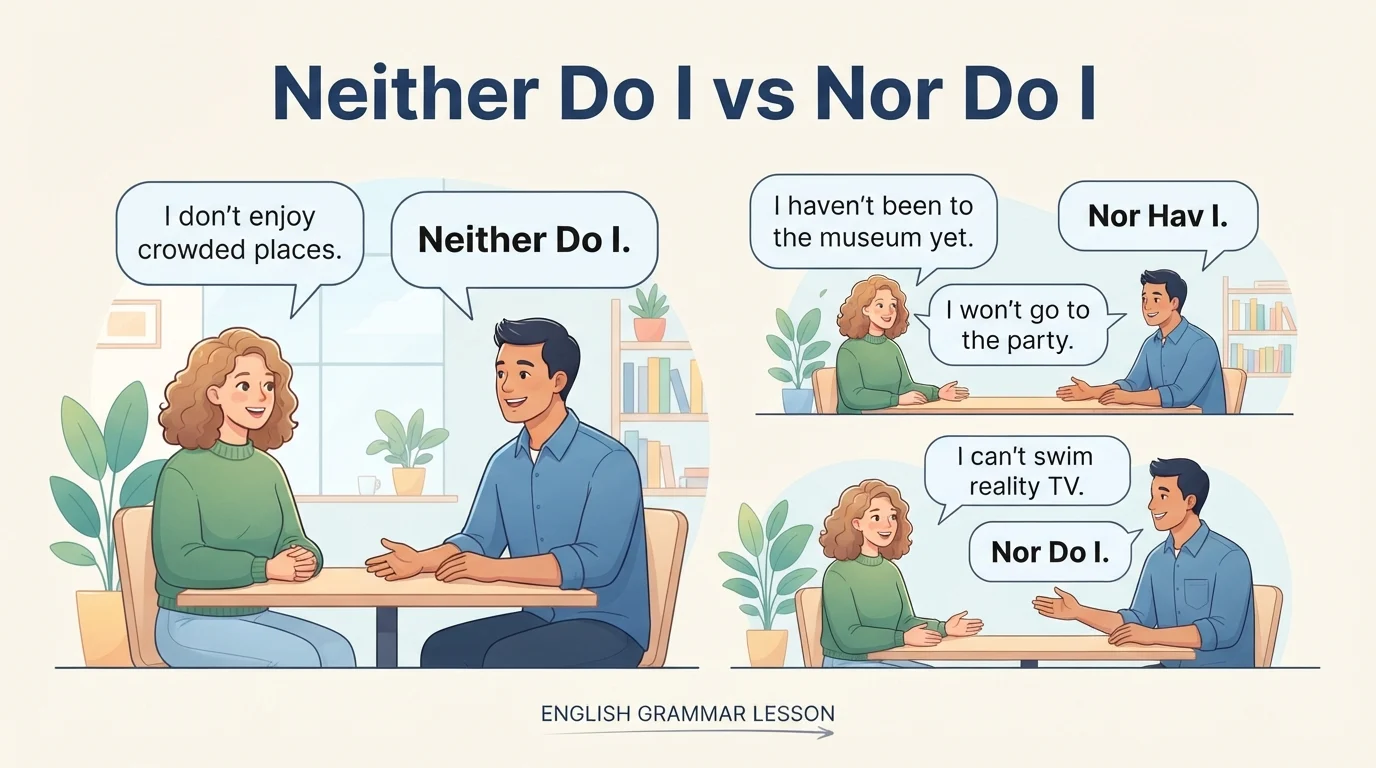
Person A: “I do not enjoy horror movies.”
Person B: “Neither do I.”
Person B could also say, “Nor do I,” particularly when continuing a previous negative statement or in a more formal context.
The main difference is how the expressions are commonly used. Neither do I works naturally as a short, independent response. Nor do I is especially useful for adding another negative idea to an existing statement.
Both expressions can be correct, but they are not always equally natural in every context.
What Does Neither Do I Mean?
Neither do I means “I also do not” or “I do not either.” It is used when you want to agree with someone who has made a negative statement about themselves.
The word neither means not one and not the other, or in this conversational structure, that the same negative situation applies to you.
Examples of Neither Do I
- Person A: “I do not like spicy food.”Person B: “Neither do I.”
- Person A: “I cannot swim.”Person B: “Neither can I.”
- Person A: “I have never visited London.”Person B: “Neither have I.”
- Person A: “I am not tired.”Person B: “Neither am I.”
Notice that the auxiliary verb changes according to the original sentence. You use do, can, have, or am depending on the grammar of the statement.
When Is Neither Do I Most Natural?
Use neither do I when you want to give a short, direct response to a negative statement.
For example:
“My brother does not eat meat.”
“Neither do I.”
This response is natural, concise, and widely understood in both American and British English.
What Does Nor Do I Mean?
Nor do I means “and I do not either” or “and neither do I.” It is often used to introduce an additional negative statement.
The word nor connects a negative idea to another negative idea. In this structure, the auxiliary verb comes before the subject.
Examples of Nor Do I
- “I do not drink coffee, nor do I drink tea.”
- “I have never visited Paris, nor have I visited Rome.”
- “I cannot drive, nor can I ride a motorcycle.”
- “I am not interested in football, nor am I interested in cricket.”
In these examples, nor introduces a second negative statement.
Can Nor Do I Be Used Alone?
Yes. You may hear or read nor do I as a response, particularly in formal, literary, or carefully structured English.
For example:
Person A: “I do not agree with the decision.”
Person B: “Nor do I.”
This is grammatically correct. However, in ordinary conversation, “Neither do I” is generally the more natural standalone response for many speakers.
Neither Do I vs Nor Do I: What Is the Difference?
The main difference is their typical function in a sentence. Neither do I is commonly used to agree with a negative statement, while nor do I often adds another negative statement.
| Feature | Neither Do I | Nor Do I |
|---|---|---|
| Basic meaning | I do not either | And I do not either |
| Common use | Short response to a negative statement | Adding another negative idea |
| Standalone response | Very common | Correct, but often more formal |
| Connecting negative ideas | Possible in suitable structures | Especially common |
| Example | “I do not smoke.” “Neither do I.” | “I do not smoke, nor do I drink.” |
| Tone | Natural and conversational | Often more formal or emphatic |
| American English | Common | Correct and understood |
| British English | Common | Correct and understood |
The difference is mainly about usage and sentence structure, not a completely different meaning.
When Should You Use Neither Do I or Nor Do I?
Choosing the right expression becomes easier when you consider whether you are responding to someone or adding another negative idea.
When to Use Neither Do I
Use neither do I when someone makes a negative statement and you want to express the same feeling, experience, or situation.
Examples:
“I do not watch television.”
“Neither do I.”
“I do not understand this question.”
“Neither do I.”
This structure is especially useful in everyday conversations.
When to Use Nor Do I
Use nor do I when adding a second negative statement, particularly after a clause containing not, never, or another negative expression.
Examples:
“I do not watch television, nor do I listen to the radio.”
“I have never traveled abroad, nor have I lived overseas.”
“I do not enjoy crowded places, nor do I like noisy restaurants.”
This construction can sound more formal, emphatic, or literary.
Which Expression Should English Learners Prefer?
For everyday conversation, neither do I is an excellent default choice when agreeing with a negative statement.
Use nor do I when you want to connect two negative ideas or when the sentence structure naturally calls for nor.
12 Examples of Neither Do I vs Nor Do I
These examples show how both expressions work in real conversations and complete sentences.
- Neither do I: “I do not like coffee.” “Neither do I.”Both speakers dislike coffee.
- Nor do I: “I do not like coffee, nor do I like tea.”The speaker dislikes both drinks.
- Neither do I: “I do not watch horror movies.” “Neither do I.”The second person shares the same preference.
- Nor do I: “I do not watch horror movies, nor do I enjoy thrillers.”The speaker dislikes both types of films.
- Neither do I: “I cannot speak French.” “Neither can I.”Both people cannot speak French.
- Nor do I: “I cannot speak French, nor can I understand it well.”The speaker adds another related negative idea.
- Neither do I: “I have never been to Canada.” “Neither have I.”Neither person has visited Canada.
- Nor do I: “I have never been to Canada, nor have I visited the United States.”The speaker has visited neither country.
- Neither do I: “I am not ready yet.” “Neither am I.”Both people are not ready.
- Nor do I: “I am not ready yet, nor am I prepared to leave.”The speaker adds another negative statement.
- Neither do I: “I do not understand the instructions.” “Neither do I.”Both people have the same difficulty.
- Nor do I: “I do not understand the instructions, nor do I know whom to ask.”The speaker connects two negative ideas.
Remember that the auxiliary verb must match the original sentence. For example, use neither can I with “I cannot,” and neither have I with “I have not” or “I have never.”
Common Mistakes With Neither Do I and Nor Do I
English learners sometimes make mistakes because these expressions require specific word order and auxiliary verbs.
Mistake 1: Using the Wrong Word Order
Incorrect: “Neither I do.”
Correct: “Neither do I.”
When neither introduces this kind of agreement response, the auxiliary verb normally comes before the subject.
Mistake 2: Using Do With Every Verb
Incorrect: “I am not hungry.” “Neither do I.”
Correct: “I am not hungry.” “Neither am I.”
The auxiliary verb must match the original statement. Use am with am, can with can, and have with have.
Mistake 3: Adding an Unnecessary Negative
Incorrect: “I do not like coffee, and neither do I not.”
Correct: “I do not like coffee, and neither do I.”
The expression already communicates the negative meaning. Adding another not makes the sentence incorrect or unnatural.
Mistake 4: Thinking Nor Do I Is Always Wrong as a Response
Incorrect idea: “Nor do I” can never stand alone.
Correct understanding: “Nor do I” is grammatically correct as a response, although “Neither do I” is generally more common in everyday conversation.
Mistake 5: Confusing Neither Do I With Me Neither
Both expressions can communicate agreement with a negative statement.
Example:
“I do not like cold weather.”
“Neither do I.”
“Me neither.”
Both responses are common in informal conversation. However, neither do I follows a more explicit grammatical pattern, while me neither is a conversational expression.
What Is an Easy Memory Trick for Neither Do I vs Nor Do I?
Use this simple memory trick:
Neither do I means the same is true for me. Nor do I adds another negative idea.
Imagine your friend says:
“I do not like waking up early.”
You can reply:
“Neither do I.”
Now imagine you want to explain two things you dislike:
“I do not like waking up early, nor do I enjoy working late.”
Here, nor helps connect the two negative ideas.
Remember that this is a practical guideline, not an absolute rule. Both expressions can appear in more than one sentence structure.
Are Neither Do I and Nor Do I Different in American and British English?
The basic meanings and grammar of neither do I and nor do I are the same in American and British English.
American English
American speakers commonly use neither do I in everyday conversation.
Example:
“I do not eat seafood.”
“Neither do I.”
The expression nor do I is also correct, especially when connecting negative statements.
Example: “I do not eat seafood, nor do I eat meat.”
British English
British speakers also commonly use neither do I to agree with negative statements.
Example:
“I have not seen that film.”
“Neither have I.”
The structure with nor is also standard.
Example: “I have not seen that film, nor have I read the book.”
Which Expression Is More Natural?
Both expressions are correct in both varieties of English. The most important difference is the context.
For a short conversational response, neither do I is often the safest choice. For connecting negative clauses, nor do I is often a natural option.
What Are Some Similar Words and Expressions?
Learning related expressions will help you agree with negative statements more naturally.
1. Me Neither
Me neither is an informal expression used to agree with a negative statement.
Example:
“I do not like onions.”
“Me neither.”
2. I Do Not Either
This expression communicates that the same negative situation applies to you.
Example:
“I do not play tennis.”
“I do not either.”
In natural conversation, speakers often prefer “Neither do I” or “Me neither.”
3. Neither Can I
Use neither can I when agreeing with a statement about inability.
Example:
“I cannot swim.”
“Neither can I.”
4. Neither Have I
Use neither have I to agree with a negative statement involving the present perfect.
Example:
“I have never tried sushi.”
“Neither have I.”
5. Neither Am I
Use neither am I when the original statement uses am.
Example:
“I am not interested in politics.”
“Neither am I.”
6. Nor Can I
Use nor can I to add a negative statement involving ability.
Example:
“I cannot drive, nor can I ride a motorcycle.”
7. Nor Have I
Use nor have I to connect negative statements involving experiences or actions.
Example:
“I have never visited Japan, nor have I visited South Korea.”
These expressions follow the same general principle: match the auxiliary verb to the meaning and grammar of the sentence.
Final Verdict: Neither Do I vs Nor Do I
Both neither do I and nor do I are grammatically correct expressions that can communicate agreement with a negative statement.
The difference lies mainly in how they are used. Neither do I is especially common as a short response when someone says they do not do something. Nor do I is often used to add another negative statement, although it can also stand alone as a response.
For example:
“I do not like coffee.”
“Neither do I.”
This is a natural everyday exchange.
“I do not like coffee, nor do I like tea.”
This sentence connects two negative ideas.
If you are unsure which expression to use in conversation, choose neither do I for a simple response and nor do I when continuing a negative statement.
Frequently Asked Questions
1. Are neither do I and nor do I the same?
They have similar meanings, but their common uses differ. Neither do I is often a direct response to a negative statement. Nor do I frequently introduces an additional negative statement. Both can express agreement with a negative idea.
2. Is neither do I grammatically correct?
Yes. Neither do I is grammatically correct and widely used in everyday English.
Example:
“I do not like coffee.”
“Neither do I.”
The auxiliary verb changes depending on the original statement, as in neither can I and neither have I.
3. Can I say nor do I by itself?
Yes. Nor do I can be used as a standalone response, especially in formal or emphatic contexts. However, neither do I is often the more natural choice for everyday conversational agreement.
4. Is neither do I more common than nor do I?
As a short response to a negative statement, neither do I is generally more common and natural. Nor do I is particularly useful when adding a second negative clause, although actual usage depends on the context.
5. Can I say me neither instead of neither do I?
Yes. Me neither is a common informal alternative.
Example:
“I do not like horror movies.”
“Me neither.”
It is especially common in casual conversation, while neither do I follows a more explicit grammatical structure.
6. Should I say neither can I or neither do I?
Use the auxiliary verb that matches the original statement.
“I cannot swim.” “Neither can I.”
“I do not swim.” “Neither do I.”
The verb can expresses ability, while do supports the simple present negative construction.
7. Are neither do I and nor do I different in British and American English?
Their grammar and meanings are essentially the same in both varieties. Neither do I is common as a conversational response in both, while nor do I often connects negative statements.
8. Can I use nor do I in formal writing?
Yes. Nor do I is appropriate in formal writing when the sentence structure calls for it.
Example: “I do not support the proposal, nor do I believe it will succeed.”
It can also be used in everyday speech, although it may sound more formal in some contexts.
Remember This
- Neither do I: A common way to agree with a negative statement.
- Nor do I: Often used to add another negative idea.
- Neither can I: Used when agreeing about inability.
- Neither have I: Used when agreeing about an experience.
- Me neither: A common informal alternative.
- Memory trick: Use neither for a direct negative response and nor to connect negative ideas.
Conclusion
The expressions neither do I and nor do I are closely related, but they often serve different purposes in English. Neither do I is the most natural choice when responding to someone who has made a negative statement. Nor do I is particularly useful when connecting another negative idea to what has already been said.
Both expressions are correct in American and British English, and both can help you communicate agreement clearly. Pay attention to the auxiliary verb, the word order, and the context. With regular practice, you will know when to use neither do I, nor do I, and related expressions such as me neither.