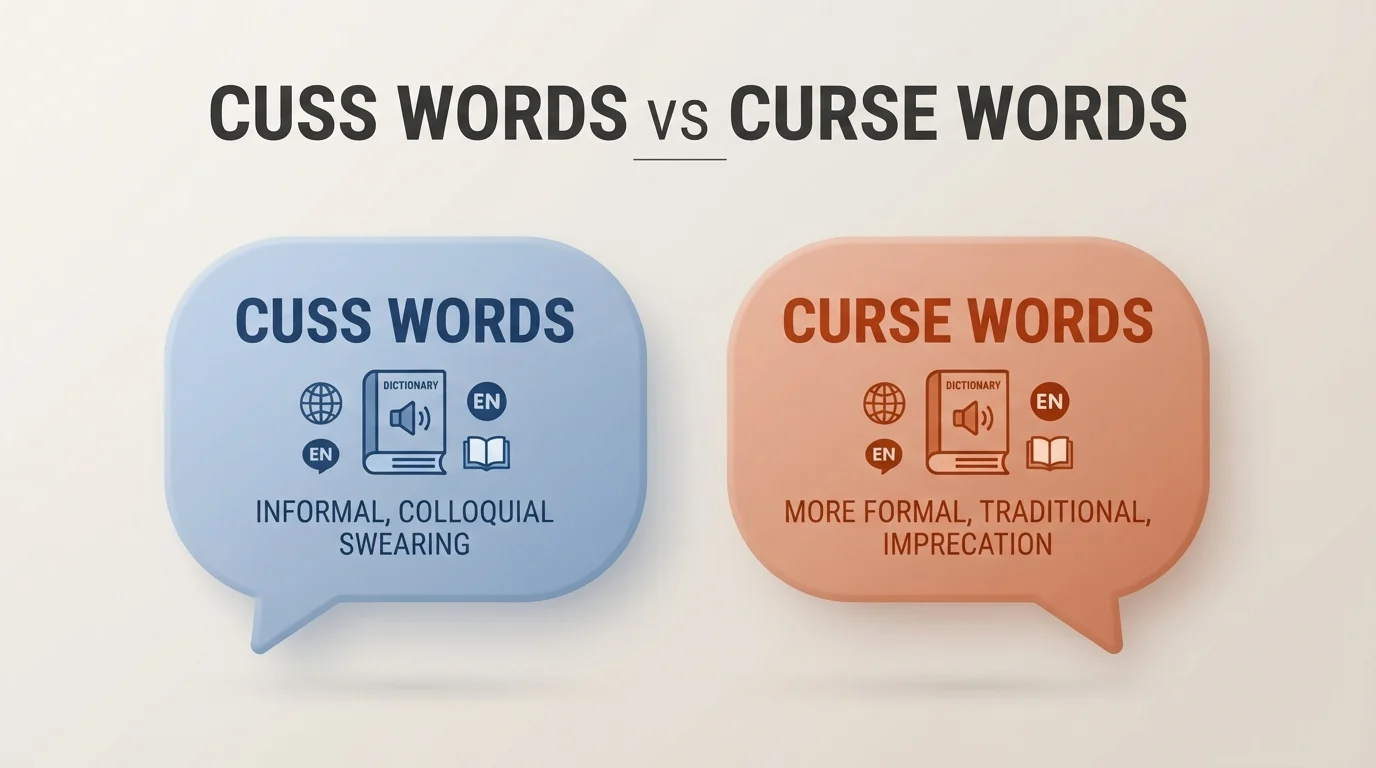
The English language has many words that sound similar but carry slightly different meanings. Cuss words vs curse words is a common example because both expressions are connected to offensive language, anger, and strong emotions. Although people often use them interchangeably, there are small differences in their meanings, usage, and tone.
Understanding the difference can help students, English learners, and everyday readers communicate more naturally. Both terms appear in conversations, movies, books, and online discussions. However, the meaning of a word or expression can change depending on the situation, the speaker’s intention, and the audience.
Learning when to use each term can also help you recognize informal American English and understand how people describe rude or offensive language. In this guide, you will learn the definitions of cuss words and curse words, explore practical examples, discover common mistakes, and understand if these expressions differ in American and British English.
Quick Answer
Cuss words and curse words both refer to offensive or strong language, but they have slightly different meanings. Cuss words usually mean swear words or vulgar expressions used to show anger, frustration, or surprise. Curse words can also mean swear words, but the term may additionally refer to words used to wish harm or bad luck on someone.
Why Do People Confuse Cuss Words and Curse Words?
People confuse these expressions because both describe language that may be considered rude, inappropriate, or offensive.
In everyday conversation, the two terms often have the same meaning. For example, someone might say, “Please do not use cuss words,” or “Please do not use curse words.” Both sentences ask someone to avoid offensive language.
The main difference is that curse can also refer to wishing harm, misfortune, or suffering on another person. The word cuss is more closely associated with informal swearing, particularly in American English.
Context is important because a curse word can be a swear word, but a curse can also be an expression of ill will rather than simply an offensive term.
What Are Cuss Words?
Cuss words are informal expressions that people use when they swear, express strong emotions, or speak offensively. The term is especially common in American English.
People may use cuss words when they are angry, frustrated, shocked, excited, or joking with friends. However, these words can sound disrespectful or inappropriate in formal situations.
Examples include:
- “Damn, I forgot my keys.”
- “What the heck is happening?”
- “He used a swear word during the argument.”
The first example contains a mild swear word in some contexts, while the second uses a softer expression. The third describes swearing without including an offensive word.
Is Cuss a Formal or Informal Word?
Cuss is informal. It is common in everyday American conversation, but it is less suitable for academic writing and formal communication.
For example:
Informal: “He started cussing when his phone stopped working.”
More formal: “He began using offensive language when his phone stopped working.”
Both sentences describe the same general behavior, but the second sounds more appropriate in a formal report.
What Are Curse Words?
Curse words are words or expressions that people use to swear, insult others, express anger, or communicate strong negative feelings. The term can also refer to words used to invoke harm, misfortune, or bad luck.
For example:
- “She used a curse word when she dropped the glass.”
- “He cursed at the driver who cut in front of him.”
- “The character placed a curse on his enemy.”
The first example refers to offensive language. The second describes directing abusive language at someone. The third describes a supernatural or figurative act intended to bring harm or misfortune.
These examples show why curse has a broader range of meanings than cuss.
Does Curse Always Mean Swearing?
No. Curse does not always mean swearing. It can describe offensive speech, an expression of anger, or a wish that something bad will happen to someone.
For example, “She cursed her bad luck” may simply mean that she expressed frustration about an unfortunate situation. In a story, “The witch cursed the prince” may mean that she placed a spell on him.
The surrounding sentence determines the intended meaning.
Cuss Words vs Curse Words: Comparison Table
| Feature | Cuss Words | Curse Words |
|---|---|---|
| Basic meaning | Informal swear words | Swear words or expressions associated with cursing |
| Common usage | Everyday informal speech | Everyday speech and broader contexts |
| Main purpose | Express emotion or use offensive language | Express emotion, insult someone, or invoke harm |
| Tone | Usually informal | Informal or serious, depending on context |
| American English | Especially common | Also common |
| British English | Less common | More widely understood |
| Broader meaning | Mainly associated with swearing | Can include wishing harm or invoking a curse |
| Formal writing | Usually avoided | Usually avoided when referring to offensive language |
The most important distinction is that cuss words generally refers to swear words, while curse words can refer to swear words and language associated with placing a curse on someone.
When Should You Use Cuss Words or Curse Words?
Choose the expression that best matches your meaning and audience.
Use Cuss Words When
Use cuss words when talking casually about swearing or offensive language, especially in American English.
Examples:
- “My little brother repeats cuss words he hears in movies.”
- “The teacher asked the students not to use cuss words.”
- “Some people cuss when they feel frustrated.”
This expression works well in informal conversations and discussions about language.
Use Curse Words When
Use curse words when referring to swear words in general or when the context involves cursing, insults, or expressions of ill will.
Examples:
- “The film contains several curse words.”
- “He shouted curse words during the argument.”
- “The story describes an ancient curse.”
In the third example, curse refers to a harmful spell rather than a swear word. Notice that the natural expression is “an ancient curse,” not necessarily “an ancient curse word.”
Which Expression Is Better for Students?
For English learners, swear words is often the clearest and most widely understood expression.
Use cuss words when discussing informal American English. Use curse words when discussing swear words or the broader meaning of cursing.
In formal writing, expressions such as “offensive language,” “profanity,” and “vulgar language” may be more appropriate.
12 Examples of Cuss Words vs Curse Words in Sentences
These examples demonstrate how the terms work in everyday English. Some sentences describe offensive language without reproducing strong profanity.
Examples of Cuss Words
- “He used a cuss word after missing the bus.”
- “Please do not say cuss words in front of the children.”
- “She sometimes cusses when she is angry.”
- “The movie has several cuss words, so parents should check its rating.”
- “My friend apologized for using a cuss word.”
- “He stopped cussing when his manager entered the room.”
Examples of Curse Words
- “The teacher explained why curse words are inappropriate in formal essays.”
- “He shouted curse words when someone damaged his car.”
- “The comedian used curse words to express frustration.”
- “The novel contains curse words and other mature language.”
- “In the fantasy story, the wizard used a curse to punish the king.”
- “She cursed her terrible luck after losing her wallet.”
These examples illustrate an important distinction. In the first group, the focus is on swearing. In the second group, the term can refer to swearing or, in the fantasy example, a spell intended to cause harm.
Common Mistakes When Using Cuss Words and Curse Words
English learners sometimes use these expressions incorrectly because their meanings overlap.
Mistake 1: Assuming They Have Completely Different Meanings
Incorrect understanding: “Cuss words are always different from curse words.”
Correct understanding: The expressions often mean the same thing in everyday conversation. Their meanings are not completely separate.
Mistake 2: Thinking Every Curse Is a Swear Word
A curse can be a statement wishing harm or misfortune on someone, or a supernatural spell in a story. It does not always involve profanity.
For example, “The villain placed a curse on the kingdom” does not necessarily describe swearing.
Mistake 3: Using Cuss in Formal Writing
The word cuss sounds informal and conversational.
Instead of writing, “The speaker used many cuss words,” in a formal report, consider writing, “The speaker used frequent profanity.”
Mistake 4: Assuming All Offensive Words Are Equally Strong
Not all swear words have the same level of offensiveness. Their impact depends on the word itself, the audience, the culture, and the situation.
A mild expression may be acceptable among friends but inappropriate in a classroom or workplace.
Mistake 5: Confusing Curse With Cuss as Verbs
Both words can function as verbs, but their meanings may differ.
“Cuss at someone” usually means to swear at that person.
“Curse someone” can mean to swear at them, condemn them, or wish harm on them.
What Is an Easy Memory Trick for Cuss Words vs Curse Words?
Remember this simple rule:
Cuss means informal swearing. Curse means swearing or wishing harm.
Think of cuss as the casual word you might hear in an American conversation. Think of curse as the broader word that can describe both offensive language and a harmful spell or wish.
For example:
“He cussed when he dropped his phone” describes swearing.
“The witch cursed the prince” describes placing a curse on someone.
This memory trick is a useful starting point, although both terms can refer to swear words in ordinary conversation.
Are Cuss Words and Curse Words Different in American and British English?
Yes, there is a difference in how familiar and common these expressions are.
In American English, cuss and cuss words are well established informal expressions. People may use them in casual conversations, television dialogue, and discussions about inappropriate language.
In British English, swear words and swearing are generally more familiar choices. Curse words is also understood, although cuss words may sound more distinctly American.
The meaning is usually clear to speakers of both varieties of English. The main difference is regional preference rather than a strict difference in definition.
For example:
American English: “He got in trouble for using cuss words.”
British English: “He got in trouble for swearing.”
Both sentences communicate essentially the same idea.
What Words Are Similar to Cuss Words and Curse Words?
Several related expressions describe swearing, profanity, or offensive language. However, they are not always interchangeable.
Swear Words
Swear words is a widely understood term for words used as profanity or vulgar expressions.
Example: “The television program contains several swear words.”
Profanity
Profanity is a more formal term for offensive or irreverent language, particularly language considered inappropriate in a religious or social context.
Example: “The report discusses profanity in popular films.”
Bad Words
Bad words is a simple, informal expression often used when speaking to children or beginners.
Example: “The parent told the child not to repeat bad words.”
Vulgar Language
Vulgar language refers to crude, offensive, or socially unacceptable expressions.
Example: “The review warns readers about vulgar language in the novel.”
Expletives
Expletives are words or short expressions used to express strong feelings, including anger, surprise, or frustration. They may be offensive or relatively mild.
Example: “He muttered an expletive when he realized his mistake.”
Obscenities
Obscenities are words or expressions considered especially offensive, often because they refer to sexual matters or other socially sensitive subjects.
Example: “The newspaper removed the obscenities from the quotation.”
Frequently Asked Questions
1. Are Cuss Words and Curse Words the Same?
They often mean the same thing in everyday English. Both can refer to swear words or offensive expressions. However, curse also has meanings related to wishing harm or misfortune on someone, while cuss is mainly associated with informal swearing.
2. Which Is Correct, Cuss Words or Curse Words?
Both expressions are correct. Cuss words is especially common in informal American English, while curse words is also widely understood. Choose the expression that sounds natural for your audience and context.
3. Is Cuss an American Word?
Yes, cuss is particularly associated with informal American English. It is used as a verb meaning to swear and as a noun referring to a swear word. Other English speakers generally understand it, but they may prefer different expressions.
4. Is Curse a Bad Word?
No, curse is not itself necessarily a bad word. It is an ordinary English word that can mean to swear, express anger, condemn someone, or invoke harm. Its meaning depends on the context in which it is used.
5. What Is the Difference Between Cussing and Swearing?
Cussing and swearing generally describe the same behavior: using swear words or profanity. Cussing sounds more informal and is especially common in American English, while swearing is widely used in both American and British English.
6. Are Curse Words Always Offensive?
No. Their offensiveness depends on the particular expression, its meaning, the audience, and the situation. Some words are considered highly offensive, while others are mild or acceptable in casual conversation. A word can also be used in a quotation or linguistic discussion without being directed at anyone.
7. What Is the Most Polite Alternative to Cuss Words or Curse Words?
Useful alternatives include swear words, offensive language, profanity, and inappropriate language. In formal writing, profanity or offensive language often sounds more professional than cuss words.
8. Should English Learners Use Cuss Words or Curse Words?
English learners should first understand what these expressions mean and recognize that their appropriateness varies by situation. For general communication, swear words is a useful neutral choice. In professional, academic, or unfamiliar social settings, it is usually safer to avoid profanity.
Remember This
Cuss words and curse words often have the same meaning, but they are not identical in every context.
- Cuss words usually refer to informal swearing.
- Curse words can refer to swearing, insults, or offensive expressions.
- A curse can also mean a wish for harm or a supernatural spell.
- Cuss is especially common in informal American English.
- Swear words is a widely understood alternative.
- Profanity and offensive language are useful choices in formal writing.
Conclusion
The difference between cuss words and curse words is small but useful to understand. Both expressions commonly refer to offensive language, and many English speakers use them interchangeably. However, cuss words is particularly associated with informal American speech, while curse words can also connect to the broader meaning of cursing, including wishing harm or placing a curse on someone.
For students and English learners, the easiest approach is to remember that context determines the meaning. Use cuss words when discussing casual swearing, curse words when discussing swearing or the broader idea of cursing, and swear words when you want a familiar expression that works across many English speaking contexts. Understanding these distinctions will help you recognize natural English usage and choose the right words for different situations.