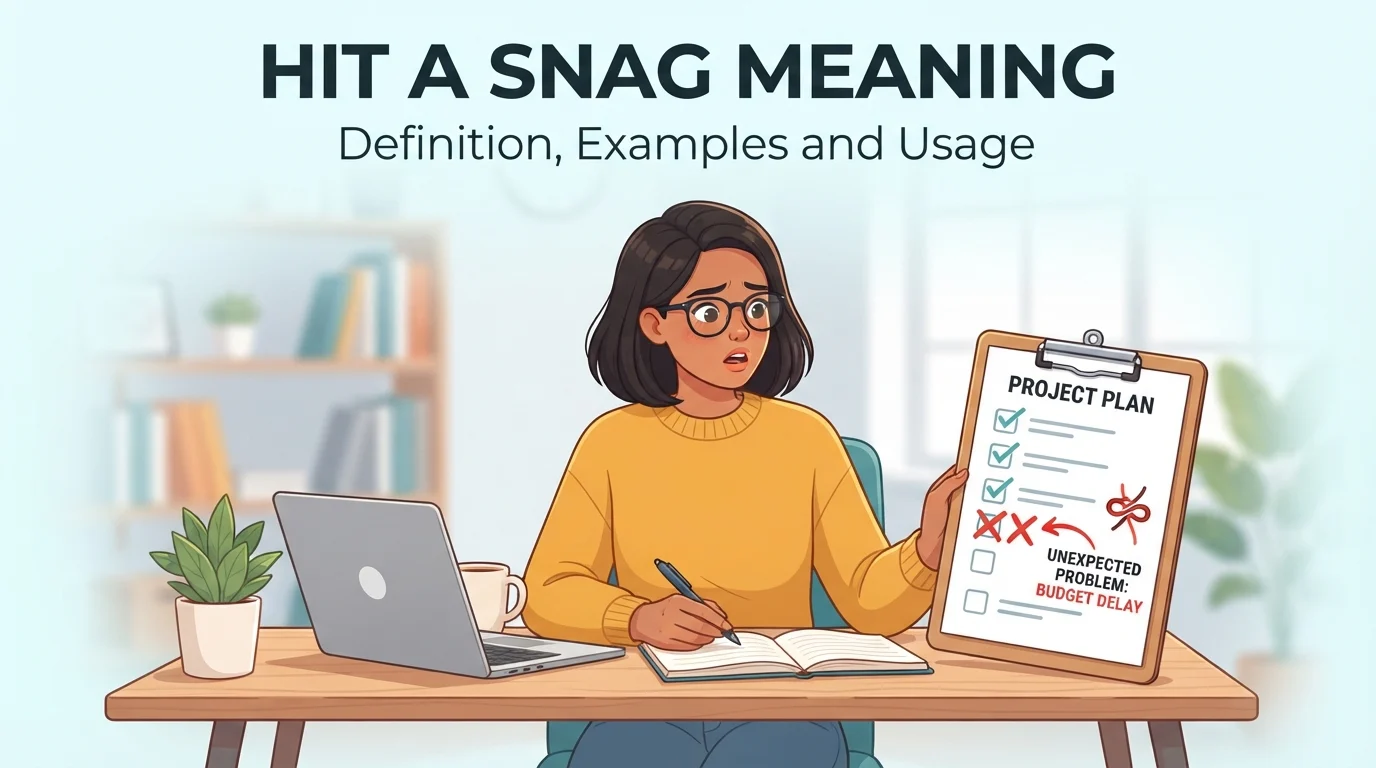
Have you ever been working on an important project when something unexpected caused a delay? Perhaps your computer stopped working, a meeting was postponed, or a delivery failed to arrive on time. In English, you can describe this situation by saying that you “hit a snag.” This common idiom is used in everyday conversations, workplace discussions, emails, and informal writing.
The phrase may sound unusual if you interpret it literally, but its meaning is simple. To hit a snag means to encounter an unexpected problem, difficulty, or obstacle while doing something.
For example, “We hit a snag while planning the event” means that a problem came up during the planning process. The problem may be small or serious, temporary or difficult to solve. In this guide, you will learn the meaning of “hit a snag,” how to use it in sentences, similar expressions, common mistakes, and practical examples.
Quick Answer: What Does “Hit a Snag” Mean?
“Hit a snag” means to encounter an unexpected problem or difficulty that slows down or interrupts progress. For example, “We hit a snag while building the website” means that an unexpected problem occurred during development. The expression is informal and commonly used in everyday English, especially when discussing projects, plans, work, travel, or other activities that do not go as expected.
What Does “Hit a Snag” Mean?
“Hit a snag” is an English idiom. It describes a situation in which someone encounters a problem while trying to complete a task or achieve a goal.
In simple English, it means to run into a problem or face an unexpected difficulty.
For example:
- We hit a snag while preparing the presentation.
- The construction project hit a snag.
- I hit a snag while booking my flight.
In each sentence, something unexpected made the task more difficult or delayed progress.
A snag does not always mean that the entire plan has failed. Often, it simply means that a problem has appeared and needs to be handled before work can continue.
10 Examples of “Hit a Snag” in Sentences
Here are ten examples showing how to use this idiom naturally.
- We hit a snag while planning the wedding.
An unexpected problem came up during the preparations. - The project hit a snag because the supplier delivered the materials late.
The late delivery caused a delay. - I hit a snag while trying to install the software.
I encountered an unexpected problem during installation. - Our travel plans hit a snag when the flight was canceled.
The canceled flight disrupted our plans. - The company hit a snag during the product launch.
The company experienced a problem while launching the product. - We hit a snag, but we found a solution quickly.
A problem occurred, but we managed to solve it. - The negotiations hit a snag over the price.
The discussions encountered a problem because the parties disagreed about the price. - I hit a snag with my internet connection while taking the online exam.
An internet problem interrupted the exam. - The renovation hit a snag when workers discovered a damaged pipe.
An unexpected issue delayed the renovation. - Everything was going smoothly until we hit a snag.
Everything was fine until an unexpected problem appeared.
Hit a Snag vs. Run Into a Problem
These expressions have almost the same meaning, but they can differ slightly in tone.
| Hit a snag | Run into a problem |
|---|---|
| Often suggests an unexpected obstacle during a process. | A general expression for encountering a problem. |
| Common in discussions about plans and projects. | Suitable for almost any type of difficulty. |
| Example: We hit a snag during development. | Example: We ran into a problem during development. |
Both are correct and natural. “Hit a snag” is particularly useful when a task was progressing but an obstacle appeared along the way.
Hit a Snag vs. Face a Setback
These phrases are related, but they are not always interchangeable.
Hit a snag means to encounter a problem or obstacle.
Face a setback means to experience something that delays progress or makes it harder to reach a goal.
Examples:
- We hit a snag when the computer stopped working.
- The team faced a major setback after losing its biggest client.
A snag may be a relatively small or temporary problem. A setback often suggests a more significant delay or loss of progress, although the exact meaning depends on context.
Hit a Snag vs. Reach a Dead End
These expressions describe different kinds of difficulty.
| Hit a snag | Reach a dead end |
|---|---|
| Encounter an obstacle that may be possible to overcome. | Reach a point where the current approach offers no way forward. |
| Progress may continue after solving the problem. | A different approach may be necessary. |
| Example: We hit a snag during the investigation. | Example: The investigation reached a dead end. |
If a problem can be solved and the task can continue, “hit a snag” is often appropriate. If there seems to be no way forward, “reach a dead end” may be a better choice.
Common Situations Where People Hit a Snag
The expression is useful in many everyday situations.
1. At Work
“We hit a snag while preparing the monthly report.”
A problem interrupted the work.
2. During Travel
“Our holiday plans hit a snag when the hotel lost our reservation.”
An unexpected issue affected the trip.
3. While Studying
“I hit a snag while solving the final question.”
The student encountered a difficult problem.
4. During a Business Project
“The company hit a snag while negotiating the contract.”
The negotiations encountered an obstacle.
5. While Using Technology
“I hit a snag when my phone stopped connecting to Wi-Fi.”
A technical issue made the task more difficult.
How to Use “Hit a Snag” in Different Tenses
The expression changes according to the tense of the verb “hit.” The present and past forms look the same, but the context tells you which tense is being used.
| Tense | Example |
|---|---|
| Present simple | We hit a snag whenever the system loses its connection. |
| Past simple | We hit a snag yesterday. |
| Present continuous | We are hitting a snag with the new software. |
| Present perfect | We have hit a snag in the planning process. |
| Future | We may hit a snag if the delivery arrives late. |
The past tense of “hit” is also “hit,” not “hitted.”
Common Mistakes to Avoid
Mistake 1: Taking the Phrase Literally
Incorrect understanding: Someone physically hit a small branch or piece of wood.
Correct understanding: In this idiom, “hit a snag” usually means encountering a problem.
Mistake 2: Thinking a Snag Always Means Failure
A snag does not necessarily mean that a project has failed. It usually means an obstacle has appeared.
Example: “We hit a snag, but we resolved it by the afternoon.”
Mistake 3: Using “Hitted a Snag”
Incorrect: We hitted a snag during the project.
Correct: We hit a snag during the project.
“Hit” has the same spelling in the present and past simple forms.
Mistake 4: Using It for Every Kind of Problem
The expression is especially natural when describing an obstacle that appears while doing something. For a serious emergency or a major disaster, more specific wording may be clearer.
Easy Memory Trick
Imagine a person walking along a path and suddenly catching their clothing on a small branch. The branch interrupts their progress.
That unexpected obstacle is a snag.
In everyday English, when you “hit a snag,” you encounter a problem that gets in the way of what you are trying to do.
Remember:
- Hit a snag: Encounter an unexpected problem.
- Overcome a snag: Solve the problem.
- Get back on track: Resume making progress.
American English vs. British English
“Hit a snag” is commonly understood in both American and British English. The meaning and spelling are the same.
| American English | British English |
|---|---|
| We hit a snag with the project. | We hit a snag with the project. |
| The plan hit a snag. | The plan hit a snag. |
| We ran into a problem. | We ran into a problem. |
The phrase is suitable for casual conversation and workplace communication in both varieties of English.
Synonyms and Similar Expressions
Here are some alternatives you can use depending on the situation.
| Expression | Meaning |
|---|---|
| Run into a problem | Encounter a difficulty |
| Encounter an obstacle | Come across something that blocks progress |
| Face a setback | Experience a delay or loss of progress |
| Come up against a problem | Find yourself facing a difficulty |
| Run into trouble | Experience a problem or difficulty |
| Meet with a difficulty | Experience an obstacle, often in a more formal style |
| Reach a stumbling block | Encounter something that prevents progress |
| Get held up | Be delayed |
For example, “We hit a snag during the project” can also be expressed as “We ran into a problem during the project.”
Final Verdict: What Does “Hit a Snag” Mean?
“Hit a snag” means to encounter an unexpected problem or obstacle while doing something. It is a common English idiom used when work, plans, travel, or other activities do not go as smoothly as expected.
For example, “We hit a snag while organizing the event” means that an unexpected problem appeared during the preparations. The expression does not necessarily mean failure. It often suggests that the problem can be solved and progress can continue.
Frequently Asked Questions
1. What does “hit a snag” mean in simple English?
It means to encounter an unexpected problem or difficulty. For example, “We hit a snag while making the website” means that a problem came up during development.
2. Is “hit a snag” an idiom?
Yes. It is an idiom because its intended meaning is not usually about physically hitting something. It means encountering an obstacle.
3. Is “hit a snag” formal or informal?
It is generally an informal or neutral expression. It is appropriate in everyday conversations and many professional situations.
4. What is another way to say “hit a snag”?
You can say “run into a problem,” “encounter an obstacle,” or “face a setback.” The best choice depends on the context.
5. What does “we hit a snag” mean?
It means that the speaker and others encountered an unexpected problem while doing something. The problem may delay their plans or require a solution.
6. Does hitting a snag mean failure?
No. It usually means that an obstacle has appeared. The task or project may continue once the problem is resolved.
7. Is it correct to say “hitted a snag”?
No. The past tense of “hit” is “hit.” The correct sentence is “We hit a snag yesterday.”
8. Can I use “hit a snag” in a business email?
Yes. For example, “We hit a snag during testing, so the launch may be delayed.” It communicates a problem in a clear and natural way.
Remember This
- “Hit a snag” means to encounter an unexpected problem.
- It is a common English idiom.
- It is used for projects, plans, travel, and everyday tasks.
- A snag does not necessarily mean complete failure.
- “Run into a problem” is a useful alternative.
- The past tense of “hit” is still “hit.”
Conclusion
“Hit a snag” is a useful expression for describing unexpected difficulties that interrupt progress. You might hit a snag while planning an event, working on a project, using technology, or organizing a trip. It tells others that something has gone wrong or become more difficult than expected.
To use the phrase naturally, remember that it describes an obstacle rather than a final failure. For example, you can say, “We hit a snag with the delivery, but we found another solution.” With regular practice, you will recognize this idiom in conversations, workplace emails, and everyday English.