Have you ever wondered whether to say “I awoke early” or “I woke early”? Both expressions are correct, and both describe the past action of waking up. However, there are small differences in how they are used, their tone, and the expressions that commonly appear with them.
Understanding awoke vs woke is useful for students, English learners, writers, and anyone who wants to speak or write English naturally. Although these words have the same basic meaning, they come from different forms of the verb awake and are not always interchangeable in every sentence. In everyday conversation, woke is generally more common, while awoke can sound slightly more formal or literary.
In this guide, you will learn the meanings of awoke and woke, their grammatical forms, the difference between them, and how to use each word correctly. You will also find practical examples, common mistakes, synonyms, and answers to frequently asked questions.
Quick Answer: Awoke vs Woke
Awoke and woke are both correct past tense forms associated with waking up. Awoke is the simple past tense of awake, while woke is the simple past tense of wake. Both can mean that someone stopped sleeping and became conscious. Woke is more common in everyday English, while awoke often sounds more formal or literary.
What Does Awoke Mean?
Awoke is the simple past tense of the verb awake. It means that someone stopped sleeping or became conscious after being asleep.
The word is often used in written English, storytelling, literature, and more formal descriptions. It can make a sentence sound slightly more polished or descriptive.
Examples:
- I awoke early this morning.
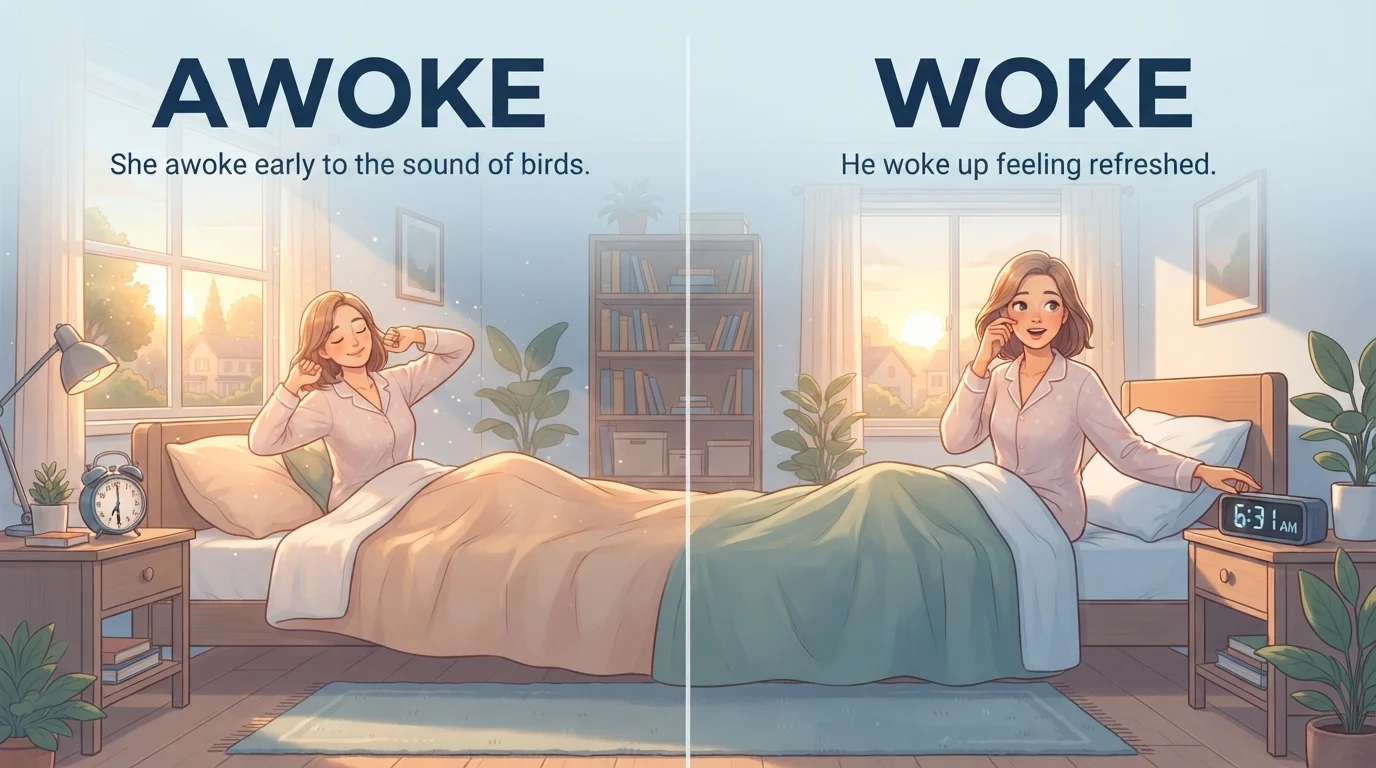
- She awoke to the sound of birds singing.
- He awoke suddenly during the night.
- The child awoke from a deep sleep.
- We awoke to find the room filled with sunlight.
- They awoke when the alarm rang.
- I awoke feeling refreshed and energetic.
- She awoke from a strange dream.
- He awoke to the smell of fresh coffee.
- The travelers awoke before sunrise.
In these examples, awoke describes the moment when someone became awake.
Important: The verb awake is irregular. Its common forms are awake, awoke, and awoken.
What Does Woke Mean?
Woke is the simple past tense of the verb wake. It means that someone stopped sleeping or became awake.
It is widely used in everyday conversation and informal writing. In many situations, it sounds more natural and direct than awoke.
Examples:
- I woke up at seven o’clock.
- She woke when the phone rang.
- He woke up feeling tired.
- We woke early to catch the train.
- The baby woke in the middle of the night.
- They woke up because of the loud noise.
- I woke from a dream and checked the time.
- My brother woke me before sunrise.
- She woke up and opened the window.
- He woke to find that it was raining.
In everyday English, woke up is especially common when talking about getting out of sleep.
Important: Wake has the common forms wake, woke, and woken.
Awoke vs Woke: Key Differences
| Feature | Awoke | Woke |
|---|---|---|
| Base verb | Awake | Wake |
| Grammatical form | Simple past tense | Simple past tense |
| Basic meaning | Stopped sleeping | Stopped sleeping |
| Everyday usage | Less common | More common |
| Tone | Often formal or literary | Usually conversational |
| Common expression | Awoke from a dream | Woke up early |
| Example | She awoke at dawn. | She woke up at dawn. |
The main difference is not the basic meaning. It is the base verb and the style in which each form is commonly used.
When Should You Use Awoke?
Use awoke when you want to describe someone becoming awake in a slightly more formal, descriptive, or literary way.
For example:
Literary or descriptive:
The prince awoke in a mysterious forest.
Everyday alternative:
The prince woke up in a mysterious forest.
Both sentences are grammatically correct. The first may sound more like a story, while the second sounds more conversational.
You can use awoke in these situations:
- Storytelling: The hero awoke in a strange place.
- Descriptive writing: I awoke to the gentle sound of rain.
- Formal narration: The patient awoke after the procedure.
- Personal reflection: I awoke with a new sense of purpose.
Remember that awoke is not incorrect or outdated. It is simply less common than woke in ordinary conversation.
When Should You Use Woke?
Use woke when talking naturally about waking up in daily life.
Examples:
- I woke up late today.
- She woke me at six.
- We woke because someone knocked on the door.
- He woke up feeling hungry.
- They woke early for their journey.
The expression woke up is especially common in casual conversations.
For example:
Question: What time did you wake up?
Answer: I woke up at eight.
You could also say, “What time did you awake?” in some contexts, but it sounds less natural to many speakers than “What time did you wake up?”
Awoke vs Woke in Example Sentences
Compare these sentences to understand how the words work.
| With awoke | With woke |
|---|---|
| I awoke before sunrise. | I woke up before sunrise. |
| She awoke from a nightmare. | She woke up from a nightmare. |
| He awoke when the door opened. | He woke when the door opened. |
| We awoke to the sound of thunder. | We woke up to the sound of thunder. |
| The baby awoke during the night. | The baby woke during the night. |
Both columns contain correct English. The woke versions are generally more familiar in everyday speech, especially when used with up.
Awoke vs Woke vs Awakened vs Woken
These four forms can be confusing because they are related but have different grammatical uses.
| Word | Main grammatical use | Example |
|---|---|---|
| Awake | Base verb | I awake early when I have work. |
| Awoke | Simple past of awake | I awoke early yesterday. |
| Wake | Base verb | I wake up at seven. |
| Woke | Simple past of wake | I woke up at seven yesterday. |
| Woken | Past participle of wake | I have woken up early all week. |
| Awakened | Past tense or past participle of awaken | She was awakened by a noise. |
| Awoken | Past participle of awake | He had awoken before dawn. |
How to use these forms correctly
Awoke: Use it for a completed action in the past.
Example: I awoke at five yesterday.
Woke: Also use it for a completed action in the past.
Example: I woke at five yesterday.
Woken: Use it with an auxiliary verb such as have, has, or had.
Example: I have woken up early every day this week.
Awakened: This can be used as the past tense or past participle of awaken.
Example: The loud alarm awakened everyone.
Awoken: This is the past participle of awake.
Example: She had awoken before the alarm rang.
Common Situations Where Awoke and Woke Are Used
1. Talking about your morning routine
Everyday English: I woke up at six this morning.
More literary: I awoke at six this morning.
2. Describing a sudden noise
Everyday English: The noise woke me up.
More literary: The noise awoke me.
Both versions are correct, although woke me up is especially common.
3. Talking about dreams
Everyday English: I woke up from a strange dream.
More descriptive: I awoke from a strange dream.
4. Writing a story
Literary style: The old man awoke in an unfamiliar room.
Conversational style: The old man woke up in an unfamiliar room.
5. Describing an emotional realization
The verb awake can also have figurative uses related to becoming aware or alert.
Example: A new idea awoke her curiosity.
In this figurative sentence, awoke means that something stirred or activated her curiosity.
Common Mistakes to Avoid
Mistake 1: Using woke with have
Incorrect: I have woke up early.
Correct: I have woken up early.
Explanation: Use woken, not woke, after have in the standard present perfect tense.
Mistake 2: Using awoke after have
Incorrect: I have awoke at six every day this week.
Correct: I have awoken at six every day this week.
More natural: I have woken up at six every day this week.
Explanation: Awoke is a simple past form, while awoken is the past participle of awake.
Mistake 3: Thinking awoke and woke have different basic meanings
Incorrect assumption: Awoke means suddenly waking up, while woke means waking up slowly.
Correct understanding: Neither word inherently describes how quickly someone wakes up. Both can describe waking up suddenly or gradually, depending on the context.
Mistake 4: Thinking woke is always slang
Incorrect assumption: Woke is only slang and should not be used in standard English.
Correct understanding: Woke is a standard grammatical past tense of wake. It also has a separate modern sociopolitical meaning in some contexts, but that does not change its ordinary grammatical use.
Mistake 5: Using awake as the simple past tense
Incorrect: I awake late yesterday.
Correct: I awoke late yesterday.
Also correct: I woke up late yesterday.
Explanation: In standard English, awake is the base form, not the simple past form.
Easy Memory Trick
Remember this simple rule:
- Awake → Awoke → Awoken
- Wake → Woke → Woken
Both verbs can describe becoming awake, but their forms belong to different verb patterns.
A quick way to remember the everyday choice is:
Woke = everyday conversation.
Awoke = often more descriptive writing.
This is a general usage preference, not a strict rule. You can use either past tense when the sentence fits naturally.
American English vs British English
There is no major difference between American and British English in the basic meanings of awoke and woke. Both varieties use these forms.
| Situation | American English | British English |
|---|---|---|
| Everyday morning routine | I woke up early. | I woke up early. |
| Descriptive writing | I awoke to the rain. | I awoke to the rain. |
| Past participle | I have woken up. | I have woken up. |
The main difference is stylistic rather than regional. Speakers in both countries commonly use woke up in conversation.
Synonyms of Awoke and Woke
Depending on the context, these words can express a similar idea.
| Synonym or expression | Meaning | Example |
|---|---|---|
| Awakened | Became awake or was made awake | The sound awakened me. |
| Roused | Was brought out of sleep or inactivity | The bell roused the students. |
| Stirred | Began to move or become active | She stirred but did not open her eyes. |
| Got up | Left the bed | I got up at seven. |
| Became conscious | Regained awareness | He became conscious after the operation. |
| Came around | Regained consciousness, usually after fainting or being unconscious | She came around a few minutes later. |
These expressions are not perfect replacements in every sentence. For example, got up usually refers to leaving the bed, while woke up refers to stopping sleep. A person can wake up without getting out of bed.
Frequently Asked Questions
1. Is awoke correct English?
Yes. Awoke is the correct simple past tense of awake. For example, “I awoke before sunrise” is grammatically correct.
2. Is woke correct English?
Yes. Woke is the simple past tense of wake. For example, “I woke up before sunrise” is correct and common in everyday English.
3. Which is more common, awoke or woke?
Woke is generally more common in everyday conversation, especially in the expression woke up. Awoke is often used in descriptive writing, literature, and formal narration.
4. Can I say “I awoke up”?
In standard contemporary English, “I awoke” and “I woke up” are the usual forms. “I awoke up” is generally considered redundant or nonstandard because awake does not normally take up in this construction.
5. What is the past participle of awoke?
The past participle of awake is awoken. The forms are awake, awoke, and awoken.
Example: She had awoken before dawn.
6. Is “I have woke up” grammatically correct?
In standard English, the preferred form is “I have woken up.” The past participle woken follows have in the present perfect tense.
7. Do awoke and woke mean exactly the same thing?
They share the same basic meaning when they describe waking from sleep. The main differences are their base verbs and their typical style of use. Woke is more common in everyday conversation, while awoke can sound more literary.
8. Does woke have another meaning?
Yes. In modern social and political contexts, woke can refer to awareness of social injustice or inequality. It can also be used critically or sarcastically, depending on the speaker. This is separate from the ordinary past tense of wake.
Remember This
- Awoke is the simple past tense of awake.
- Woke is the simple past tense of wake.
- Both words can mean that someone stopped sleeping.
- Woke up is particularly common in everyday English.
- Awoke often sounds more descriptive or literary.
- Use woken or awoken as the appropriate past participle, not woke or awoke, after have or had in standard perfect constructions.
- Neither awoke nor woke automatically means that someone woke up suddenly.
Conclusion
The difference between awoke and woke is simple once you understand their verb forms. Awoke comes from awake, while woke comes from wake. Both are correct past tense forms when describing the act of becoming awake. Although awoke often appears in descriptive or literary writing, woke is widely used in ordinary conversation.
For everyday situations, “I woke up early” is a natural and common choice. For storytelling or a more descriptive style, “I awoke early” works just as well. The most important thing is to use the correct verb form for the tense you need. Once you remember awake, awoke, awoken and wake, woke, woken, you will find it much easier to use these words confidently.