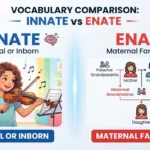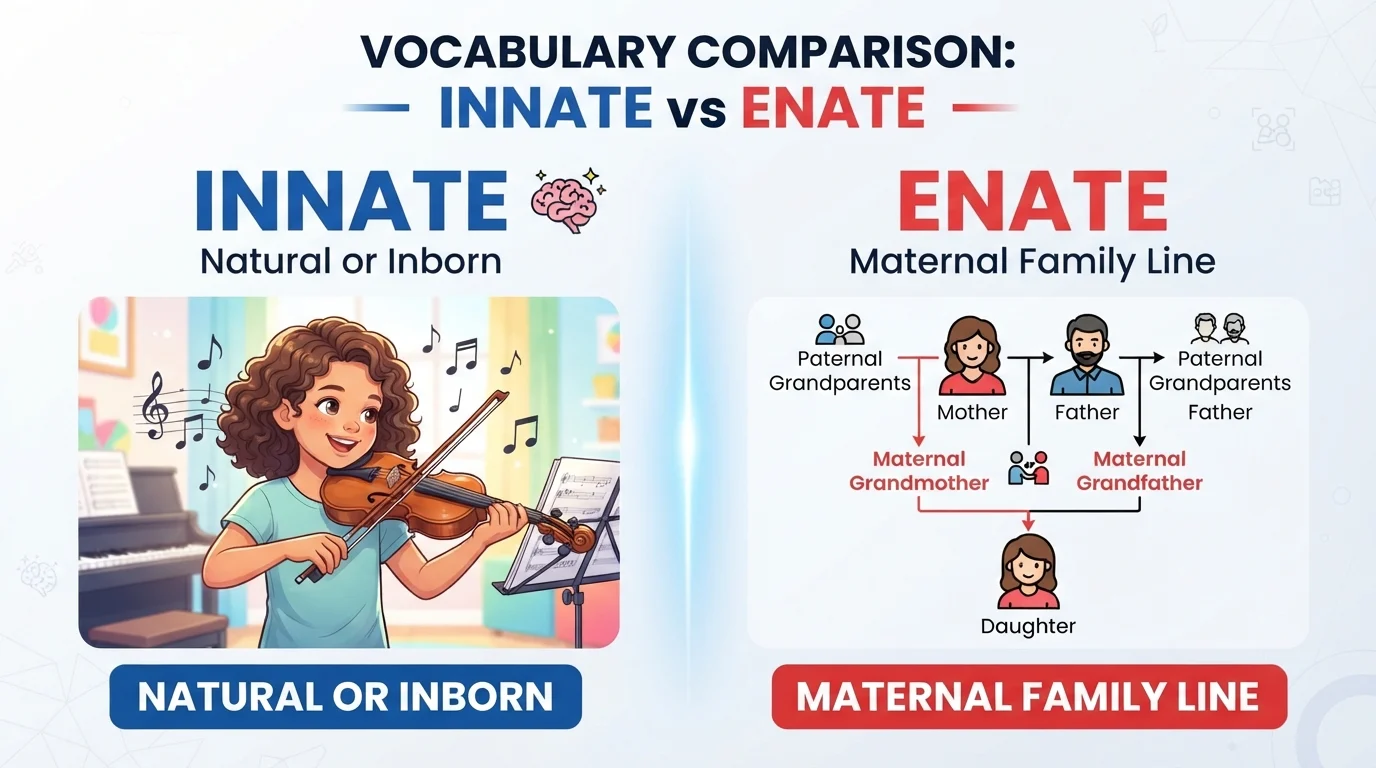
Have you ever wondered whether the correct word is “innate” or “enate”? These two words look and sound similar, but they have very different meanings and are not interchangeable. Innate is a common English word that describes something natural, inborn, or present from birth. Enate is a much less common word, mainly used in genealogy and biology, that refers to relationships or origins on the mother’s side.
Understanding the difference between innate and enate can help you avoid spelling mistakes and choose the correct word in writing. For example, someone might have an innate talent for music, meaning the talent seems natural rather than learned.
In contrast, an enate relative is a relative connected through the maternal side of a family. In this guide, you will learn the definitions, pronunciation, examples, common mistakes, and practical ways to remember the difference between these two words.
Quick Answer: Innate vs Enate
Innate means natural, inborn, or existing from birth. For example, “She has an innate ability to understand music” means she seems to have a natural ability.
Enate means related through the mother’s side of a family. For example, an enate relative is a relative connected through the maternal line.
The main difference is that innate describes a natural quality or characteristic, while enate describes a maternal family relationship or lineage. In everyday English, “innate” is far more common.
What Does Innate Mean?
Innate is an adjective that describes a quality, ability, characteristic, or tendency that is natural or present from birth rather than acquired through learning or experience.
In simple English, innate means inborn or natural.
Examples:
- She has an innate talent for painting.
- Humans have an innate ability to learn language.
- His innate curiosity makes him ask many questions.
- Some animals display innate behaviors.
The word is commonly used in psychology, biology, education, philosophy, and everyday conversation.
Examples of Innate in Sentences
- She has an innate sense of rhythm.
She seems naturally good at keeping time with music. - His innate kindness makes people feel welcome.
Kindness appears to be a natural part of his character. - Some birds have an innate ability to navigate.
Their navigation behavior is partly natural rather than entirely learned. - The child showed an innate interest in science.
The child seemed naturally curious about science. - Leadership does not always come naturally; it can also be learned.
This example shows that not every useful ability is necessarily innate.
What Does Enate Mean?
Enate is a rare adjective that refers to someone or something connected through the mother’s side of a family. It is mainly encountered in specialized writing about family relationships, genealogy, and related subjects.
In simple English, enate means related through the maternal side.
For example:
- An enate relative is related through the mother’s side of the family.
- A family tree may distinguish maternal relationships from paternal relationships.
The word is uncommon in everyday conversation. Most English speakers would say “maternal relative” or “relative on the mother’s side” instead.
Examples of Enate in Sentences
- The historian traced the family’s enate relationships.
The historian studied connections through the maternal side. - He researched his enate relatives as part of his family history.
He investigated relatives connected through his mother’s side. - The genealogist recorded both enate and paternal connections.
The genealogist documented maternal and paternal family relationships.
Because “enate” is rare, it is best to use it when a specialized term is appropriate. In ordinary writing, “maternal” is usually clearer.
Innate vs Enate: Main Differences
| Feature | Innate | Enate |
|---|---|---|
| Meaning | Natural or inborn | Related through the mother’s side |
| Part of speech | Adjective | Adjective |
| Common usage | Everyday English and academic writing | Rare, specialized usage |
| Common context | Abilities, qualities, traits, behaviors | Family relationships and genealogy |
| Example | She has an innate talent for music. | He studied his enate relatives. |
| Simple alternative | Natural, inborn | Maternal, related through the mother’s side |
Easy rule: Use “innate” when describing something natural or inborn. Use “enate” when referring to a maternal family connection.
Innate vs Enate: Pronunciation
The two words are pronounced differently, although they look similar.
- Innate: ih NAYT
- Enate: EE nayt or ih NAYT, depending on the dictionary and speaker
Pronunciation can vary, and some speakers may pronounce the words similarly. Therefore, the safest way to distinguish them is to focus on their meanings and spelling.
Innate vs Inborn vs Inherent
These three words are related in meaning, but each has its own typical use.
| Word | Meaning | Example |
|---|---|---|
| Innate | Natural or present from birth | She has an innate musical ability. |
| Inborn | Present from birth | The baby has an inborn reflex. |
| Inherent | An essential or built in part of something | Risk is inherent in some activities. |
“Innate” and “inborn” are often interchangeable when describing natural characteristics. “Inherent” is broader and can describe a quality that belongs naturally to a thing or situation, even if it was not present from birth.
Innate vs Maternal
These words have very different purposes.
Innate describes a quality that is natural or inborn.
Maternal means related to a mother or the mother’s side of a family.
Examples:
- She has an innate ability to solve puzzles.
- He visited his maternal grandparents.
The first sentence describes a natural ability. The second describes a family relationship.
Because “enate” is rare, “maternal” is usually the better word when discussing relatives on the mother’s side.
Common Mistakes to Avoid
Mistake 1: Using enate when you mean innate
Incorrect: He has an enate ability to learn languages.
Correct: He has an innate ability to learn languages.
The correct word for a natural or inborn ability is “innate.”
Mistake 2: Using innate to describe a maternal relative
Incorrect: My innate uncle lives in Lahore.
Correct: My maternal uncle lives in Lahore.
Use “maternal” for a relative on your mother’s side. “Innate” describes natural characteristics, not family connections.
Mistake 3: Assuming enate is a common everyday word
“Enate” is a legitimate but uncommon word. In everyday writing, “maternal relative” or “relative on the mother’s side” is usually easier to understand.
Mistake 4: Thinking innate means something can never be learned
“Innate” suggests that a quality is natural or inborn, but it does not mean that learning and experience have no role in developing it. Many abilities involve a combination of natural tendencies and practice.
Easy Memory Trick
Use this simple memory trick to remember the difference.
Innate = Inborn
Both words contain the idea of something natural or present from birth.
Enate = Related through the mother’s side
Think of “enate” as a specialized family history word connected with maternal relationships.
Remember:
- Innate talent means natural talent.
- Enate relative means a relative connected through the maternal line.
American English vs British English
“Innate” has the same meaning and spelling in American and British English. “Enate” is also a rare term in both varieties.
| American English | British English |
|---|---|
| She has an innate talent for music. | She has an innate talent for music. |
| He researched his maternal relatives. | He researched his maternal relatives. |
The main difference is not regional usage but frequency: “innate” is common in both varieties, while “enate” is rare.
Similar Words and Expressions
| Word | Meaning |
|---|---|
| Inborn | Present from birth |
| Natural | Not artificial or not necessarily learned |
| Inherent | Belonging naturally to something |
| Instinctive | Done naturally without conscious reasoning |
| Maternal | Related to the mother |
| Paternal | Related to the father |
| Ancestral | Connected with one’s ancestors |
| Hereditary | Passed from parents to children through genes |
These words are not all exact synonyms. Choose the word that best matches whether you mean a natural quality, an instinct, or a family connection.
Final Verdict: Innate vs Enate
“Innate” and “enate” are different words with different meanings. Innate means natural or inborn and is widely used in everyday English. Enate is a rare term referring to relationships through the mother’s side of a family.
If you are describing a person’s natural talent, curiosity, or ability, use “innate.” If you are writing about maternal family relationships in a specialized context, “enate” may be appropriate. In most everyday situations, however, “maternal” is clearer than “enate.”
Frequently Asked Questions
1. What is the main difference between innate and enate?
“Innate” means natural or inborn. “Enate” refers to relationships connected through the mother’s side of a family.
2. Is enate a real English word?
Yes. “Enate” is a real but uncommon English word used mainly in specialized discussions of family relationships and genealogy.
3. What is an example of innate?
“She has an innate ability to understand music.” This means she seems to have a natural ability for music.
4. What does an enate relative mean?
An enate relative is a relative connected through the maternal side of a family. In everyday English, “a relative on the mother’s side” is clearer.
5. Is innate the same as inborn?
They are very similar. Both describe something natural or present from birth, although the best choice depends on the sentence.
6. Is enate the opposite of paternal?
Not exactly in every context, but “enate” refers to the maternal line, while “paternal” refers to the father’s side. The more common contrasting terms are “maternal” and “paternal.”
7. Can I use innate to describe a family member?
No, not when you mean a family relationship. Use words such as “maternal,” “paternal,” or “ancestral,” depending on what you mean.
8. Which word is more common, innate or enate?
“Innate” is much more common. “Enate” is rare and usually appears in specialized writing.
Remember This
- Innate means natural or inborn.
- Enate means connected through the mother’s side of a family.
- Innate is common in everyday English.
- Enate is a rare, specialized term.
- “Inborn” is a useful alternative to innate.
- “Maternal” is usually a clearer alternative to enate.
Conclusion
The difference between “innate” and “enate” becomes easy to understand when you focus on their meanings. “Innate” describes qualities or abilities that are natural or inborn, such as an innate curiosity or an innate talent. “Enate,” on the other hand, refers to family relationships connected through the mother’s side and is rarely used in everyday English.
To avoid confusion, remember that innate relates to a natural characteristic, while enate relates to maternal lineage. When writing for a general audience, choose familiar alternatives such as “inborn” and “maternal” whenever they communicate your meaning more clearly.