Have you ever wondered whether to say “choose an answer” or “select an answer”? Both expressions are correct, but they can sound slightly different depending on the situation. English speakers use choose and select when deciding between options, picking something, or identifying a preferred item. Although these verbs often have the same meaning, they are not always used in exactly the same way.
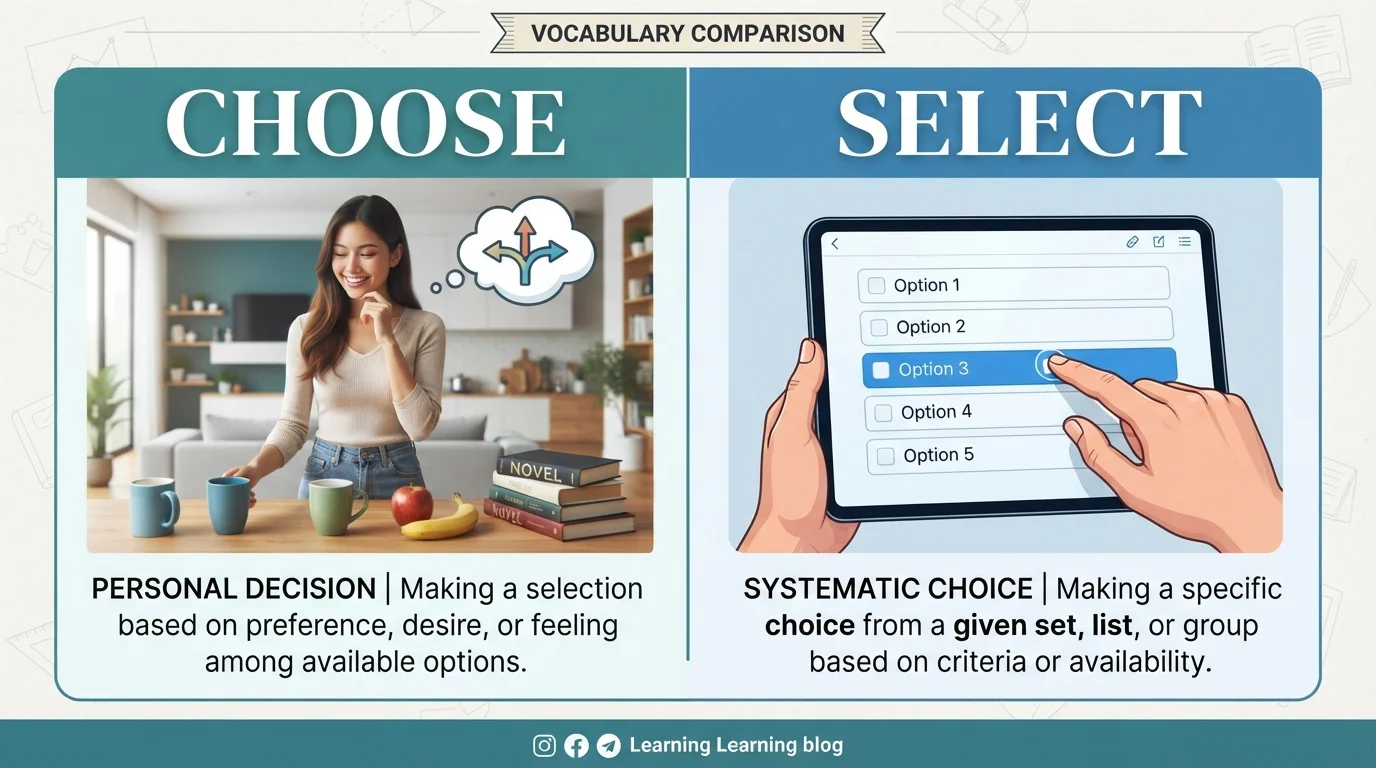
The main difference is that choose is a common, flexible word used for everyday decisions, preferences, and personal choices, while select often sounds more formal, systematic, or precise. For example, you might choose what to eat for dinner, but a manager might select a candidate for a job. In many situations, however, either word works naturally.
In this guide, you will learn the meanings of choose and select, understand their differences, and discover how to use them correctly in daily conversation, academic writing, and professional situations. You will also find example sentences, common mistakes, synonyms, and answers to frequently asked questions.
Quick Answer: Choose vs Select
Choose and select both mean to pick something from available options. Choose is more common in everyday English and often emphasizes personal preference or decision making. Select is frequently used in formal, technical, or organized situations where someone picks an item according to specific criteria. Both words are correct in many of the same sentences.
What Does Choose Mean?
Choose means to decide which person, thing, action, or option you want from several possibilities.
It is commonly used in everyday conversation because it works for personal preferences, important decisions, and ordinary selections.
Examples:
- I need to choose a birthday gift for my sister.
- She chose the blue dress instead of the red one.
- You can choose any seat you like.
- He chose to study medicine.
- We must choose a restaurant for dinner.
- They chose the best route to avoid traffic.
- I usually choose tea over coffee.
- She had to choose between two job offers.
- The children chose their favorite games.
- You should choose what makes you happy.
In these examples, choose describes the act of making a decision or expressing a preference.
Common uses of choose
- Choosing what you like: “I choose the chocolate cake.”
- Making a life decision: “She chose to move abroad.”
- Comparing options: “We chose the cheaper hotel.”
- Expressing a preference: “He chooses comfort over style.”
- Making a personal decision: “You must choose your own path.”
The word can be used for both small, everyday decisions and major life choices.
What Does Select Mean?
Select means to pick or identify someone or something from a group of options. It often suggests that the choice is made carefully, according to particular requirements, or through an organized process.
It is especially common in professional, academic, technical, and administrative contexts.
Examples:
- Please select your preferred language.
- The manager selected three candidates for interviews.
- You must select an answer before continuing.
- The committee selected the winning proposal.
- She selected a suitable location for the event.
- The computer allows users to select multiple files.
- The teacher selected five students for the competition.
- Please select the correct option from the list.
- The company selected a new supplier.
- Researchers selected participants according to specific criteria.
In these examples, select emphasizes picking an item, person, or option from a defined group.
Common uses of select
- Filling out forms: “Select your country.”
- Using software: “Select the file you want to open.”
- Hiring: “The company selected the most qualified applicant.”
- Academic testing: “Select the correct answer.”
- Formal evaluation: “The committee selected the best proposal.”
The word often sounds more official or procedural than choose, although it can also be used in ordinary situations.
Choose vs Select: Key Differences
| Feature | Choose | Select |
|---|---|---|
| Basic meaning | Decide what you want | Pick something from a group |
| Typical tone | Everyday and conversational | Often more formal or procedural |
| Personal preference | Very common | Possible, but sometimes less natural |
| Official processes | Common | Especially common |
| Technology and forms | Common | Very common |
| Example | Choose your favorite song. | Select a song from the menu. |
The distinction is a matter of emphasis rather than a strict grammatical rule. Both verbs can describe the same action.
Choose vs Select in Example Sentences
Compare the following sentences to understand how each word sounds in context.
| With choose | With select |
|---|---|
| Choose your favorite color. | Select a color from the palette. |
| I chose a new phone. | I selected a new phone after comparing its features. |
| She chose a career in teaching. | She was selected for a teaching position. |
| Choose what you want to eat. | Select your meal from the menu. |
| We chose a team captain. | The committee selected a team captain. |
| He chose the best answer. | He selected the correct answer. |
Both columns are grammatically correct. However, choose often sounds more natural when discussing personal preferences, while select often fits situations involving lists, criteria, or formal decisions.
When Should You Use Choose?
Use choose when talking about everyday decisions, personal preferences, or deciding what action to take.
1. Talking about preferences
Example: “I choose the blue shirt because I like its color.”
The sentence emphasizes personal preference.
2. Making important decisions
Example: “She chose to become a doctor.”
Here, chose describes a personal decision about her future.
3. Deciding between alternatives
Example: “You can choose between studying at home and going to the library.”
The focus is on making a decision between options.
4. Giving advice
Example: “Choose your friends carefully.”
This is a natural way to encourage someone to make thoughtful decisions.
5. Talking about freedom
Example: “Everyone should be able to choose their own goals.”
Here, choose emphasizes personal freedom and decision making.
When Should You Use Select?
Use select when picking something from a defined group, following specific criteria, or completing a formal or technical process.
1. Filling out a form
Example: “Select your date of birth from the calendar.”
The instruction guides someone through a particular process.
2. Using a computer
Example: “Select the documents you want to upload.”
This is common language in software instructions.
3. Hiring or recruitment
Example: “The company selected the strongest candidate.”
The word fits an organized evaluation process.
4. Taking a test
Example: “Select one correct answer.”
This is a common instruction in exams and multiple choice questions.
5. Making an official decision
Example: “The panel selected the winner after reviewing all entries.”
The word emphasizes a formal process involving evaluation.
Choose vs Select vs Pick
The word pick is another common alternative. All three verbs can mean choosing something, but their tone and usage differ.
| Word | Typical style | Example |
|---|---|---|
| Choose | General and conversational | Choose your favorite dessert. |
| Select | Often formal or systematic | Select a dessert from the available options. |
| Pick | Informal and casual | Pick any dessert you like. |
Choose
Often emphasizes making a decision or expressing a preference.
Example: “I chose to stay home.”
Select
Often emphasizes identifying something from a defined group.
Example: “The judge selected the winner.”
Pick
Often sounds casual and direct.
Example: “Pick a movie, and let’s watch it.”
In many everyday situations, these three words can replace one another without changing the basic meaning.
Choose vs Select vs Decide
These words are related, but decide focuses more directly on reaching a conclusion.
| Word | Main emphasis | Example |
|---|---|---|
| Choose | Picking one option | I chose the red car. |
| Select | Picking from a group | I selected the red car from the list. |
| Decide | Reaching a decision | I decided to buy the red car. |
For example, you might decide to buy a new phone and then choose a model or select one from a list of available products.
Grammar: Choose, Chose, Chosen vs Select, Selected
The verbs have different forms, so it is important to use the correct one.
| Form | Choose | Select |
|---|---|---|
| Base form | Choose | Select |
| Third person singular | Chooses | Selects |
| Simple past | Chose | Selected |
| Past participle | Chosen | Selected |
| Present participle | Choosing | Selecting |
Examples:
- Present: “I choose my clothes carefully.”
- Past: “I chose the black jacket yesterday.”
- Present perfect: “I have chosen a new course.”
- Present continuous: “She is choosing a gift.”
- Present: “I select a file.”
- Past: “I selected the wrong file.”
- Present perfect: “I have selected my preferred language.”
- Present continuous: “She is selecting the photographs.”
Important: The simple past of choose is chose, not choosed. The past participle is chosen.
Incorrect: “I choosed the blue one.”
Correct: “I chose the blue one.”
Common Mistakes to Avoid
Mistake 1: Using choosed instead of chose
Incorrect: “She choosed the best answer.”
Correct: “She chose the best answer.”
Explanation: Choose is an irregular verb. Its past tense is chose.
Mistake 2: Using chose instead of chosen after have
Incorrect: “I have chose my topic.”
Correct: “I have chosen my topic.”
Explanation: The present perfect tense uses have plus the past participle, which is chosen.
Mistake 3: Thinking select is always more correct than choose
Incorrect assumption: “Select” should always be used in formal English.
Correct understanding: Both words are correct in formal and informal settings. Choose the word that sounds natural in context.
For example, “I chose a career in science” is perfectly appropriate in formal writing.
Mistake 4: Assuming choose and select have completely different meanings
Incorrect assumption: You can use choose only for personal decisions and select only for official decisions.
Correct understanding: Their meanings overlap considerably. The difference is usually one of tone and emphasis.
Mistake 5: Using select when a different verb is needed
For example, “I selected to study medicine” sounds unnatural in standard English.
Better: “I chose to study medicine.”
You can also say, “I decided to study medicine.”
Explanation: Choose to do something is a common structure for describing a decision about an action. Select is more commonly used with a person or thing as its object.
Easy Memory Trick
Remember this simple distinction:
Choose = decide what you want.
Example: “I choose the chocolate cake because I like it.”
Select = pick something from a group.
Example: “Select the chocolate cake from the menu.”
This is a helpful guideline, not a strict rule. Both words can be used for selecting from a group or making a personal decision.
American English vs British English
Unlike words such as modeling and modelling, choose and select are spelled the same way in American and British English.
| Feature | American English | British English |
|---|---|---|
| Choose | Choose | Choose |
| Select | Select | Select |
| Chose | Chose | Chose |
| Selected | Selected | Selected |
| Basic meaning | Same | Same |
The difference between the two verbs is about usage and context, not regional spelling.
Synonyms of Choose and Select
Several words can express a similar idea, but each has its own nuance.
| Synonym | Meaning | Example |
|---|---|---|
| Pick | Choose something, often informally | Pick a card. |
| Decide | Reach a conclusion | I decided to stay. |
| Opt for | Choose one option over another | She opted for the cheaper plan. |
| Prefer | Like one thing more than another | I prefer tea to coffee. |
| Elect | Choose someone for a position, often through voting | The members elected a new leader. |
| Nominate | Put forward someone for a position or award | They nominated her for the prize. |
| Appoint | Officially assign someone to a role | The board appointed a new director. |
These words are related but not interchangeable in every sentence. For example, nominate means proposing someone for a role or award, while appoint means officially assigning someone to a position.
Frequently Asked Questions
1. What is the main difference between choose and select?
Both mean to pick something from available options. Choose is common in everyday speech and often emphasizes personal preference or decision making. Select often sounds more formal, systematic, or precise.
2. Is select more formal than choose?
Generally, yes. Select is frequently used in official instructions, forms, technical interfaces, and professional processes. However, choose is also suitable for formal writing.
3. Can choose and select be used interchangeably?
Often, yes. For example, “Choose an answer” and “Select an answer” are both correct. The difference is usually subtle and depends on the context.
4. Which is better: choose an answer or select an answer?
Both are correct. “Select an answer” is especially common in exams, forms, and computer interfaces. “Choose an answer” sounds more conversational but is also widely used.
5. What is the past tense of choose?
The simple past tense is chose.
Example: “I chose the blue shirt yesterday.”
6. Is it choose or chose?
Use choose for the base form and present tense, and chose for the simple past.
Present: “I choose my clothes carefully.”
Past: “I chose my clothes yesterday.”
7. What is the difference between select and pick?
Select often sounds more formal or systematic, while pick is usually more informal. Both can mean choosing an item from a group.
8. Can I use choose in professional writing?
Yes. Choose is perfectly appropriate in professional writing when discussing decisions, preferences, or alternatives. For example, “The organization chose a new strategy” is natural and professional.
Remember This
- Choose and select both mean to pick something from available options.
- Choose is common in everyday conversation and personal decisions.
- Select often sounds more formal, systematic, or technical.
- Both words can be correct in the same sentence.
- The past tense of choose is chose.
- The past participle of choose is chosen.
- The words have the same spelling in American and British English.
Conclusion
The difference between choose and select is mainly about tone and emphasis. Choose is a flexible, everyday verb that often highlights personal preference or the act of making a decision. Select is frequently used when picking something from a defined group, especially in formal, professional, academic, or technical situations. Nevertheless, the meanings overlap, and either word can be correct in many contexts.
To use these words naturally, think about the situation. If you are talking about what you want, such as a favorite meal or a career path, choose is often a natural option. If you are following instructions, completing a form, or identifying an item from a list, select may be more appropriate. Remember the forms choose, chose, chosen as well, and you will be able to use these verbs confidently in both spoken and written English.